What Is Threadlocker on a Car Fastener? Purpose, Types, and Service
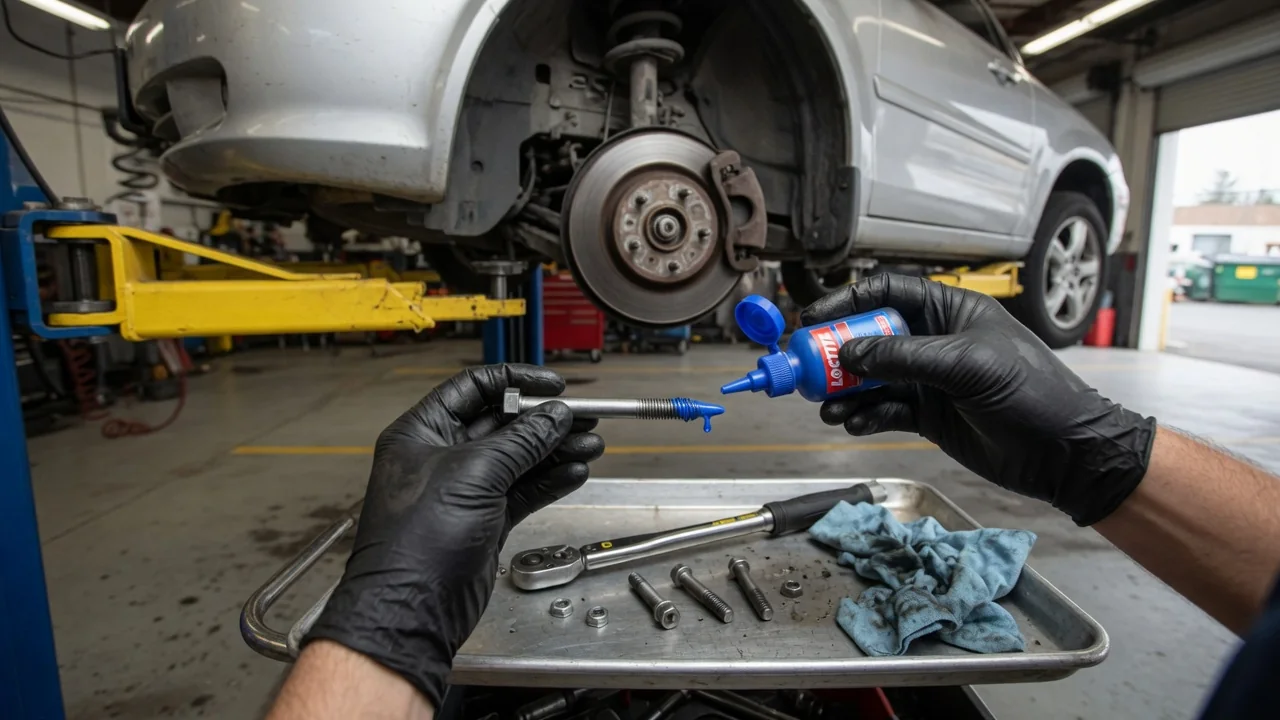
Threadlocker is a liquid or semi-solid adhesive applied to the threads of a bolt, stud, or screw so the fastener resists loosening once it is tightened. On a car, you may find it already present as a colored coating on new hardware, or a service procedure may call for applying it during reassembly. Knowing what threadlocker does, which type a job needs, and how to handle it during repairs helps you put components back together the way they were designed to be held.
Vibration and Why Fasteners Loosen
A tightened fastener stays put because the clamping force stretches the bolt slightly, and friction in the threads and under the head resists rotation. In a vehicle, that joint is constantly disturbed. Engine pulses, road impacts, driveline torque reversals, and repeated heating and cooling all cause tiny movements between the mating parts. When the joint slips sideways even slightly, the friction holding the threads can momentarily drop, and the fastener can rotate a small amount in the loosening direction. Repeated many times, those small movements can reduce clamp load until a part rattles, leaks, or separates. Threads also have small clearances between the male and female profiles, which leaves room for this movement to begin.
Most threadlockers are anaerobic adhesives. They stay liquid while exposed to air, but once confined between metal threads and cut off from oxygen, contact with the metal triggers curing into a hard plastic. The cured material fills the clearances in the thread engagement, which blocks the relative motion that starts loosening and adds resistance to turning. Because it fills those gaps, it also helps seal the threads against moisture and corrosion. Threadlocker is not a substitute for proper torque, however. It supports a correctly clamped joint; it cannot rescue one that was undertightened, has damaged threads, or uses the wrong fastener.
Choosing the Correct Type
Threadlockers are generally sorted by strength, which describes how hard the fastener is to remove after curing. A widely used color convention groups them as low strength, often purple, for small screws and adjustment fasteners; medium strength, often blue, for general-purpose fasteners that must be removable with ordinary hand tools; and high strength, often red, for studs and fasteners intended to stay in place semi-permanently. A separate wicking grade, often green, has a very low viscosity so it can penetrate the threads of fasteners that are already assembled. Colors are a convention rather than a guarantee, so the product label and the repair instructions are the reliable references.
For automotive threadlocker use, the key question is what the vehicle's service information specifies for that location. Repair manuals typically name a strength or a product type for fasteners that need it, and some joints are designed with no thread treatment at all. Using a stronger grade than called for can make the next repair difficult and may require heat to break the bond, which is not appropriate near fuel lines, wiring, rubber bushings, or painted and plastic parts. Using a weaker grade, or none, where one is specified can allow the fastener to back out over time.
Form and material matter too. Threadlockers come as liquids, gels, and semi-solid sticks; gels and sticks are less likely to run on overhead or vertical fasteners. Some metals, such as stainless steel and certain plated finishes, are less chemically active and may cure slowly or incompletely, which is why some products are paired with a primer or activator. Many new automotive fasteners arrive with a dry, pre-applied patch on the threads that activates when the fastener is installed. Liquid threadlocker is generally not suitable for plastic threads, because some formulations can damage certain plastics.
Service: Removal, Cleaning, and Reapplication
When removing a fastener that was installed with threadlocker, expect higher breakaway effort than normal. Medium-strength products are generally intended to come apart with standard tools, while high-strength products often need localized heat to soften the cured material first. Use the correct size socket or wrench, apply steady force, and stop if the fastener seems ready to twist off or strip, since a broken stud is a far bigger repair than a stubborn one. Any heating should be controlled and kept away from anything flammable or heat sensitive.
Before reassembly, old cured material should be removed from both the male and female threads. A wire brush, thread chaser, or tap of the correct size helps, followed by a solvent cleaner that leaves no oily residue, since oil and grease can interfere with curing. Apply new threadlocker only to the threads that will actually be engaged, in the amount the product instructions recommend, then tighten to the specified torque. Allow the stated cure time before returning the component to service if the instructions call for it.
Fasteners with a pre-applied patch deserve particular attention. Manufacturers often specify that these are single use and that a new fastener should be installed rather than cleaning and reusing the old one. Some critical fasteners are also designed to stretch during tightening and must be replaced regardless of thread treatment. When the service information says to replace hardware, adding liquid threadlocker to the old part is not an equivalent repair.
Practical Implications and Limits
In everyday terms, threadlocker is a small detail that affects both how a repair holds up and how easy the next repair will be. Thread treatment is used in many areas of a vehicle, including chassis, brake, and powertrain hardware, but whether a particular bolt on a particular vehicle uses it can only be confirmed from that vehicle's service information or from the fastener itself. A colored residue on removed threads is a strong hint that thread treatment was part of the original assembly and should be restored in some form.
Threadlocker also has limits worth keeping in mind. It does not compensate for worn threads, mismatched fasteners, or a joint that moves because a gasket or bushing has failed. It can change thread friction, so a torque value written for dry or oiled threads may not produce the same clamp load with a liquid applied unless the procedure accounts for it. It should not be added to wheel lug nuts, wheel studs, or other safety-critical fasteners unless the vehicle manufacturer calls for it. Excess material can be difficult to clear from blind holes, so more is a liability rather than extra insurance. When in doubt, matching the original assembly method and following the specified procedure is the most reliable approach.