What Is Suspension Geometry? Wheel Path, Alignment, and Handling Explained
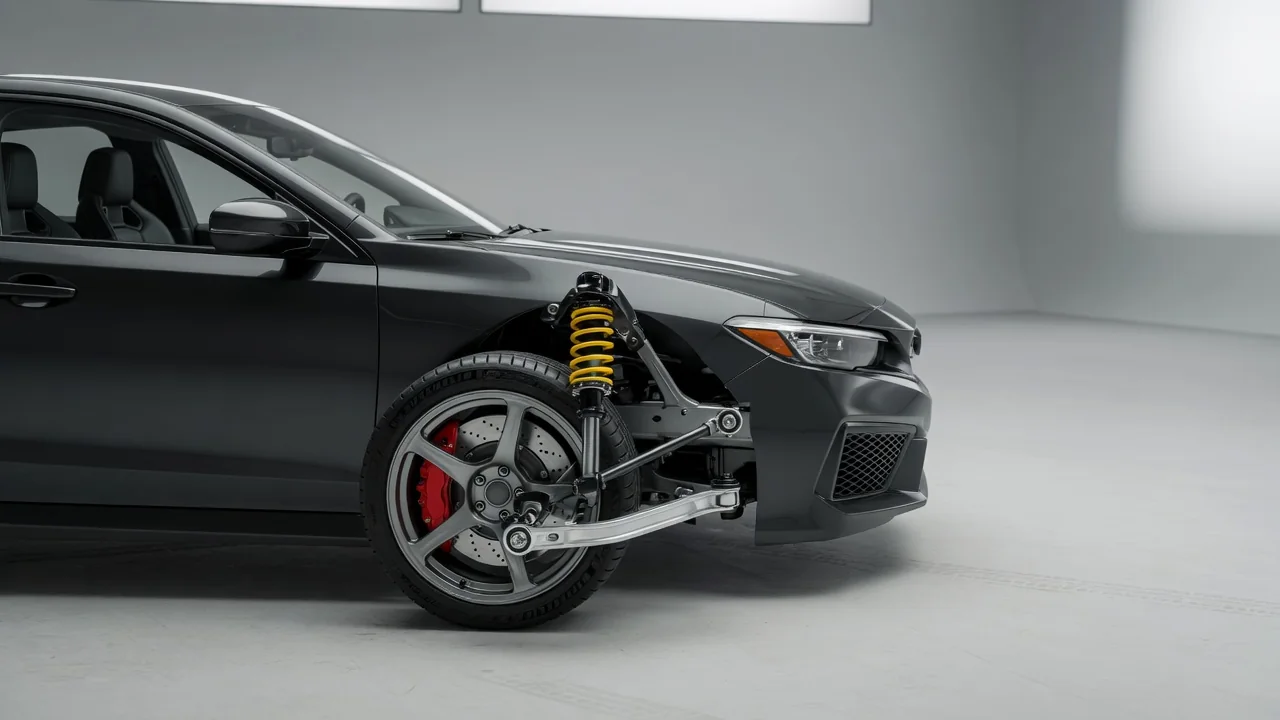
Suspension geometry is the arrangement of the links, pivots, and mounting points that locate each wheel relative to the body and the road. It determines how a wheel moves as the suspension compresses and extends, which angles the tire holds against the pavement, and how the car responds to steering, braking, and cornering. Understanding vehicle suspension geometry basics explains why alignment specifications exist, why worn parts change the way a car drives, and why modifications can have side effects.
Wheel path: how the wheel moves through its travel
Every suspension lets the wheel move up and down, but no practical design moves it in a perfectly straight vertical line. Control arms swing in arcs around their bushings or ball joints, struts slide along an inclined axis, and multi-link layouts combine several arcs at once. The resulting trajectory of the wheel center and tire contact patch is called the wheel path. It depends almost entirely on where the pivot points are placed and how long the links are.
Several important characteristics come from that path. Camber change describes how the wheel tilts in or out as it rises and falls. In a double wishbone layout with an upper arm shorter than the lower arm, for example, the wheel typically gains negative camber in compression. Bump steer describes how much the wheel turns left or right as it moves vertically, which depends on how well the arc of the steering tie rod matches the arcs of the suspension arms. Track change, sometimes called scrub, describes how far the contact patch moves sideways during travel, which can influence stability on uneven surfaces.
Different suspension types tend to produce different wheel paths. A MacPherson strut is compact and simple but offers fewer geometric degrees of freedom, so its camber change is usually more limited. Double wishbone and multi-link systems give designers more control over the path at the cost of space, parts, and complexity. Solid axles keep both wheels linked, so movement on one side affects the other. These are general tendencies; the actual behavior of any given vehicle depends on its specific dimensions and tuning.
Alignment: the static angles that set the starting point
If wheel path describes how geometry changes in motion, alignment describes where it starts. Alignment refers to the measurable angles of the wheels and steering axis with the vehicle at rest, typically at a specified ride height and load. The three most familiar are camber, caster, and toe. Camber is the inward or outward tilt of the wheel seen from the front; negative camber means the top of the tire leans toward the vehicle. Toe is the angle of the wheels relative to each other seen from above; toe-in means the fronts of the wheels point slightly together, and toe-out means they point slightly apart.
Caster is the forward or rearward tilt of the steering axis seen from the side. Positive caster, where the axis leans back at the top, helps the steering return to center and adds straight-line stability, while also increasing steering effort. Related geometric quantities include steering axis inclination, the inward tilt of the steering axis seen from the front, and scrub radius, the distance at the ground between the steering axis and the center of the contact patch. These two are generally fixed by the design and are not adjusted during a routine alignment.
Not every angle is adjustable on every vehicle. Many cars allow toe adjustment through the tie rods but provide limited or no factory adjustment for camber or caster, relying instead on manufacturing tolerances. Where adjustment exists, it may use eccentric bolts, shims, slotted mounts, or adjustable links. The correct targets and tolerances are vehicle-specific and come from the manufacturer's service information.
Handling: how geometry shapes the car's behavior
Handling is where wheel path and alignment combine with weight transfer. When a car corners, the body rolls and load shifts toward the outside tires. The geometry determines what happens to the tire angles during that roll. If the outside wheel tilts toward positive camber as the body leans, the tire rides more on its outer shoulder and loses some grip; geometry that adds negative camber in compression can partly offset this. Toe changes during body roll, often called roll steer, can make an axle steer itself slightly into or out of the turn, which designers use to tune how stable or responsive the car feels.
The roll center is another geometric concept tied to handling. It is a theoretical point, derived from the suspension link layout, about which the body tends to roll and through which lateral forces pass between the wheels and the body. Its height relative to the center of gravity influences how much the body leans and how the suspension reacts to cornering forces. The balance between front and rear roll behavior contributes to whether a vehicle tends toward understeer or oversteer, although springs, anti-roll bars, tires, and weight distribution matter just as much.
Geometry also governs behavior under braking and acceleration. The angles of the control arms seen from the side can create anti-dive and anti-squat effects, which use part of the braking or driving force to resist the nose dipping or the rear squatting. Caster and the steering axis layout influence steering feel, self-centering, and how much feedback reaches the driver through the steering wheel.
Practical implications and limits
For owners, the most visible link between geometry and everyday driving is tire wear and steering behavior. Toe outside its specification tends to produce feathered or uneven wear across the tread and can make the car wander or feel unsettled. Camber far from its target often concentrates wear on the inner or outer shoulder. A steering wheel that sits off center when driving straight, or a car that pulls to one side, can point to an alignment problem, although tire condition, brake drag, and road crown can produce similar symptoms. An alignment check after replacing steering or suspension components, or after a hard impact with a curb or pothole, is a common service recommendation.
An alignment only restores static angles. It cannot correct worn bushings, loose ball joints, bent arms, or sagging springs, all of which change the effective geometry while driving, so these parts are usually inspected first. Modifications deserve similar caution. Lowering a vehicle, fitting taller springs, or installing wheels with a different offset shifts the operating point of the geometry, which can alter camber change, bump steer, roll center height, and scrub radius in ways a standard alignment cannot fully undo. Correction parts such as adjustable arms exist for many applications, but their effect depends on the specific design.
Suspension geometry is always a compromise. Settings that improve cornering grip may increase tire wear or reduce straight-line stability, and packaging, cost, comfort, and noise all constrain what engineers can choose. Because specifications, adjustment points, and acceptable ranges differ between vehicles, the manufacturer's service manual or a qualified alignment technician remains the reliable reference for any particular car.