What Is Suspension Droop? Extension Travel, Tire Contact and Limit Straps
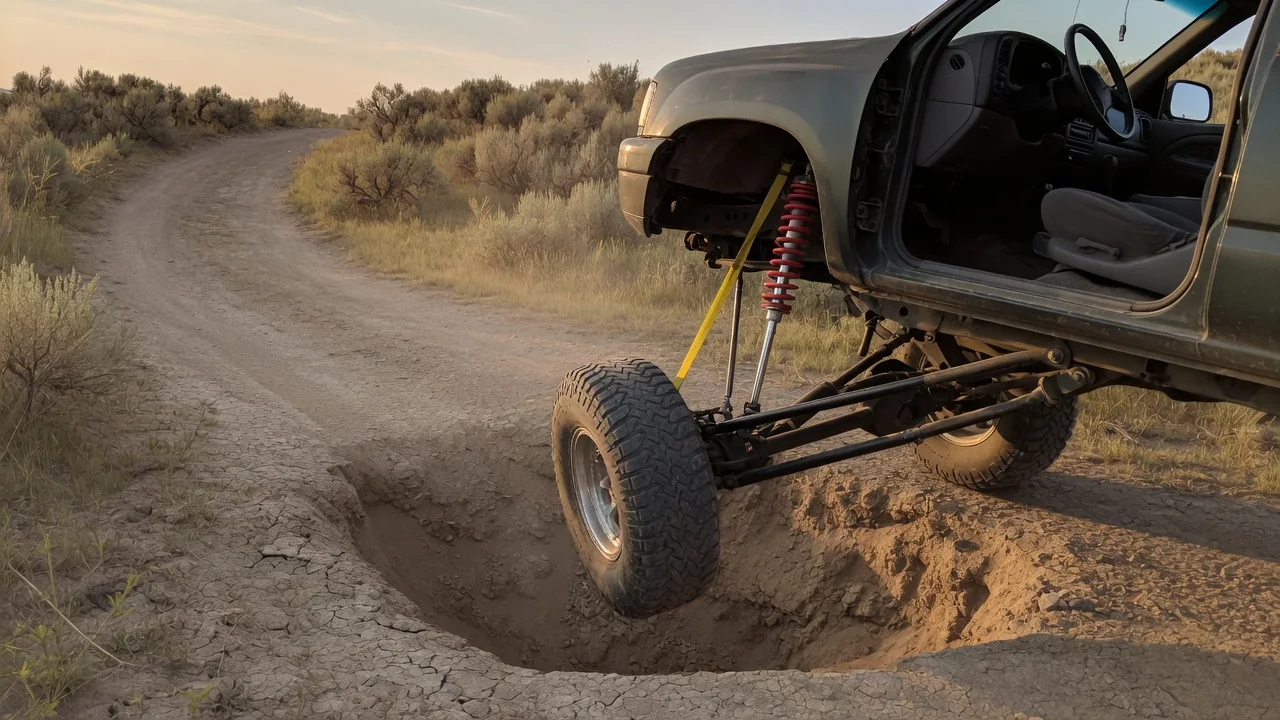
Suspension droop is the downward travel a wheel can make from its normal ride height as the suspension extends. It is the opposite of bump, or compression, which is upward movement toward the body. When people ask what suspension droop is, they usually want to know how far a wheel can drop, what stops it and why that range matters. The answer covers three linked ideas: how extension travel is defined, how it keeps the tire on the ground and how it is deliberately limited.
Extended travel: how droop is defined
Every suspension moves within a total travel range. One end is the fully compressed position and the other is the fully extended position. Ride height sits somewhere between them, set by the vehicle's weight acting on the springs. Travel above ride height is bump travel, and travel below it is droop travel. Droop is therefore not a fixed property of one part. It is a relationship between where the vehicle normally sits and how far the wheel can hang before something stops it. If you change the ride height, the springs or the load, the split between bump and droop changes, even when total travel stays the same.
Wheel suspension droop happens whenever the load on a corner decreases. Common causes include driving over a crest, dropping a wheel into a dip or pothole, lifting the body on a jack, and weight transfer during cornering, braking or acceleration. During weight transfer, the lightly loaded side of the vehicle rises relative to its wheels. The suspension on that side extends into droop while the opposite side compresses. In every case the spring pushes the wheel away from the body until the forces balance or the suspension reaches a mechanical end point.
That end point varies by design. On many road vehicles, the shock absorber or strut reaches full extension and an internal rebound stop takes the load. Other designs use a rubber or polyurethane rebound bumper, a physical stop on a control arm, or a dedicated strap. The wheel also moves through an arc set by the control arms, links or axle. As a result, droop can change camber and toe, and on driven wheels it changes the operating angle of the axle shafts and joints. How large these changes are depends on the specific suspension layout.
Tire contact: why droop keeps the wheel on the ground
The main purpose of droop travel is to let the tire follow the surface when the ground falls away beneath it. A tire can transmit braking, steering and driving forces only while it touches the surface. If a wheel runs out of droop in a dip or on an uneven trail, it can lift off or carry very little load, and that corner stops contributing grip. On a driven axle with an open differential, a lightly loaded or airborne wheel can also spin, sending drive torque where it does little good.
Droop works together with compression to provide articulation, which is the ability of one wheel to rise while another falls. On rough terrain, generous droop helps spread load across all four tires and keeps the body more level. On paved roads the amounts involved are usually smaller, but the principle is the same. Contact also depends on how much force the spring still applies near the end of extension. A spring that is nearly unloaded presses the tire down only lightly, so grip from that corner can fade before the wheel actually leaves the ground.
More droop is not automatically better for every purpose. In some motorsport setups, extension is intentionally restricted to control body attitude, even though this can unload a tire sooner. Whether that trade-off helps depends on the vehicle, the surface and the goals of the setup.
Limiting straps and other droop stops
A limiting strap, often called a limit strap, is a band of strong webbing or similar flexible material. It is attached between the chassis and the axle or a control arm. The strap hangs slack through normal travel and becomes taut only as the suspension nears its chosen maximum extension. Because a strap works only in tension, it stops downward movement without interfering with compression. Limit straps are most associated with off-road and modified vehicles, but dedicated extension stops appear in other forms on many suspensions.
Straps protect the components that would otherwise act as the stop. When a shock absorber is the only thing limiting extension, every full-droop event loads its internal parts and mounts. A strap set slightly short of full shock extension takes that load instead. Limiting droop can also: • keep axle shafts and constant-velocity joints within a workable angle; • prevent brake hoses, wiring and driveshafts from being overextended; • stop coil springs from coming loose in their seats when the suspension hangs fully
Some coilover and racing suspensions use internal droop limiters, adjustable rebound stops, or helper springs that keep the main spring seated during large extension. These do a similar job by different means. Whatever the hardware, the stop must be set in relation to the rest of the system. A strap that is too short cuts useful travel and can lift the tire early. One that is too long leaves the shock or other parts to absorb the impact.
Practical implications and limits
For owners, droop matters most when something changes ride height or travel. Lift kits, lowering springs, spacers, different-length shocks and heavier loads can all shift the balance between bump and droop. The result can be too little extension for comfort and grip, or too much for brake lines and drive components. For example, lowering a vehicle with shorter springs on the original shocks generally leaves more droop and less bump travel than before. After such changes, a basic step is to check hose, wiring and axle-joint clearance at full extension. This is usually done with the body supported and the wheels hanging.
Service work also exposes droop. Raising a vehicle by the body lets the wheels hang at full extension, which can strain boots, joints and hoses. That is one reason many procedures call for tightening rubber-bushed pivot bolts with the suspension at or near ride height rather than at full droop. Exact procedures, torque values and acceptable travel figures are specific to each vehicle, so the manufacturer's repair manual remains the reference for any particular model.
Droop is not a single number to maximize. More extension can improve articulation and tire contact on uneven ground. Controlled or reduced droop can protect hardware and, in some setups, shape handling. Possible signs that the suspension is reaching its extension limit include: • a clunk or knock over dips; • a wheel that lifts or spins easily; • wear or damage on shock mounts or straps; These symptoms can also have other causes, so diagnosis should look at the whole suspension rather than assume droop is the problem.