What Is Stoichiometric Combustion in a Gas Engine?
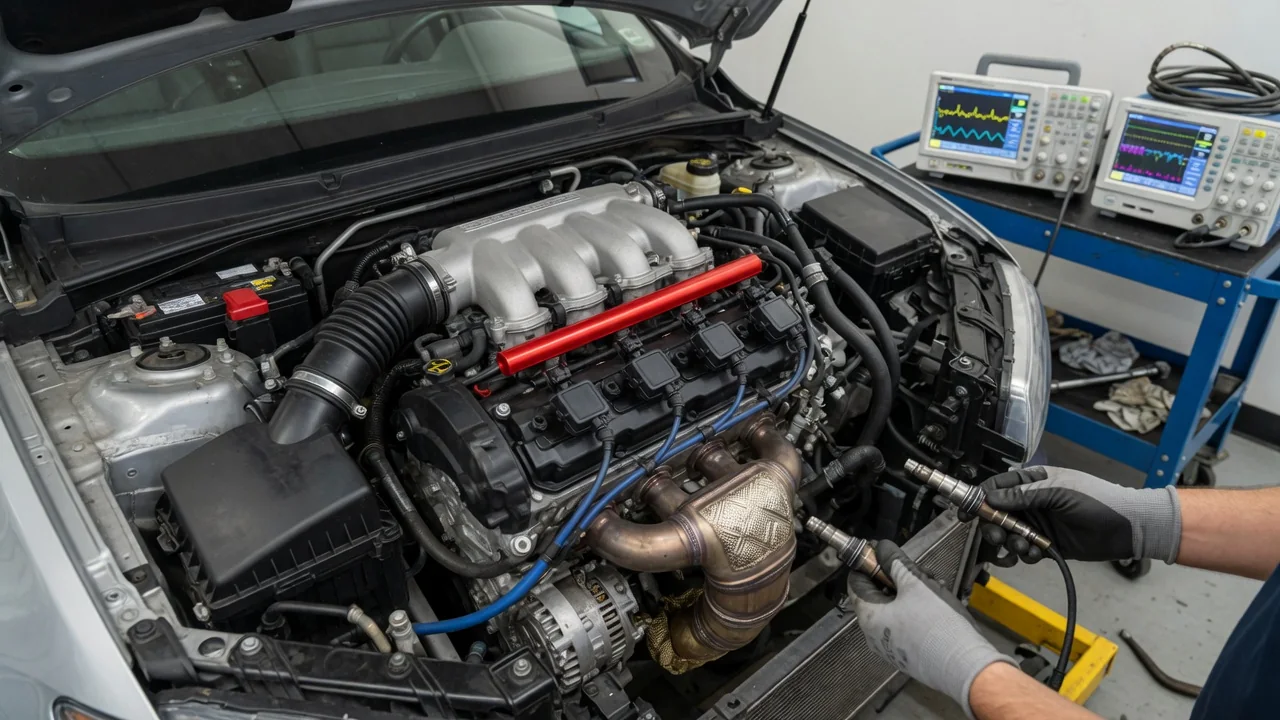
Stoichiometric combustion is the chemically balanced condition in which an engine burns exactly enough air to consume all of its fuel, with no oxygen or fuel theoretically left over. In a gasoline engine, this stoichiometric air fuel mix sits at roughly 14.7 parts air to one part fuel by mass. Knowing what that number means, why engine computers target it, and where it stops being the goal explains much of how modern fuel control works.
Complete reaction concept
Gasoline is a blend of hydrocarbons, molecules built from hydrogen and carbon atoms. When they burn, oxygen from the intake air combines with the carbon to form carbon dioxide and with the hydrogen to form water vapor, releasing the heat that pushes the pistons. Each fuel molecule needs a specific amount of oxygen to finish that reaction. Stoichiometric describes the exact proportion at which all available fuel and all available oxygen are used up together. For typical gasoline, that works out to about 14.7 kilograms of air for every kilogram of fuel. Because air is mostly nitrogen and only about one fifth oxygen, a large mass of air is needed to deliver a comparatively small amount of oxygen.
Engineers often express mixture strength as lambda, the ratio of the actual air-fuel ratio to the stoichiometric one. Lambda 1.0 is stoichiometric. Values below 1.0 are rich, meaning there is more fuel than the available oxygen can fully burn. Values above 1.0 are lean, meaning extra oxygen remains after the fuel is consumed. Lambda is useful because the stoichiometric ratio itself changes with fuel composition. Ethanol already contains oxygen in its molecule, so it needs less air per unit of fuel, and gasoline blended with ethanol therefore has a lower stoichiometric air-fuel ratio than pure gasoline. Lambda 1.0 still describes a chemically balanced mixture regardless of the blend.
A perfectly complete reaction is a theoretical reference point. Inside a real cylinder, combustion happens in milliseconds, the mixture is never perfectly uniform, and flame near cool cylinder walls and in narrow crevices can go out before all the fuel burns. At high flame temperatures, some combustion products also partially break apart. As a result, even a precisely stoichiometric charge leaves small amounts of carbon monoxide, unburned hydrocarbons and nitrogen oxides in the exhaust. Stoichiometry defines the balance point, not a guarantee of clean exhaust.
Emissions control
The main reason most modern gasoline engines run near stoichiometric is the three-way catalytic converter. It treats three pollutant groups at once: it oxidizes carbon monoxide and unburned hydrocarbons into carbon dioxide and water, and it reduces nitrogen oxides back toward nitrogen. Those reactions pull in opposite directions. Oxidation needs some available oxygen, while reduction of nitrogen oxides works best when oxygen is scarce. Only in a narrow band around lambda 1.0 can the catalyst do both jobs efficiently. Run noticeably rich and carbon monoxide and hydrocarbons slip through; run noticeably lean and nitrogen oxide conversion drops sharply.
To stay inside that band, the engine control unit uses closed-loop fuel control. An oxygen sensor or air-fuel ratio sensor upstream of the catalyst measures oxygen in the exhaust and reports whether combustion was rich or lean. The computer then adjusts injector pulse width, making continuous small corrections known as fuel trims. Short-term trims react quickly to current conditions, while long-term trims learn persistent offsets, such as those caused by component wear. Depending on the sensor type, the mixture may oscillate slightly around stoichiometric or be held closer to a specific target.
Catalysts can also store and release a limited amount of oxygen, which buffers the brief rich and lean swings that occur during normal control. A second oxygen sensor downstream of the converter lets the computer judge how well the catalyst is handling that storage. When the downstream signal starts to mirror the upstream one, it can indicate reduced catalyst efficiency, which on many vehicles sets a diagnostic trouble code.
Limits
Stoichiometric is the best mixture for emissions control with a three-way catalyst, but it is not the best mixture for every purpose. Maximum power typically comes from a mixture somewhat richer than stoichiometric, because the extra fuel helps ensure all available oxygen is used and the evaporating fuel cools the charge. Best fuel economy, in principle, comes from leaner-than-stoichiometric operation, but a conventional three-way catalyst cannot effectively reduce nitrogen oxides under lean conditions. Engines designed to run lean for efficiency need additional aftertreatment strategies.
There are also operating conditions in which the control system deliberately leaves stoichiometric. During a cold start, the sensors and catalyst have not reached working temperature and fuel condenses on cold surfaces, so the engine typically runs open loop with additional fuel. Under heavy load or wide-open throttle, many engines enrich the mixture to protect exhaust valves, turbochargers or the catalyst itself from excessive heat. During deceleration, fuel may be cut off entirely. When and how far an engine departs from lambda 1.0 depends on its calibration, so these behaviors vary between designs.
Practical implications and limits
For an owner, stoichiometric control is mostly invisible when it works. It shows up indirectly through the check engine light and stored codes. Faults that let unmeasured air into the intake, such as vacuum leaks, or that restrict fuel delivery tend to push long-term fuel trims positive as the computer adds fuel to compensate. Leaking injectors or excessive fuel pressure tend to drive trims negative. When the needed correction exceeds what the system allows, many vehicles set a lean or rich mixture code. Reviewing fuel trims with a scan tool is often more informative than replacing an oxygen sensor on suspicion, since the sensor is frequently reporting a real mixture problem rather than causing it.
Mixture problems also affect the catalytic converter. Prolonged rich running or misfires send unburned fuel into the converter, where it can burn and overheat the substrate. Oil consumption or coolant entering the combustion chamber can contaminate the catalyst and sensors, reducing their effectiveness. Fixing the root cause before replacing a converter helps avoid repeat failures.
The general mechanism is common across gasoline engines, but the details are not. Sensor types and locations, how long an engine stays in open loop, enrichment thresholds and trim limits are set by each manufacturer's calibration. A reading that is normal on one engine may be abnormal on another, so specific values and diagnostic procedures should come from the service information for the exact vehicle. Fuel blend, altitude and overall engine condition also influence how the system behaves from day to day.