What Is Speaker Impedance in a Car? Load, Amp Matching and Sound
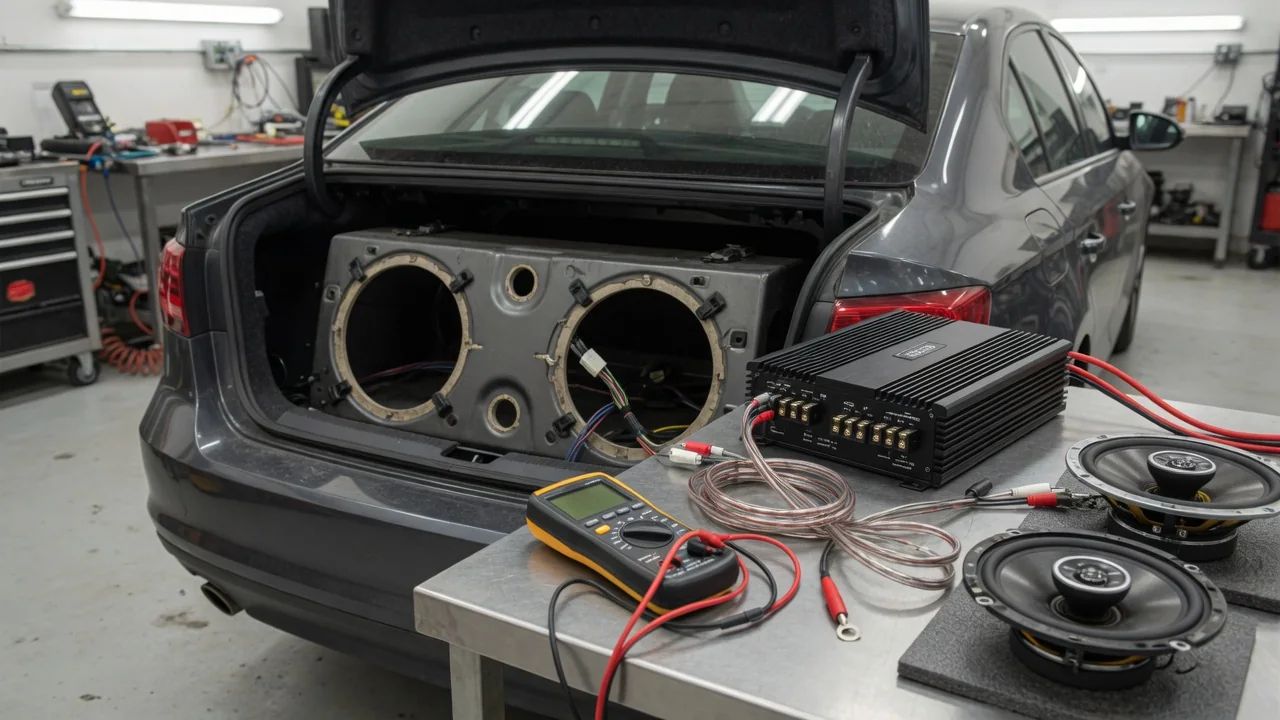
Car speaker impedance is the electrical opposition a speaker presents to the amplifier driving it, measured in ohms. It determines how much current the amplifier must supply, how much power it can deliver, and whether the pairing runs reliably or overheats. Understanding what speaker impedance means in a car helps you choose compatible speakers, wire subwoofers correctly, and avoid mismatches that cost sound quality or damage equipment.
Electrical load
Impedance is similar to resistance, but it applies to alternating current, which is what an audio signal is. A speaker's voice coil has a fixed DC resistance from its wire. As the coil moves in the magnetic field and the signal frequency changes, inductance and the motion of the cone add to the opposition. As a result, a speaker's impedance is not one number. It rises and falls across the frequency range, typically peaking near the driver's resonant frequency and climbing at higher frequencies because of coil inductance.
Because of this variation, manufacturers publish a nominal impedance, a representative figure used for matching. In car audio, 4 ohms is the most common nominal value for full-range speakers. 2-ohm and other ratings are also available, especially among subwoofers. Some factory systems use different nominal values, so you should not assume every vehicle uses the same rating. A multimeter reads DC resistance, not impedance, and that reading is normally somewhat lower than the nominal rating.
Ohm's law explains why the load matters. At a given voltage, a lower impedance draws more current. An amplifier driving a 2-ohm load must deliver more current than it would into a 4-ohm load at the same output voltage. That extra current produces more heat in the amplifier's output stage. It also places more demand on the power wiring and the vehicle's charging system.
Amp matching
Every amplifier and head unit is designed to work safely down to a minimum load impedance, which appears in its specifications or manual as a rated or stable impedance. Most head units with built-in amplification are designed for 4-ohm speakers. External amplifiers often list power at more than one impedance. A solid-state amplifier typically produces more power into a lower impedance, up to the limits of its power supply and output devices. Running below the rated minimum risks overheating, protection mode, distortion, or failure.
Speaker wiring changes the load the amplifier sees. Wiring two identical speakers in parallel halves the impedance, so two 4-ohm drivers become a 2-ohm load. Wiring them in series adds the impedances, so the same pair becomes 8 ohms. Dual voice coil subwoofers offer similar flexibility. A sub with two 4-ohm coils can be wired to present either 2 ohms or 8 ohms, and multiple subs multiply the possible combinations. The goal is a final load the amplifier is rated to handle, ideally one where it produces the power you need.
Bridged operation needs special attention. When two channels are bridged into one, each channel effectively sees about half of the connected speaker's impedance. A 4-ohm speaker on a bridged pair therefore loads each channel roughly like a 2-ohm speaker would. For this reason, many amplifiers specify a higher minimum impedance in bridged mode than in stereo mode. The amplifier's own documentation is the authority on which bridged loads it supports.
Sound
Impedance by itself does not make a speaker sound better or worse. A 2-ohm speaker is not inherently higher quality than a 4-ohm one. The rating only describes how the speaker interacts with the amplifier. What changes the audible result is how impedance affects the available power and how much power the speaker needs to reach a given volume. Speaker sensitivity, cone design, enclosure, and placement in the door or cabin usually have a larger effect on how a system sounds.
Mismatches change sound mainly through power. A speaker with a higher impedance than the amplifier is designed for is usually safe, but it receives less power. The system plays quieter and may run out of clean headroom sooner. A load below the amplifier's rating can push it into clipping, overheating, or protection shutdowns, which you hear as harsh distortion or sudden cutouts. Speaker wire also matters more as impedance falls. Its resistance sits in series with the speaker, so undersized wire on a low-impedance load wastes more power. It also reduces the amplifier's control over cone motion, often described as damping.
Passive crossovers in component speaker sets are designed around a specific impedance. Their filter frequencies depend on the load connected to them. Pairing a crossover with drivers of a different impedance can shift the crossover points and alter the tonal balance between tweeter and midrange. For the same reason, replacing one speaker in a system designed for a particular impedance can subtly change how the frequency range is divided.
Practical implications and limits
Before buying speakers or an amplifier, confirm the impedance your existing equipment expects. The most reliable references are the owner's manual, the head unit or amplifier documentation, and the labels on the original speakers. Factory systems with a separate factory amplifier may be designed around values other than 4 ohms. In those systems, replacement speakers with a different impedance can change volume or balance. Details for a specific model should come from that vehicle's documentation, not general assumptions.
Mixing impedances on one channel is a common pitfall. When speakers of different impedance share a channel in parallel, the lower-impedance speaker draws more current and plays louder. The combined load may also fall below what the amplifier tolerates. To avoid uneven output and unpredictable loading, keep the speakers on each channel matched or give them separate channels.
Impedance matching is a safety and efficiency guideline, not a guarantee of results. A correctly matched system can still underperform if the gain is set too high, the power wiring is undersized, or the speakers are poorly mounted. A mild mismatch on the safe side, such as a load above the amplifier's minimum, usually costs only some output. Treat the nominal rating as a starting point and confirm it against each component's documentation. Before applying full power, you can check the finished wiring with a multimeter, keeping in mind that it reads DC resistance slightly below the nominal figure.