What Is Short-Term Fuel Trim? Meaning, Sensor Input, and Diagnosis
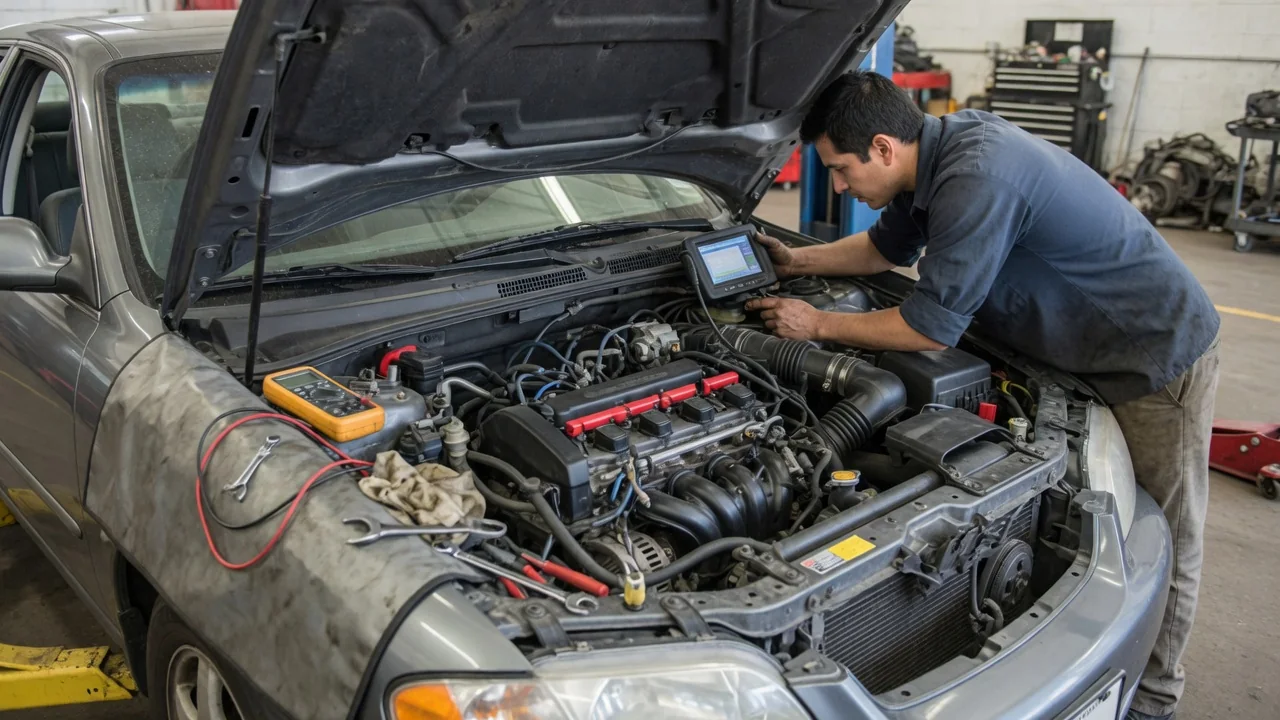
Short-term fuel trim is the engine computer's real-time adjustment to the amount of fuel it injects, made in response to what the exhaust sensors report. If you have seen STFT on a scan tool and wondered about the short-term fuel trim meaning, it is a percentage showing how much fuel the computer is adding or removing right now, relative to its base calculation. Understanding it helps you read live data sensibly and recognize when an engine is running lean or rich.
Immediate correction
The engine control module calculates a base fuel quantity from inputs such as airflow or manifold pressure, engine speed, and coolant and intake air temperature. That calculation is a prediction, and real conditions never match it perfectly: injectors wear, fuel pressure varies, and air density changes. Short-term fuel trim closes the gap. A positive value means the computer is adding fuel because the exhaust appears lean, and a negative value means it is removing fuel because the exhaust appears rich. A reading near zero means the base calculation is close to what the engine actually needs at that moment.
The term short-term describes both speed and memory. The correction changes many times per second and is not retained once conditions change or the engine is switched off. When short-term trim stays pushed in one direction for a while, the computer shifts that bias into long-term fuel trim, a learned value stored in memory and applied across similar operating ranges. Short-term trim then moves back toward zero. This is why the two values are usually read together: their sum describes the total correction, while short-term trim alone shows only what is happening in this instant.
Short-term trim is active only in closed-loop operation, when the computer is using sensor feedback. During open loop, such as a cold start before the sensors are ready, heavy acceleration, or deceleration fuel cutoff, the computer relies on its programmed tables instead. In those conditions short-term trim typically reads zero or holds a fixed value, although exactly how it is displayed depends on the manufacturer.
Sensor input
The primary input is the upstream oxygen sensor or air-fuel ratio sensor, mounted in the exhaust ahead of the catalytic converter. On engines with two cylinder banks, each bank has its own upstream sensor and its own short-term trim value, usually labeled bank 1 and bank 2. Sensors located after the catalytic converter mainly monitor converter efficiency. On many vehicles they have little direct role in short-term trim, though some systems use them for slower fine adjustment.
Sensor type shapes how the trim behaves. A traditional narrowband oxygen sensor switches sharply between a rich signal and a lean signal near the ideal air-fuel ratio, so it tells the computer only which side of that point the mixture is on. The result is a short-term trim that continuously ramps up and down, oscillating around its center. A wideband air-fuel ratio sensor reports how rich or lean the mixture is in proportional terms, allowing smoother and more precise corrections, so short-term trim on these engines often looks steadier. Both patterns are normal for their sensor type.
Short-term trim responds to what the sensor detects, which is not always what happened in the cylinders. Outside air leaking into the exhaust ahead of the sensor reads as extra oxygen and prompts the computer to add fuel even when combustion was correct. A slow or contaminated sensor can delay or distort corrections. The airflow or manifold pressure sensor that feeds the base calculation also matters: if it misreports, the base estimate is wrong and short-term trim has to make up the difference.
Diagnosis
Fuel trims are among the most useful live-data values because they show the direction and size of the problem the computer is compensating for. Persistently positive total trim points toward a lean condition: unmetered air from a vacuum leak or a cracked intake duct after the airflow sensor, weak fuel delivery from a failing pump, clogged filter, or restricted injectors, or an airflow sensor that underreports. Persistently negative trim points toward a rich condition: leaking injectors, excessive fuel pressure, an evaporative purge valve stuck open, or fuel-diluted engine oil releasing vapor through crankcase ventilation. When the computer reaches its correction limit, it commonly sets generic OBD-II codes such as P0171 or P0174 for lean and P0172 or P0175 for rich, by bank.
Comparing operating conditions narrows the cause. A vacuum leak tends to have its largest effect at idle, where the leak is a big share of total airflow, and the trim often improves as engine speed rises. A fuel supply problem frequently shows up more under load, when fuel demand is highest. Comparing banks also helps: if only one bank is off, the cause is likely specific to it, such as an intake leak near those cylinders, a faulty injector, or an exhaust leak ahead of that bank's sensor. Similar readings on both banks suggest something shared, like fuel pressure, the airflow sensor, or a central vacuum leak. These are general patterns, not rules, and should be confirmed with tests such as a smoke test, a fuel pressure measurement, or a check of sensor response.
Practical implications and limits
Because short-term trim moves constantly, a single snapshot reveals little. It is more informative to watch it over time at warm idle, at a steady higher engine speed, and during a drive, and graphing the values makes trends easier to see. Scan tools refresh at different rates, and a slow update can hide quick oscillations. Freeze-frame data stored with a fuel trim code records the conditions present when the fault was set, which is often more useful than a reading taken later under different circumstances.
Clearing codes or disconnecting the battery resets learned long-term trim on many vehicles. Afterward, short-term trim temporarily carries the entire correction until the computer relearns, so readings taken right after a reset can look exaggerated. The same applies after a repair: trims need driving time to settle, and how long that takes varies by vehicle.
Fuel trim shows compensation, not the root cause. It cannot distinguish a vacuum leak from a skewed sensor without further testing, and a misfire can mislead it, because unburned oxygen passing into the exhaust looks like a lean mixture and prompts the computer to add fuel. Acceptable ranges, correction limits, and display conventions are set by each manufacturer, so precise thresholds should come from service information for the specific vehicle rather than from general rules.