What Is Seatback Recline Hardware? Pivot, Lock, Adjustment and Wear
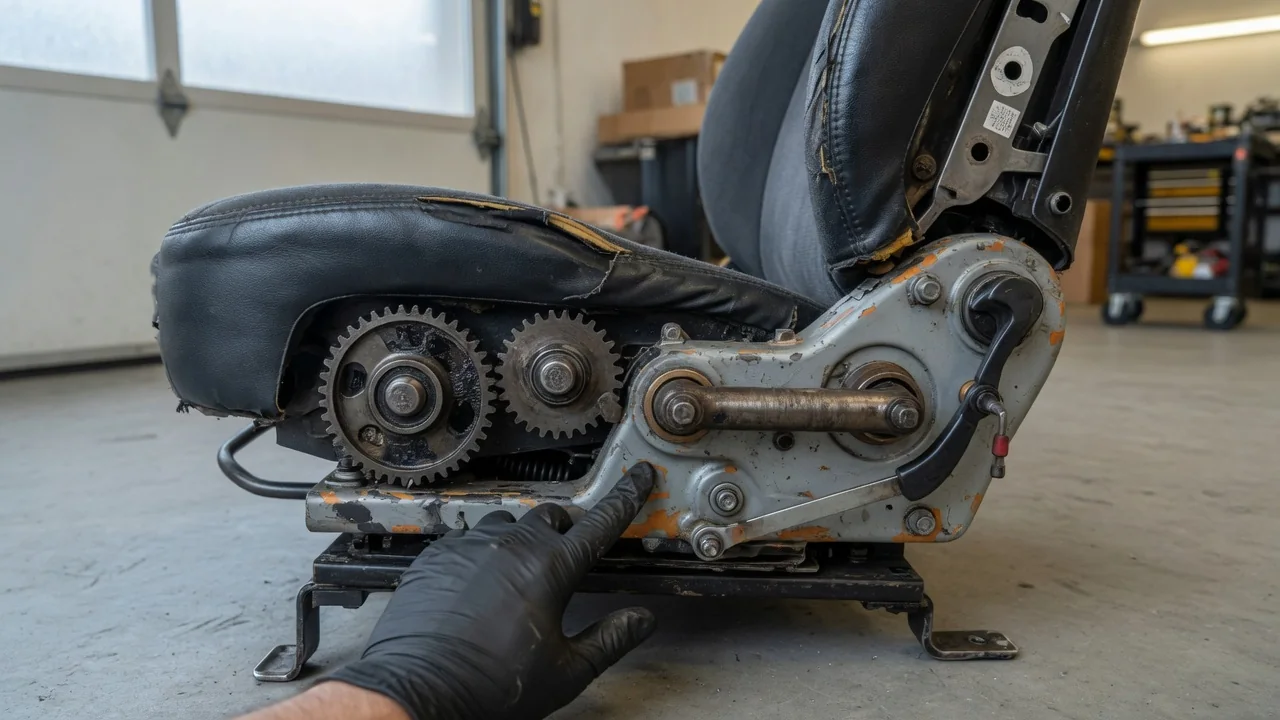
Seatback recline hardware is the set of hinges, locking parts, and controls that let a car seat's backrest tilt and then hold its position. It is often called the car seat recliner mechanism. It connects the seatback frame to the seat cushion frame and carries the loads an occupant puts on the backrest. Knowing how it pivots, locks, adjusts, and wears helps owners tell normal behavior from signs that the hardware needs attention.
Pivot and lock
At its core, the recliner is a hinge. On most seats, a recliner unit sits on each side of the seat where the backrest meets the cushion, with the pivot roughly near the occupant's hip. One half of each unit is fastened to the seatback frame, and the other half is fastened to the cushion frame or its side brackets. Many designs tie the left and right units together with a cross rod or tube. This makes both sides release and lock at the same time and keeps the backrest from twisting. Some seats instead use a locking recliner on one side and a simpler pivot on the other. The exact layout depends on the individual seat design.
The locking part of the hardware is what turns a plain hinge into a recliner. A common manual design uses a toothed sector or gear ring on one half and a pawl or set of locking teeth on the other. When the control is released, a spring pushes the teeth into engagement, which holds the seatback at that angle. Pulling the lever withdraws the teeth so the back can rotate. Another widely used approach is a sealed, disc-shaped recliner. Inside it, gears or eccentric elements hold the position continuously instead of in fixed notches. With either design, the lock is part of the seat structure. It is designed to resist an occupant leaning back and the much larger loads that can occur in a collision.
Adjustment
How the backrest adjusts depends on the recliner type. Lever-operated recliners are the most familiar. The occupant lifts a handle, leans back or lets the seatback come forward, and then releases the handle to lock it. Because the teeth engage in discrete steps, the seatback settles into one of a fixed number of positions. A spring at the hinge usually pushes the backrest forward, so it rises toward upright when the lever is released and nobody is leaning on it. This spring is why the seatback of an empty seat can swing forward quickly when the lever is pulled.
Knob or wheel recliners turn a gear train inside the hinge, so each rotation moves the seatback a small amount. They allow fine, nearly stepless adjustment but are slower for large changes. Power recliners replace the hand control with an electric motor that drives a gear inside the recliner unit. A switch on the side of the seat or on the door controls the motor, and some vehicles tie power recliners into seat memory settings. Rear seats and some front passenger seats may also have a separate release that folds the back fully for cargo or entry. That fold function is separate from the everyday comfort angle adjustment.
Wear
Recline hardware is under load every time someone sits down, leans back, or climbs in and out, so gradual wear is normal over a vehicle's life. A typical symptom is play. The seatback rocks or clunks slightly when the occupant shifts weight or when the vehicle accelerates and brakes. Possible causes include worn locking teeth, worn pivot bushings, loose mounting fasteners, or growing clearance inside a sealed recliner unit. If the two sides wear unevenly, the backrest can feel twisted, or one side may seem to lock later than the other.
Other wear points sit outside the hinge itself. Release cables can stretch or fray, and levers and plastic handles can crack. The return spring can weaken so the seatback no longer rises cleanly. On power seats, a stripped gear, a worn drive coupling, a failing motor, or an electrical fault can leave the back stuck or moving only some of the time. Dirt or objects dropped between the seat and the console can jam the release linkage and look like a mechanical failure. Corrosion can also develop wherever moisture reaches the seat frame, for example from wet floor mats or spills.
Practical implications and limits
The recliner's design explains a few everyday habits worth keeping. Keep a hand or your back against the seatback when releasing a lever so the spring cannot snap it forward. Do not force a seatback that will not move. A jammed linkage or an obstruction is more likely than a need for extra effort, and force can damage teeth or gears. Sitting reasonably upright while the vehicle is moving also matters. Seat belts and other restraints are designed around an occupant in a normal seated posture, and a steeply reclined position can reduce how well the belt fits the body.
Because the recliner is part of the seat's load path, it is not a component to improvise on. Welding a slipping hinge, adding shims, or substituting fasteners can change how the seat behaves in a crash. Procedures, fastener requirements, and replacement parts vary by vehicle, so the service manual for the specific model is the authority. Many seats also contain side airbags, occupant-detection sensors, heaters, or wiring harnesses, which add precautions before disassembly. A recliner that does not lock reliably, or a seatback with noticeable free movement, should be inspected rather than tolerated.