What Is Seat Cushion Suspension? Support, Comfort and Service
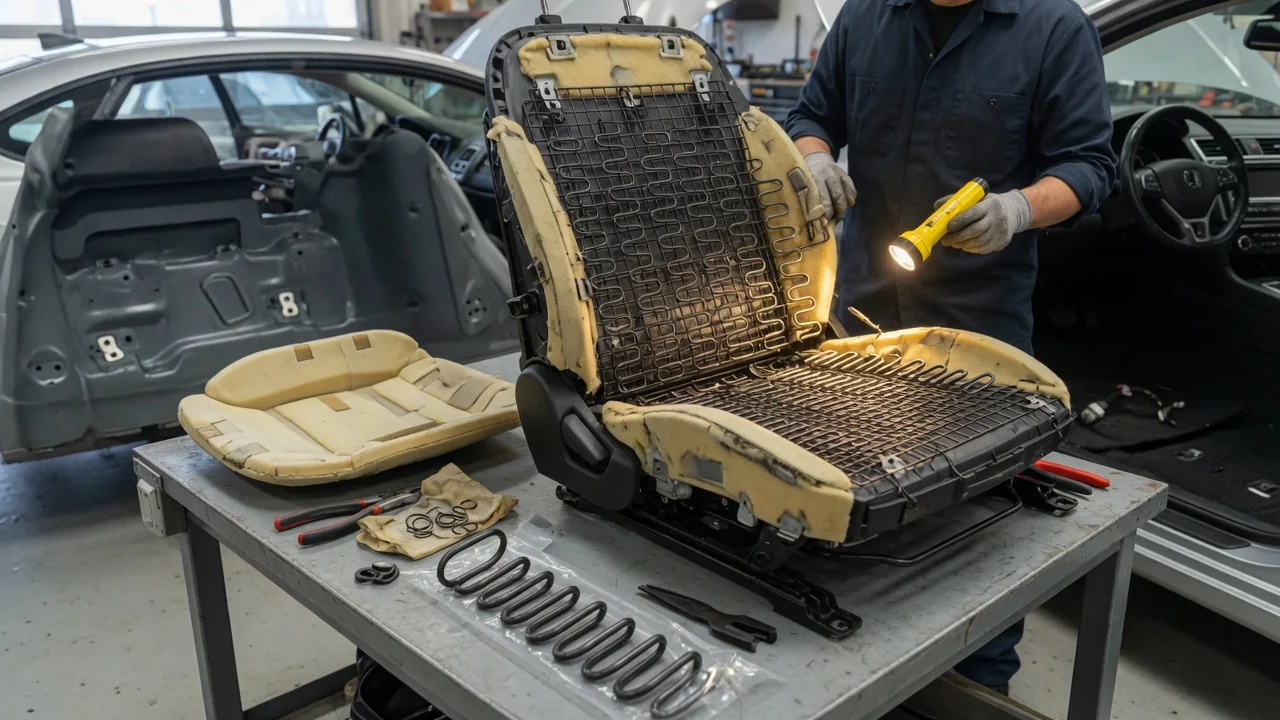
Seat cushion suspension is the supporting structure beneath the foam pad of a car seat that carries the occupant's weight into the seat frame. Depending on the design, it may be a set of zigzag wire springs, a wire grid, elastic straps, a molded plastic mat, or a rigid pan that lets the foam do most of the work. Knowing how this layer works explains why seats feel the way they do, how they wear, and what a repair actually involves.
Support Below the Foam
In most passenger car seats, the visible cushion is only the top layer. Under the cover and foam sits a frame, usually steel, that bolts to the seat tracks. The cushion suspension spans the open area of that frame or covers it, giving the foam something to rest on. The most familiar form is the sinuous spring, a length of spring steel wire bent into a continuous S or zigzag shape and hooked to the front and rear of the frame with clips. Several run side by side, often tied together with cross wires or links so they flex as a unit. These are what many owners mean when they talk about car seat cushion springs.
Other designs replace or supplement wire springs. Some seats use a formed wire mat stretched between the frame sides with small tension springs. Others rely on elastic or rubberized webbing, molded plastic suspension panels, or a stamped metal pan with the foam shaped to provide all of the compliance. Coil springs, once common in older bench seats, appear less often in modern cushions. Many seats combine approaches, such as a firm section at the front edge for thigh support and a spring section under the hips. The arrangement in a particular vehicle varies by manufacturer, model, trim and seat position, so the service manual for that vehicle is the reliable reference.
The term should not be confused with a suspension seat, which isolates the whole seat from the floor using a mechanical or air-sprung linkage and a damper. Those are typical in heavy trucks, buses and off-road equipment. Cushion suspension, by contrast, is a passive layer inside an ordinary seat; its job is to support and shape the foam rather than move the entire seat.
How Cushion Suspension Shapes Comfort
Foam alone can be made comfortable, but its behavior depends heavily on what is underneath. A suspension that flexes lets the cushion deflect more under the heaviest areas, mainly the sit bones, while staying firmer where load is lighter. This spreads pressure across a larger contact area, which tends to reduce pressure points on long drives. A rigid base forces the foam to provide all of that deflection, so designers typically compensate with thicker or differently formulated foam. Neither approach is inherently better; the overall feel comes from the combination of foam density, foam thickness, cover tension and suspension stiffness.
The suspension also influences how road vibration and small impacts reach the occupant. Springs and elastic supports add compliance between the frame and the body, and the foam adds damping, so together they can soften sharp inputs that pass through the vehicle's own suspension. The layer helps set posture as well. Support under the front of the cushion affects how the thighs are carried, and the way the rear section sinks influences pelvic angle and how the backrest meets the lower spine.
Comfort is not fixed for the life of the seat. Foam gradually loses resilience, and springs or straps can stretch, shift or lose their clips. When that happens, the occupant may sit lower, feel the edge of the frame, or notice that one side sinks more than the other. Because foam and suspension work as a system, a worn layer underneath can make even intact foam feel unsupportive.
Service and Repair Considerations
Common signs of a cushion suspension problem include a seat that sags noticeably compared with the opposite seat, a hard ridge that was not there before, squeaks or creaks when shifting weight, a rattle over bumps, or a wire that can be felt through the foam. A broken or unhooked sinuous spring often produces a localized dip. Squeaks may come from metal-to-metal contact at clips or worn anti-noise pads, but noises can also originate in the seat tracks, recliner or trim, so the source should be confirmed before parts are ordered.
Access usually requires removing the seat from the vehicle, then separating the cover and foam from the frame. Covers are commonly secured with hog rings, clips or plastic channel strips, and the foam may be bonded or hooked in place. Modern seats often contain wiring for seat heaters, power adjustment, belt buckle switches, side airbags or occupant detection sensors. Manufacturers typically specify disconnecting the battery and waiting before unplugging airbag-related connectors, and some passenger seats require the occupant detection system to be checked or recalibrated after cushion work. These steps differ between vehicles, so the applicable repair manual takes precedence over general advice.
Repair options depend on the design. Individual sinuous springs, clips and wire links are sometimes available separately, either from the vehicle manufacturer or as universal upholstery parts, while some manufacturers supply the cushion frame and suspension only as an assembly. Webbing can be replaced with suitable upholstery material, and a detached spring can often be rehooked if the clip and frame are undamaged. A cracked frame, bent mounting points or damage near seat belt anchorages is a different category of problem, because the frame carries crash loads; replacement with an approved part is the conservative choice.
Practical Implications and Limits
For everyday ownership, the main takeaway is that the feel of a seat belongs to the whole stack, not just the foam. Adding a thick aftermarket pad can raise a sagging seat, but it does not restore broken springs underneath, and it can change seating height, belt fit and the readings of occupant sensors built into some passenger seats. New foam laid over a worn suspension may feel good at first and then settle into the same low spot, so it makes sense to inspect what sits below before deciding what to replace.
There are also limits to what owners can change. Converting a pan-type seat to spring suspension, or the reverse, is generally impractical because the frame, foam shape and trim are designed around one approach. Fitting a seat from another vehicle raises fitment, wiring and safety-system questions that general information cannot answer. When evaluating a used vehicle, pressing on each cushion, comparing the most-used seat with less-used ones and listening for noises gives a reasonable picture of wear, but it cannot reveal hidden frame damage. Kneeling or standing on cushions concentrates load on small areas of the suspension and can dislodge springs that were never meant to carry it.