What Is Roll Forming for Car Parts? Process, Profiles and Uses
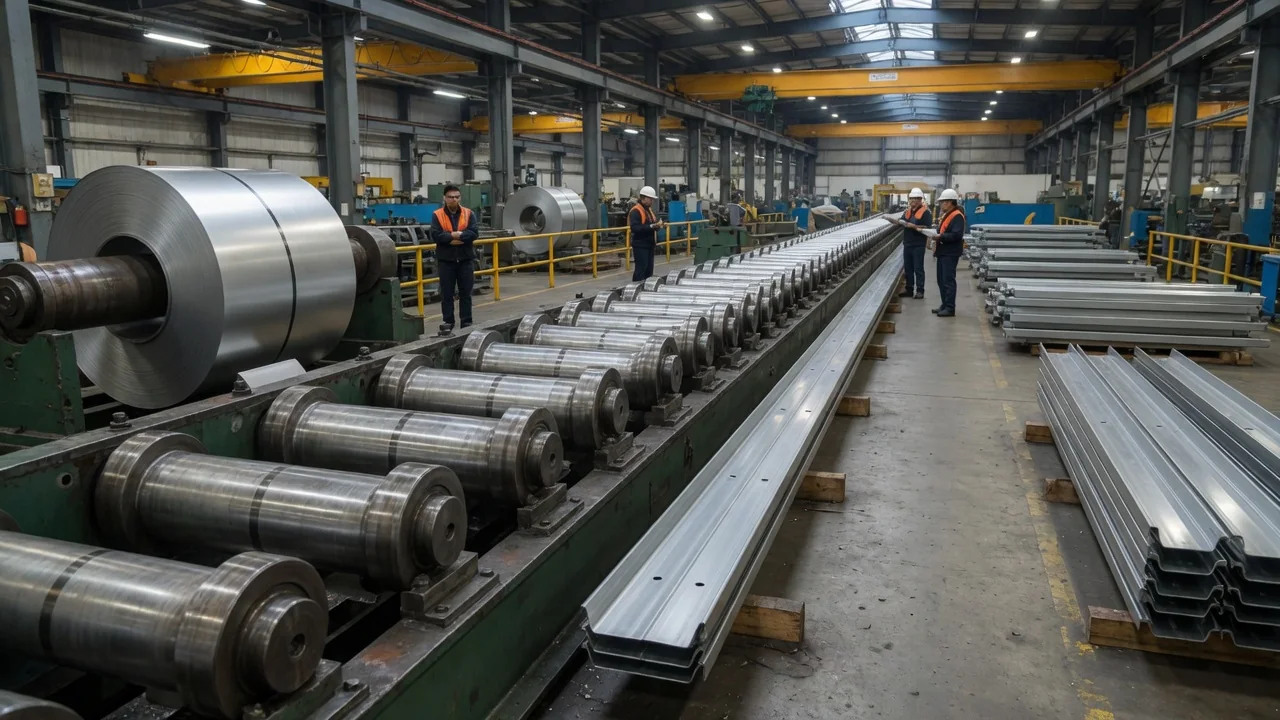
Roll forming is a continuous metalworking process that bends a flat strip of sheet metal, step by step, through a series of shaped rollers until it becomes a long part with a consistent cross-section. In car manufacturing it produces many structural and trim components that owners rarely see, from bumper reinforcement beams to window channels. This guide explains what roll forming for car parts involves, which profiles it creates, where automotive roll formed parts are typically used, and what the method can and cannot do.
Continuous Shaping: How Roll Forming Works
A roll forming line usually starts with a coil of sheet metal. The strip is unwound, flattened by a straightener, and fed into a sequence of roll stands. Each stand holds a pair of contoured rollers, and each pair bends the metal only slightly further than the one before it. By the time the strip leaves the last stand, those small increments add up to the finished shape. The process is normally done cold, at room temperature, and it runs continuously rather than in separate press strokes. How many stands a part needs depends on how complex the profile is and how the chosen material behaves when bent.
The gradual approach is the core idea. Bending a little at a time spreads the strain across many stations, which helps control cracking, wrinkling and springback, the tendency of metal to partially return toward its original shape after bending. Because roll forming mainly bends the strip rather than stretching it, wall thickness stays largely the same through the profile. That is a key difference from stamping, where a blank is pressed into a die and parts of the sheet may thin as the metal is drawn into deeper shapes.
Other operations are often built into the same line. Holes, slots and notches can be punched before or after forming. For closed sections, the edges can be welded or mechanically joined as the strip moves. A cutoff unit then separates the continuous profile into individual parts, often while traveling with the strip so the line does not have to stop. Some lines add a sweeping or bending stage that gives a straight profile a gentle curve, which is useful for parts that must follow the shape of a vehicle body.
Profiles: The Cross-Sections Roll Forming Creates
In roll forming, a profile is the shape you would see if you cut the part straight across. Open profiles include simple angles, C and U channels, Z sections and hat sections, which look like a channel with flanges along both edges. More complex open shapes can combine many bends, ribs and return flanges in one cross-section. Closed profiles are formed into a loop and joined along a seam, creating round, square or rectangular tubes. Some automotive designs use multi-chamber closed sections, where the strip is folded into two or more connected boxes for added stiffness.
Profile design depends on the material and the job the part must do. Engineers balance sheet thickness, bend radius, flange length and steel or aluminum grade against the forming limits of the rollers. Stronger materials generally need larger bend radii and more careful staging to avoid cracks. Roll forming works with mild steel, coated steel, stainless steel, aluminum and advanced high-strength steels, including very high-strength grades that can be difficult to stamp into complex shapes. That compatibility with high-strength material is one reason the process matters to modern vehicle structures, where designers try to gain strength without adding much weight.
Standard roll forming produces a cross-section that stays the same along the whole length of the part. Variants such as flexible roll forming can change the width or shape along the length, but they are more specialized. For most applications, a roll formed part is best thought of as a long, uniform shape that may later be cut, punched, curved or welded to other components.
Uses: Where Automotive Roll Formed Parts Appear
Many roll formed car parts sit inside the body structure. Common examples include bumper reinforcement beams behind the plastic bumper cover, door intrusion beams inside door shells, rocker or sill reinforcements, roof rails and roof bows, and various cross members. These parts are long and fairly uniform in section, and they often need high strength in a predictable direction, which suits the process. Exactly which components are roll formed varies by manufacturer and vehicle design, so the presence of a roll formed part in one vehicle says nothing about another.
Roll forming also shows up in less obvious places. Seat tracks and seat frame members, window channels, door frame sections, sunroof frame members, and exterior or interior trim strips can be made this way. In electrified vehicles, some battery enclosure frame members may be roll formed, although aluminum extrusions and stampings are also used for similar roles. Larger vehicles and trailers can use roll formed rails and stiffeners as well. In every case the shared trait is a long part with a repeating cross-section.
Manufacturers choose roll forming when it fits volume, geometry and material. A running line can produce long parts quickly with little scrap, and the continuous process gives consistent dimensions from part to part. It competes with stamping, extrusion and hydroforming, and the final choice depends on the shape, the alloy, the required strength and production cost for that specific design.
Practical Implications and Limits
The method has clear boundaries. Roll tooling and line setup take significant engineering effort, so the process is most economical for long production runs rather than small batches. It is poorly suited to deep, three-dimensional shapes such as a door outer panel or a complex bracket, which are usually stamped instead. Formed parts can show defects such as edge waviness, twist, bow or flared ends after cutting, and springback must be compensated for in the roll design. Very tight bends in the strongest steel grades raise the risk of cracking, which limits how sharp some profiles can be.
For owners and repair shops, the main implication is that roll formed reinforcements are often hidden behind covers and trim, and many are made from high-strength steels. Such materials can respond poorly to heating or straightening, which can change their strength. Repair information for these parts frequently limits how they may be repaired and sometimes calls for replacement rather than straightening. Because practices differ between vehicles, the manufacturer's body repair procedures are the authority for any specific case, not general rules about the process.
When a parts listing describes a component as roll formed, it tells you how the part was shaped, not how strong or well made it is. Performance depends on the material grade, the profile, the thickness and how the part is attached to the rest of the vehicle. Two roll formed parts that look similar can behave very differently, so matching the correct part for a given vehicle matters more than the manufacturing label.