What Is Roll Center Height? Suspension Geometry Explained
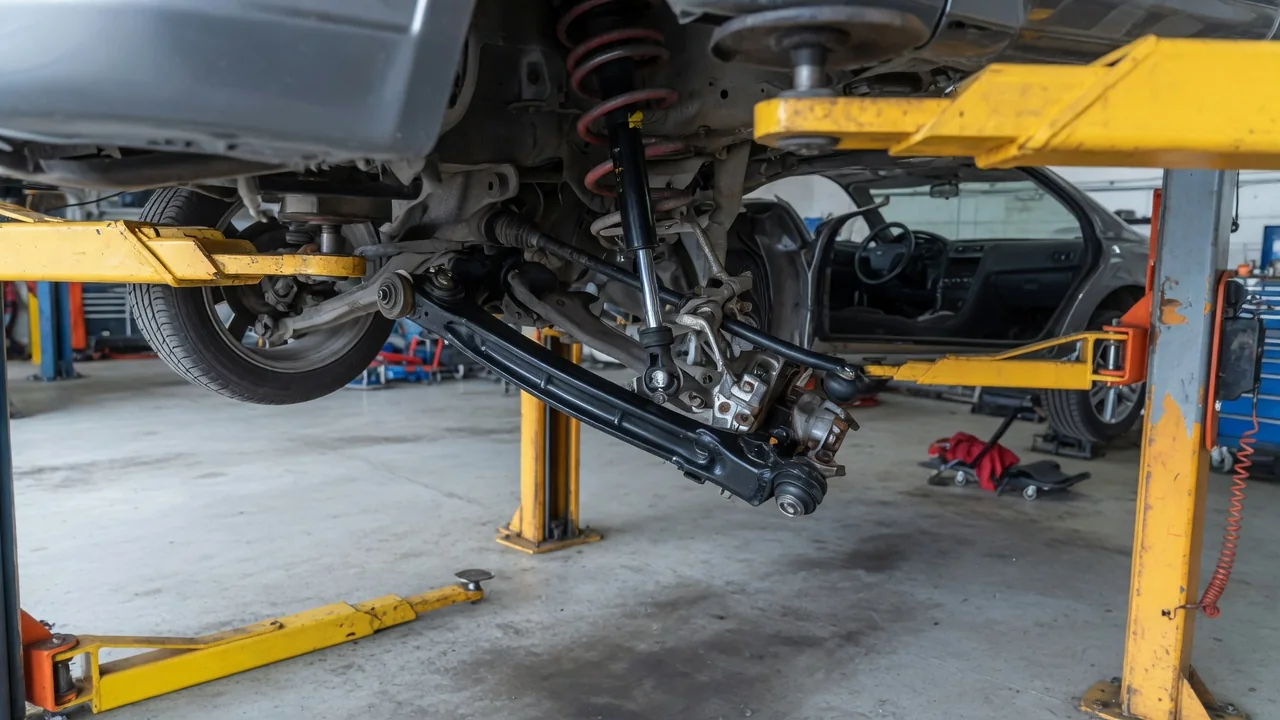
Roll center height is the distance from the ground to an imaginary point, defined by the suspension linkage, about which a car's body tends to rotate when it leans in a corner. It is not a physical part you can touch, yet it influences how much a car rolls, how cornering forces reach the body, and how the tires behave as the suspension moves. Understanding the car roll center concept helps explain why suspension geometry matters as much as springs and dampers.
Suspension geometry and how the roll center is found
The roll center is a geometric construction drawn in the front view of one axle. For an independent suspension such as a double wishbone design, extend the lines of the upper and lower control arms on one side until they meet. That intersection is the instant center, the point about which the wheel momentarily pivots relative to the body. Then draw a line from the center of that wheel's tire contact patch to its instant center, and repeat for the opposite wheel. Where the two lines cross is the roll center, and its vertical distance above the ground is the roll center height. On a symmetric car at rest, the point usually sits on the centerline and, depending on arm angles, can be above ground level, at it, or below it.
Other layouts follow the same principle with different reference lines. On a MacPherson strut, the upper reference is a line drawn perpendicular to the strut axis through its upper mount, combined with the extended line of the lower control arm. On a solid axle, the roll center is set mainly by the lateral locating device, such as a Panhard rod, a Watt's linkage, leaf springs, or angled links. Each axle has its own roll center, and the line joining the front and rear roll centers is called the roll axis.
Because the arms change angle as the suspension compresses, extends, and rolls, the instant centers move, and the roll center moves with them. This is called roll center migration. The point can shift vertically with ride height and sideways once the body leans, so a single static figure describes the geometry at only one position.
Body roll and the roll moment arm
In a corner, lateral acceleration acts at the center of gravity of the sprung mass, while the suspension reacts that force at the roll axis. The vertical distance between the center of gravity and the roll axis is the roll moment arm. The longer that arm, the larger the moment trying to rotate the body, and the more the springs and anti-roll bars must resist. Raising the roll center toward the center of gravity shortens the arm and reduces roll for the same spring and bar stiffness. If the roll axis passed through the center of gravity, cornering would theoretically create no roll moment, although that is not a practical target for road cars.
Roll center height also determines the route lateral load transfer takes into the chassis. Part of it moves directly through the suspension links, often called geometric or kinematic load transfer, and acts almost immediately. The remainder passes through the springs and anti-roll bars as the body rolls, called elastic load transfer, and builds as roll develops. A higher roll center sends more of the transfer through the links. For the vehicle as a whole, the total steady-state lateral load transfer is set by center of gravity height, track width, and lateral acceleration, so roll center height changes the path and timing rather than the overall total.
Front and rear roll center heights rarely match. Their relative heights, together with spring rates and anti-roll bars at each end, influence how load transfer is shared between the axles. Because a tire's grip grows less than proportionally with load, the axle carrying more of the transfer tends to lose grip first, nudging the car toward understeer or oversteer. Roll center placement is therefore one of several tools for setting handling balance.
Design tradeoffs of high and low roll centers
A higher roll center reduces body roll and makes the chassis respond quickly because more load transfer goes straight through the links. The cost is jacking. When the roll center sits above the ground, cornering forces at the contact patches create a vertical component that tends to lift the body, with the outer wheel usually pushing up more than the inner wheel pulls down. This can raise the center of gravity during hard cornering and make behavior less predictable near the limit.
In independent suspensions, a high roll center also tends to bring more sideways movement of the tire contact patch as the wheel travels up and down. This scrub can disturb tracking over bumps and uneven pavement. A low roll center, near or slightly above ground level, limits jacking and scrub but lengthens the roll moment arm. The car then needs stiffer springs or anti-roll bars to control roll, which can cost ride comfort and single-wheel bump compliance.
Designers also weigh migration. A geometry that keeps the roll center relatively stable through travel and roll gives more consistent handling, because the split between geometric and elastic load transfer stays similar from gentle to hard cornering. That goal competes with camber change, bump steer, anti-dive and anti-squat behavior, packaging space, and cost, so the final layout is always a compromise rather than an ideal number.
Practical implications and limits
For owners, the most common way roll center height changes is lowering the car. Shorter springs alter control arm angles, and on many layouts, particularly strut suspensions, the roll center can drop faster than the center of gravity. The roll moment arm then grows, which can partly offset the benefit of a lower body. If the arms are pushed past horizontal, migration can become larger and less predictable. Some lowering setups therefore use parts intended to restore arm angles, such as roll center adjusters or relocated pivots; whether they are useful depends on the specific suspension design and how far the car is lowered.
The concept has limits of its own. The front-view construction is a two-dimensional kinematic simplification that assumes rigid links and ignores bushing deflection, tire deformation, and three-dimensional linkage effects. Engineers rely on suspension analysis software or measurement rigs, not a tape measure in a driveway. Roll center height should not be judged in isolation either: two cars with similar values can behave very differently because of spring rates, damping, tires, weight distribution, and center of gravity height. For any specific vehicle, the manufacturer's service information remains the reference for ride height and alignment settings.