What Is Retained Accessory Power? Timer, Door Trigger and Battery Use
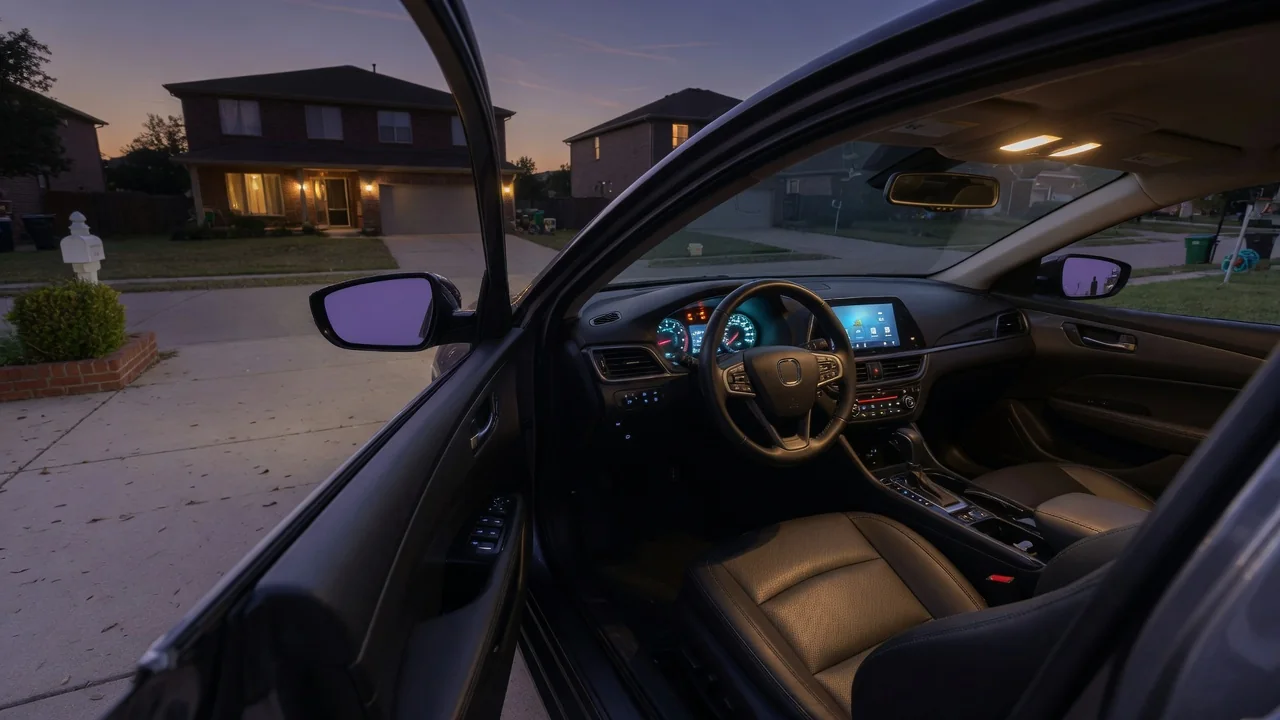
Retained accessory power, often shortened to RAP, is a body electrical feature that keeps selected convenience circuits working for a limited time after the ignition is switched off. In a car with retained accessory power, the driver can typically finish closing a window, adjust the sunroof, or let the audio system keep playing briefly without turning the key or pressing the start button again. A timer, a door signal, and the need to protect the battery govern how the feature behaves.
Timer logic
At its core, retained accessory power is a timed state managed by a control module rather than by the ignition switch itself. When the ignition moves from run or accessory to off, the module responsible for vehicle power modes, commonly the body control module on modern vehicles, starts an internal countdown instead of cutting the accessory feed immediately. While that countdown runs, the module keeps the retained circuits energized, either by holding a relay closed or by continuing to broadcast a power mode message that tells other networked modules they may stay active. The manufacturer defines the length of the interval in software or calibration, and it differs between vehicle lines. Owners should check the owner's manual for the figure that applies to their car rather than assume a universal value.
The timer is only one of several conditions the module evaluates. The logic typically ends the retained state when the countdown expires, when a defined door event occurs, or when the vehicle is locked, whichever comes first. Turning the ignition back to accessory or run normally cancels the retained state and returns the car to its ordinary power mode, and switching off again may restart the countdown. Because the decision lives in software, some vehicles expose related behavior through an infotainment settings menu or allow a service tool to change it, while others treat it as fixed. On older designs with simpler wiring, a dedicated timer relay or a timer circuit inside a window or radio module may perform the same job without a central body computer.
Door trigger
The door trigger exists because retained accessory power is meant for the moments while occupants are still seated. Once someone opens a door to get out, the system assumes the accessories are no longer needed and ends the retained state early. To make this decision, the control module monitors door ajar inputs. These can come from switches built into the door latch assemblies, from older plunger-style jamb switches, or from latch status shared over the vehicle network by a door module. Which door counts varies by design: some systems respond only to the driver's door, some to either front door, and some to any door. The owner's manual is the reliable reference for a specific vehicle.
Because the door trigger depends on a sensor, the condition of that sensor directly affects how the feature behaves. A latch switch that reports a closed door when the door is actually open can let the radio or windows stay powered after the driver walks away, until the timer or locking ends the state. A switch that reports an open door when it is closed can cut retained power immediately or prevent it entirely, which may look like a radio or window fault. The same door inputs commonly feed interior lighting, the door ajar warning, and the security system, so a symptom in one of those systems is a useful clue when retained accessory power seems inconsistent. Technicians usually confirm the door status the module actually sees with a scan tool before replacing parts.
Battery use
Everything powered during the retained period draws from the battery, because the engine and charging system are no longer running. Audio amplifiers, power window motors, sunroof motors and any accessory outlets on the retained circuit all add to that load. Window and sunroof motors draw substantial current while moving, but they usually run only for seconds. Audio and infotainment draw less at any moment, yet they can run for the whole retained period. In a healthy system with a charged battery, a single retained period is a small, predictable demand, and its limited duration is precisely what keeps the energy cost modest.
When the retained state ends, the body control module releases the accessory relays or stops broadcasting the active power mode, and participating modules move toward a low-power sleep state. What remains is the normal key-off draw for functions such as clocks, memory settings, keyless entry and the alarm. If a module fails to go to sleep after retained power ends, for example because a faulty door input or network message keeps waking it, the battery can be drained over hours or days. That is why retained accessory power matters in parasitic drain diagnosis: technicians generally wait until the retained period and module sleep timers have passed before measuring key-off current.
Practical implications and limits
For daily use, the most helpful habit is to finish window and sunroof adjustments before opening a door, since the door event usually ends the opportunity. If a window still needs closing after a door has been opened, the ignition will generally have to be switched back on. Audio that stops when someone exits or after a few quiet minutes is normal behavior, not a defect. In push-button start vehicles, retained accessory power is also distinct from the selectable accessory mode: accessory mode is an intentional power state chosen by the driver, while retained power is a brief extension that follows shutdown automatically.
Aftermarket electrical work deserves care. Dash cameras, aftermarket audio and charging devices may behave unexpectedly depending on whether they connect to a constant battery feed, an ignition feed, or a retained accessory feed, and on vehicles that control accessory power through network messages there may be no simple wire to tap. A heavy added load on a retained circuit can also exceed what its relay or fuse was designed to carry. Installers should identify the correct circuit from the vehicle's wiring diagram rather than guess.
The feature also has clear limits. It is not intended for running accessories over long periods with the engine off, and repeatedly cycling the ignition to keep the radio playing on a weak battery can leave too little charge for starting. Coverage, timing and door logic are vehicle-specific, so the general mechanism explains how car retained accessory power typically works, while the owner's manual and service information define what a particular vehicle actually does.