What Is a Progressive-Rate Suspension Spring?
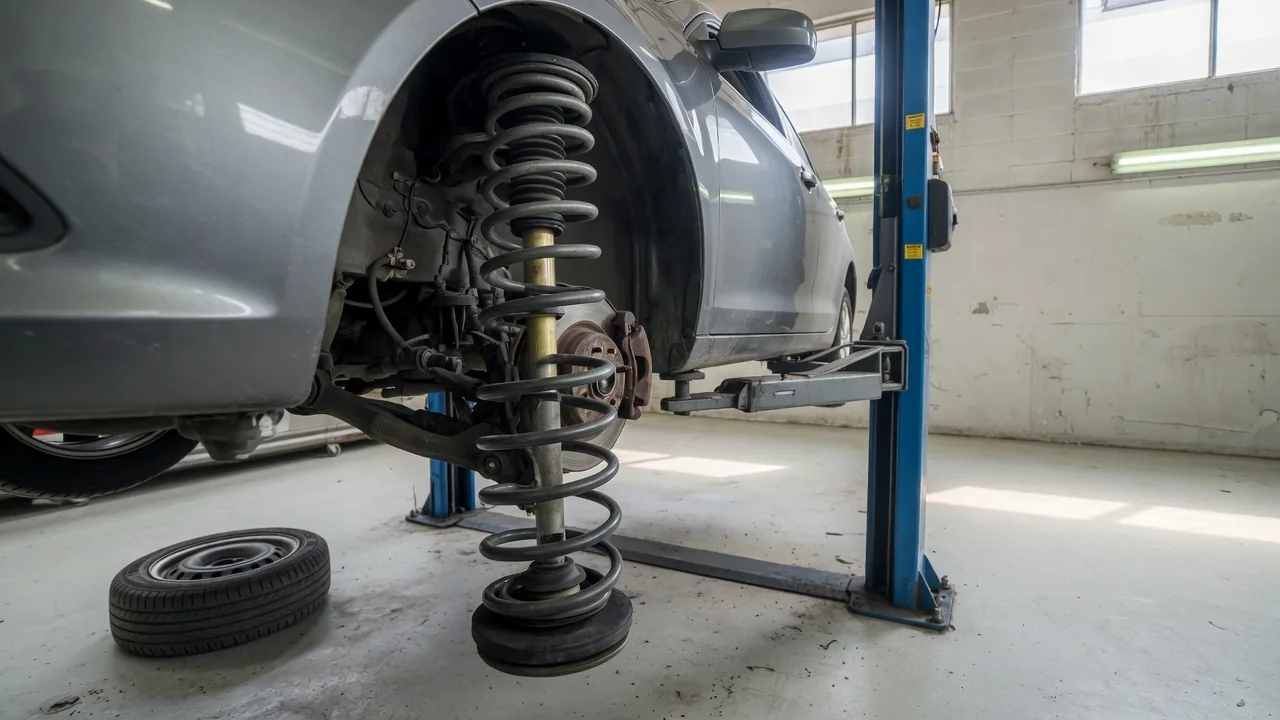
A progressive-rate suspension spring is a coil spring that gets stiffer as it compresses. A conventional spring adds the same resistance for every inch of travel. A progressive spring starts relatively soft and becomes firmer the further the suspension moves. This guide explains how a progressive spring rate in a car is created, why it can improve ride comfort, where these springs are commonly used, and what practical limits owners should keep in mind.
Changing stiffness
Spring rate describes how much force is needed to compress a spring by a given distance. It is usually expressed in pounds per inch or newtons per millimeter. A conventional linear spring has a constant rate: if the first inch of compression takes a certain force, each following inch takes roughly the same additional force. A progressive-rate spring breaks that pattern. Its rate is lower near the start of travel and rises as compression continues, so each additional inch requires more force than the last.
The most common way to build this behavior is variable coil pitch, meaning some coils are wound closer together than others. A spring's rate depends partly on the number of coils that are free to flex. The closely spaced coils compress first and eventually touch one another. Once they stack up, they stop contributing to deflection. The number of active coils drops, and the remaining spring becomes stiffer. As further groups of coils close up, the effective rate climbs again, so stiffness rises gradually rather than in a single step.
Manufacturers can create the same effect in other ways. They can vary the wire diameter along the spring, since thinner sections deflect more easily than thicker ones. They can also shape the spring as a cone or barrel, so that coils of different diameters behave differently and can nest inside one another. A related design, the dual-rate setup, uses two distinct rates, sometimes by stacking a short soft spring on a main spring. Its transition is more abrupt: once the soft section closes completely, the suspension rides on the stiffer rate alone. Strictly speaking, a true progressive spring changes rate more continuously, although the two terms are often used interchangeably.
Comfort
The main comfort argument for a progressive spring is that most driving involves small road imperfections. Expansion joints, patched asphalt, and minor ripples typically use only a fraction of the available suspension travel. With a softer initial rate, the spring yields more readily to these inputs, so less force reaches the body and the occupants. The result can be a ride that feels less busy and less harsh on everyday roads.
Larger movements bring the rising rate into play. These include big bumps, hard braking, and fast cornering. The spring resists more strongly, which helps limit body roll and pitch and reduces the chance of the suspension compressing all the way to the bump stops. A linear spring soft enough for small bumps would allow more body movement and bottoming. A linear spring stiff enough to control large movements would make small impacts feel sharper. A progressive design aims to reduce that compromise.
Load also matters. Passengers and cargo compress the springs and move them into a stiffer part of their range. This helps the suspension hold ride height and body control closer to the unladen state than a soft linear spring would. There are tradeoffs, however. The car can feel noticeably firmer when fully loaded. Shock absorbers are typically tuned for an expected range of spring rates, so they may not control a changing rate equally well in every condition.
Applications
Progressive springs appear in both factory and aftermarket suspensions. In original equipment, they are often used where a vehicle's load varies significantly. Examples include the rear axle of wagons, minivans, small vans, and some crossovers, where the same spring must handle both an empty cargo area and a full one. Whether a particular vehicle uses them depends entirely on the manufacturer's design. The service manual or parts documentation for that model is the reliable reference.
In the aftermarket, many lowering springs use a progressive rate. Lowering a car reduces available suspension travel. A spring that is soft at first and firm later can preserve some compliance over small bumps while resisting bottoming within that shorter travel. Progressive or helper springs are also used on vehicles that tow or carry heavy loads intermittently. Some off-road setups use them as well, because they must handle long travel and occasional large impacts.
The principle of rising stiffness is not limited to coil springs. Several other components also add progressive behavior to a suspension. Leaf spring packs can include helper leaves that engage under load. Air springs build pressure as they compress. Rubber or polyurethane bump stops firm up as they are squeezed. By contrast, many track-focused setups favor linear springs. A constant rate makes handling balance more predictable and easier to tune alongside adjustable dampers and anti-roll bars.
Practical implications and limits
Owners replacing springs should keep a few practical points in mind. Springs should be replaced in pairs on the same axle so that both sides share the same rate characteristics. Many progressive springs are directional, with the tightly wound section meant to sit at a specific end. Installing them upside down can change their behavior or seat them incorrectly. Follow the vehicle's repair manual or the spring maker's instructions for orientation and torque values. Ride height changes can alter wheel alignment, so check alignment after installation.
It also helps to know what a progressive spring cannot do. It does not raise a vehicle's rated payload or towing capacity, which the manufacturer sets based on many components beyond the springs. It cannot compensate for worn shock absorbers, bushings, or mounts. Fitting a markedly different spring rate with dampers tuned for the original springs can leave the suspension underdamped or overdamped. Visibly uneven coil spacing suggests a progressive design, but it does not reveal the actual rate curve. Only the manufacturer's data can confirm that.
Closely spaced coils that touch during compression can sometimes make clicking or tapping sounds. Their contact surfaces may also show coating wear over time. If the protective coating chips, corrosion can weaken the spring and eventually lead to breakage, so inspect springs during routine suspension service. If you are unsure whether a spring is sagging or behaving as designed, measure ride height against the vehicle's specification.