What Is Open-Loop Engine Operation? Preset Fueling, Startup and Load Explained
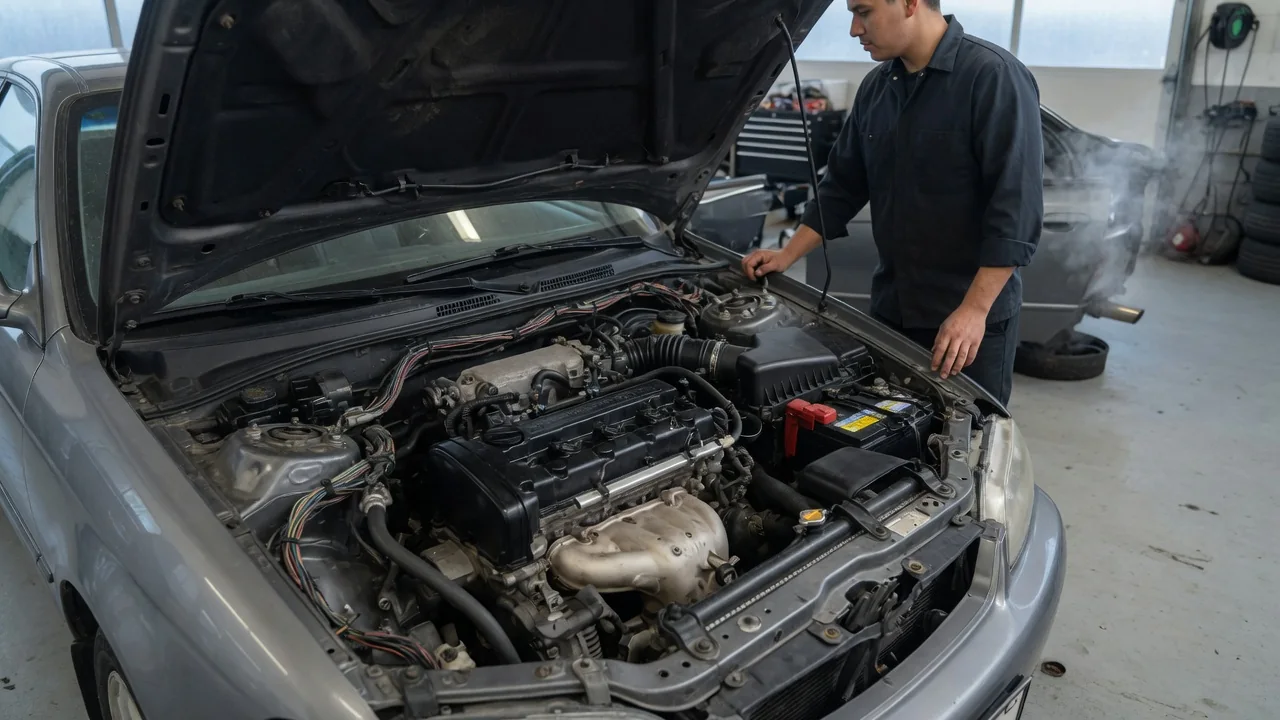
Open-loop engine operation is a fuel control mode in which the engine computer meters fuel from preset calculations instead of live feedback from the exhaust oxygen sensor. Most modern gasoline engines switch between open-loop and closed-loop fuel control during an ordinary drive. Knowing what open loop means, when it happens and what it cannot do helps explain cold-start behavior, full-throttle fueling and some of the status readings shown on a scan tool.
Preset Fueling: How Open-Loop Fuel Control Works
In a fuel-injected engine, the engine control module (ECM) has to decide how long to open each injector on every cycle. It starts by estimating how much air is entering the engine, typically from a mass airflow sensor or a manifold absolute pressure sensor combined with engine speed. It then looks up a target fuel quantity in stored calibration tables, often called fuel maps, and applies corrections for inputs such as coolant temperature, intake air temperature, throttle movement and battery voltage, which affects how quickly injectors respond. In open loop, that calculation is the final answer: the computed injector pulse is delivered, and the system does not check the exhaust to confirm the result.
Closed-loop operation adds a feedback step. An upstream oxygen sensor or air-fuel ratio sensor reports whether the exhaust is rich or lean, and the ECM adjusts fuel through short-term and long-term fuel trims to keep the mixture near stoichiometric, roughly 14.7 parts air to 1 part fuel by mass for typical gasoline. Open-loop fuel control removes that correction. Its target is also not necessarily stoichiometric; in many situations the ECM deliberately commands a richer mixture. On many systems, learned long-term corrections still influence the open-loop calculation, but how much they do so depends on the manufacturer's strategy and is not something an owner can see without service information.
Startup or Load: When Engines Run in Open Loop
The most familiar open-loop period follows a cold start. There are two reasons for it. First, an oxygen sensor must be hot to produce a usable signal. Built-in heaters shorten this delay considerably, but until the ECM judges the signal valid, it cannot rely on it. Second, a cold engine needs extra fuel because gasoline vaporizes poorly on cold intake ports and cylinder walls, and some of it condenses instead of burning. The ECM adds enrichment based mainly on coolant temperature, often alongside a raised idle speed. As the engine warms and the sensor becomes ready, the system transitions to closed loop. A restart with a warm engine usually spends much less time in open loop.
The second common case is heavy load, such as wide-open throttle or hard acceleration. Here the ECM leaves closed loop on purpose. Holding a stoichiometric mixture at high load can raise combustion and exhaust temperatures, increasing the risk of knock and heat stress on valves, pistons and the catalytic converter. A richer mixture helps because the extra fuel absorbs heat as it evaporates and resists detonation, while also supporting maximum power. This strategy is often called power enrichment, and scan tools may describe it as open loop due to driving conditions.
Other situations also bypass feedback. During deceleration fuel cutoff, the injectors shut off when the throttle closes at speed, so there is no mixture to correct. If the ECM detects a fault in the oxygen sensor or feedback system, it may fall back to open loop using stored values so the vehicle can keep running. The exact temperatures, times and throttle thresholds that trigger each mode are calibration-specific and vary between engines.
Limitations of Open-Loop Operation
The central limitation is that open loop cannot see its own results. Preset tables are calibrated for an engine with correct parts operating under expected conditions, but real engines drift. Injectors can clog or wear, unmetered air can leak in through vacuum leaks, fuel pressure can change, sensors age, and fuel composition can vary, including ethanol content. In closed loop, the oxygen sensor reveals these deviations and fuel trims compensate automatically. In open loop, the mixture is only as accurate as the calibration and the inputs feeding it.
That dependence on inputs matters. A coolant temperature sensor that reads colder than the engine really is can keep warm-up enrichment active longer than needed and may delay the switch to closed loop. A contaminated airflow sensor that underreports or overreports air passes its error straight into the fuel calculation. Because nothing downstream corrects the mistake, the symptom can look like a fuel delivery problem when the root cause is a sensor.
There are also emissions and efficiency costs. A three-way catalytic converter works most effectively when the mixture stays close to stoichiometric, which is what closed loop maintains. Richer open-loop operation increases hydrocarbon and carbon monoxide output and uses more fuel. For that reason, engine designers try to keep cold open-loop periods short, and most steady driving takes place in closed loop. Open loop is a necessary compromise for specific conditions, not a design flaw.
Practical Implications and Limits for Owners
In everyday use, open-loop behavior shows up most clearly on short trips. When a journey ends before the engine is fully warm, a large share of it may be spent with enrichment active, which is one reason short-trip fuel economy tends to be worse. A slightly higher idle or a noticeable exhaust smell right after a cold start is generally normal and not, on its own, a sign of a fault.
For diagnosis, OBD-II scan tools display a fuel system status that indicates open loop, closed loop, or variations such as open loop caused by driving conditions or a system fault. This is useful for confirming that an engine reaches closed loop after warming up. If a fully warmed engine cruising at light load remains in open loop, common areas to investigate include the coolant temperature sensor, a thermostat stuck open, the oxygen sensor or its heater circuit, and related wiring. The status alone does not identify the cause, so it should be read together with stored trouble codes, other live data and the vehicle's service information. Fuel trim values are also most meaningful while the system is in closed loop.
This explanation describes general mechanisms rather than any specific vehicle. Switching thresholds, the amount of enrichment, whether learned trims carry into open loop, how wideband sensors are used, and any additional catalyst-warming strategies on direct-injection engines all differ by manufacturer and engine. Changes to engine calibration also affect open-loop tables directly, since no sensor feedback will correct them in those operating ranges. For exact behavior on a particular engine, factory service documentation is the reliable reference.