What Is Liquid Cooling for an EV Battery?
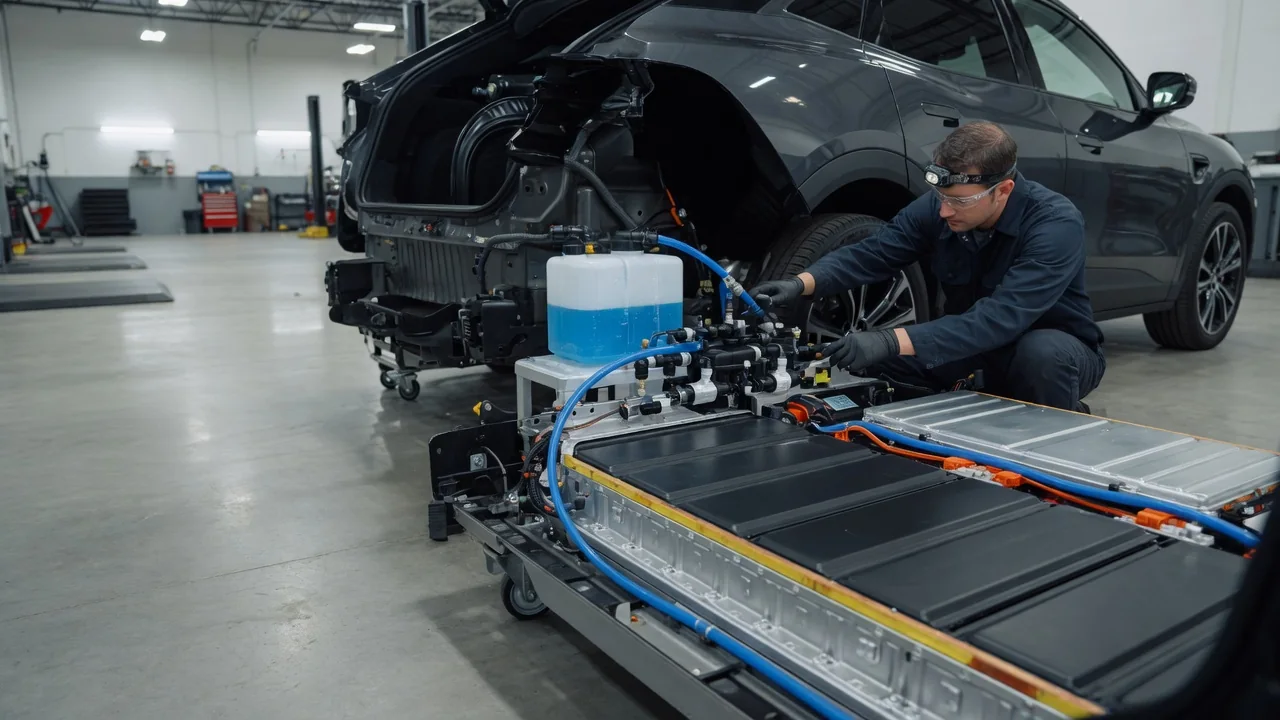
Liquid cooling for an EV battery is a thermal management method that circulates fluid through channels in contact with the battery pack. The fluid carries heat away from the cells or, in cold weather, brings heat to them. The aim is to keep the cells in a temperature range that supports power delivery, charging speed, and long-term health. Most designs rely on three core elements: a coolant path, a pump, and a heat exchanger. The exact layout differs from one vehicle to another.
Coolant path
In a typical EV battery liquid cooling system, the coolant is a mixture of water and glycol. It is broadly similar in concept to engine coolant but is formulated to the vehicle manufacturer's specification. In common designs, the coolant does not touch the cells directly. It flows through cold plates, which are flat metal panels, often aluminum, with channels inside. The plates sit beneath or between the battery modules. A thermal interface material, such as a pad, paste, or gap filler, fills the small spaces between the cells or module housings and the plate. This lets heat cross that boundary efficiently. The cells pass heat into the plate, and the moving coolant carries it away.
The circuit is a closed loop. Coolant enters the pack at an inlet and spreads across the cold plates through manifolds or branching passages. It picks up heat and leaves through an outlet, travels to a heat exchanger, and then returns to the pack. Coolant warms as it travels, so engineers arrange the channels and parallel branches to keep cells at the far end of the path from running noticeably hotter than cells near the inlet. Temperature sensors in the pack and in the loop report to the battery management system. The system uses that data to decide how much cooling or heating is needed.
In many electric vehicles, the battery loop does not stand completely alone. Valves can connect it to the loops that serve the drive motor and power electronics, or isolate it from them. Connecting the loops lets waste heat be shared. Isolating them lets each component stay in its own preferred temperature band. Whether and how this happens depends on each vehicle's design.
Pump
An electric vehicle has no engine to drive a belt-powered water pump, so liquid-cooled battery systems use an electric coolant pump. A vehicle control module commands it, and in many systems its speed can be varied rather than simply switched on and off. When the heat load is light, the pump may run slowly or not at all. During sustained high-power driving or DC fast charging, the cells generate more heat, and the controller can raise the flow rate to move that heat out of the pack faster.
Flow rate involves a trade-off. More flow generally improves heat transfer and keeps temperatures more even across the pack. It also uses more electricity and can make the pump more audible. Control software weighs these factors against the readings from the temperature sensors. Some vehicles use more than one pump, for example one for the battery loop and another for the drivetrain loop, with valves deciding how the circuits interact.
The pump can also run while the car is parked. Charging, scheduled battery preconditioning, and cool-down after a demanding drive may all require circulation when nobody is in the vehicle. Flow can drop because of a pump fault, an air pocket, or a leak. The system typically detects this through diagnostics or unexpected temperature readings. It may then limit power or charging rate to protect the cells.
Heat exchanger
Heat removed from the battery has to be released somewhere, and that is the job of the heat exchanger. One common route is a radiator at the front of the vehicle. It is sometimes called a low-temperature radiator because it serves components that run cooler than a combustion engine. Outside air passes through its fins, helped by an electric fan when the car is stopped or moving slowly. This approach uses little energy. However, it only works when the outside air is cooler than the temperature the battery needs to reach.
The other common route is a chiller. This is a compact heat exchanger that links the battery coolant loop to the refrigerant circuit of the air conditioning system. Refrigerant evaporating inside the chiller absorbs heat from the coolant flowing on the other side, which allows the coolant to be cooled below the outside temperature. That matters in hot climates and during fast charging. The chiller shares its compressor with cabin climate control. When demand is high, the vehicle's software has to divide cooling capacity between the battery and the passengers.
Heat exchange also works in the other direction. A cold battery accepts charge slowly and delivers less power. For that reason, many systems warm the coolant with an electric heater. Others use a heat pump, which moves heat from the outside air or from drivetrain components into the loop. The warmed coolant then flows through the same cold plates and raises the cell temperature from below. The specific mix of radiator, chiller, heater, and heat pump varies by vehicle.
Practical implications and limits
For drivers, the most visible effect is on charging. Some vehicles offer battery preconditioning before you arrive at a fast charger. This gives the thermal system time to bring the cells into a range that accepts higher power. The system still has finite capacity. In very hot or very cold conditions, or after several fast-charging sessions in a row, the charging rate may still be reduced to protect the cells. Fans or pumps running while the car charges or sits parked are normally the system doing its job, not a sign of trouble.
Thermal management also costs energy. The pump, compressor, fan, and heater all draw on the same battery that drives the car, so range can drop somewhat in extreme weather. That energy use is the price of keeping the cells in a healthier operating window. It is also one reason heating and cooling efficiency varies between designs.
On the maintenance side, battery coolant is a service item on some vehicles. The owner's manual or service documentation lists the correct coolant type and any replacement interval. The wrong fluid can weaken corrosion protection and, in some designs, fail to meet electrical conductivity requirements. Coolant leaks and thermal system warnings deserve prompt attention, and work on the high-voltage pack should be left to qualified technicians. Finally, liquid cooling slows some kinds of battery aging but does not prevent it, and cells still lose capacity over time and with use.