What Is Level 2 EV Charging at Home?
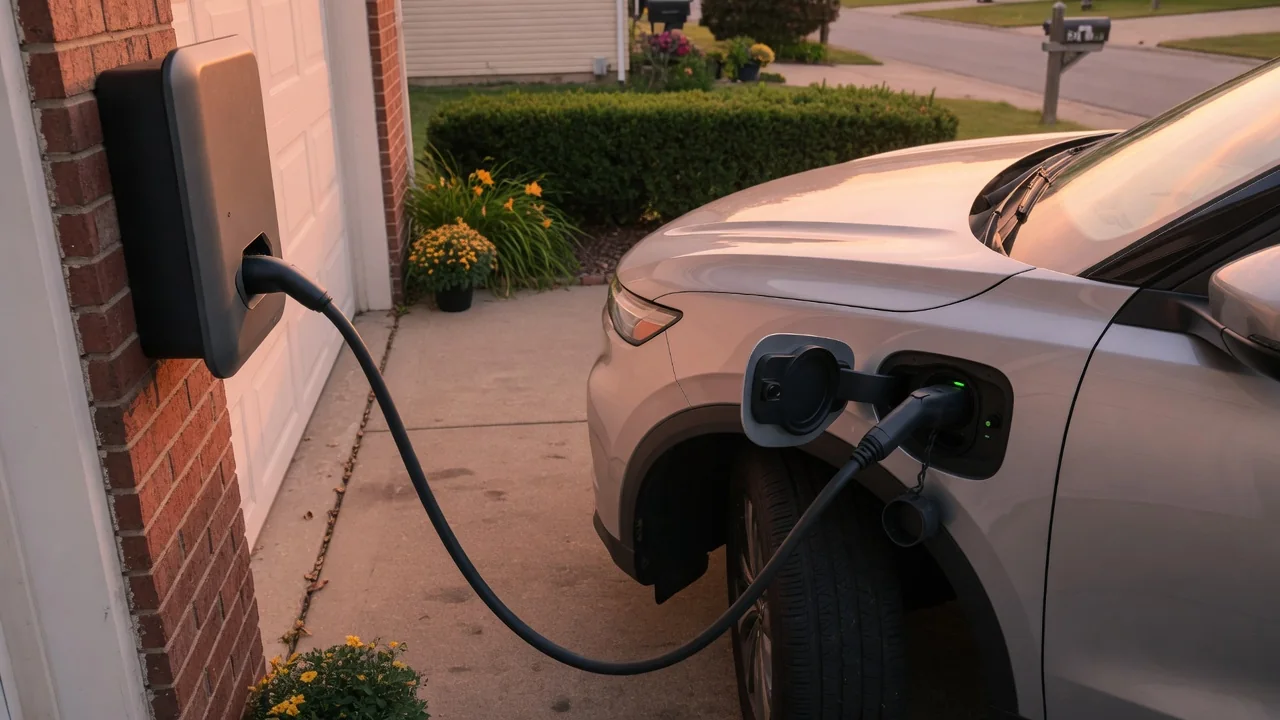
Drivers who ask what is Level 2 EV charging at home are usually comparing it with the slow cord that plugs into an ordinary wall outlet. Level 2 is alternating-current charging supplied from a higher-voltage household circuit, typically the 240-volt type used by large appliances. It delivers more power than a standard outlet, so a parked car recovers range much faster overnight.
Charging unit
The box on the garage wall is often called a charger, but it is more accurately electric vehicle supply equipment. It does not convert power for the battery. Instead, it acts as a supervised switch that tells the car how much current the circuit can safely provide, checks for ground faults, and only energizes the cable after the connector is latched and the vehicle has signaled that it is ready to accept power.
Units differ in ways owners can see. Some are hardwired to the electrical panel, while others plug into a heavy-duty receptacle. Cable length, connector style, weather rating, and maximum current output vary by product, and many include indicator lights or an app showing session status and energy delivered. The connector must match the vehicle's charge port or work through an adapter approved for that car, so the port type is worth confirming before buying equipment.
Vehicle limit
The actual conversion from AC to the direct current stored in the battery happens inside the car, in a component called the onboard charger. That component has a maximum power rating, and it sets the ceiling for home charging speed. If the wall unit can supply more current than the onboard charger accepts, the car simply draws what it can handle and the extra capacity goes unused.
This is why two vehicles plugged into the same wall unit can charge at different rates. Plug-in hybrids often have smaller onboard chargers than fully electric models, and ratings can differ between trim levels or model years of the same vehicle. The owner's manual or the manufacturer's specifications list the accepted AC charging rate, and the instrument cluster or infotainment screen usually displays the power being received during a session, which makes the limit easy to observe.
Installation planning
Planning starts at the electrical panel rather than at the car. A Level 2 unit needs a dedicated circuit, and because charging is a long continuous load, the circuit is sized with a safety margin above the current the equipment will actually deliver. A licensed electrician can perform a load calculation to determine whether the existing service has spare capacity or whether a panel upgrade or a load management device would be needed.
Location matters as much as capacity. The distance from the panel to the parking spot affects wire length and labor, and the unit should sit where the cable reaches the charge port without stretching across walkways. Outdoor installations call for equipment rated for weather exposure. Local codes commonly require a permit and inspection, and some utilities have their own rules or programs for EV circuits, so requirements should be confirmed locally before work begins.
Everyday Use and Observations
Daily use is simple. The driver parks, plugs in, and hears the connector latch and often a contactor click as the unit begins supplying power. Indicator lights near the charge port or on the wall unit change color or pattern to show charging, completion, or a fault. Many vehicles and units allow scheduled charging, which lets owners delay the session until overnight hours when electricity rates may be lower under some utility plans.
Charging speed is not constant, and that is normal. Power typically tapers as the battery approaches full, and cold weather can slow the early part of a session while the pack warms up or the car diverts energy to battery conditioning. The cable and connector may feel slightly warm under sustained load. A connector that becomes hot to the touch, a discolored plug, or repeated tripping of the breaker are signs to stop and have the equipment inspected.
Limits and Next Steps
Level 2 is still AC charging, so it will not match the speed of the DC fast chargers found along highways, which bypass the onboard charger entirely. It is intended for vehicles that sit for hours at a time. For drivers with short commutes, a standard outlet may already cover daily needs, while those with longer drives, larger batteries, or more than one plug-in vehicle generally benefit most from the higher-power setup.
A sensible next step is to gather three facts: the vehicle's accepted AC charging rate, its connector type, and the available capacity of the home's electrical service. With those in hand, an electrician can recommend a circuit size and an equipment rating that suit both car and house. If a charging fault message appears afterward, it should be treated as a clue pointing toward the vehicle, the cable, or the supply rather than proof of a failed part.