What Is Level 1 EV Charging at Home?
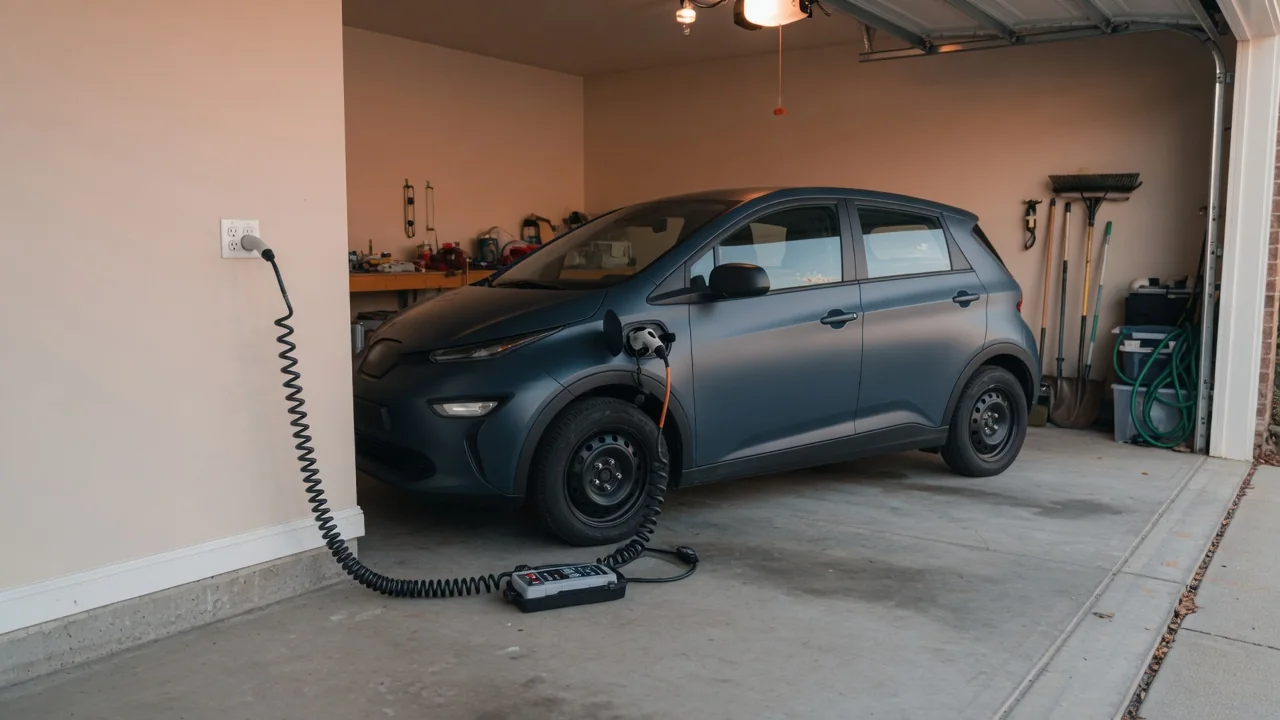
Level 1 EV charging at home means plugging an electric vehicle into a standard 120-volt household outlet using the portable cordset that many automakers supply or offer. It is the slowest way to charge, yet it requires no special equipment where the vehicle and outlet support it. Understanding what Level 1 charging is helps owners decide whether a plain wall outlet covers their daily driving.
Power path
Electricity for Level 1 charging starts at the home's breaker panel, travels through a branch circuit to a standard three-prong receptacle, and then enters the portable cordset. That cordset is not actually the charger. Its control box is a safety device that checks for a proper ground, communicates with the car, and only then closes a relay to let alternating current flow through the cable and connector to the vehicle's charge port.
Inside the vehicle, the onboard charger converts household alternating current into direct current at the voltage the battery pack needs, while the battery management system supervises cell temperature and state of charge. Drivers can observe this sequence: indicator lights on the control box, a click as the connector latches, and a charging symbol on the instrument cluster or charge port light. Connector style, port location, and indicator colors differ between manufacturers, so the owner's manual is the reference for what each signal means.
Charging time
Charging time on a household outlet is governed by the modest power a 120-volt circuit can deliver, not by the battery alone. Because the cordset draws limited current, energy enters the pack slowly, typically adding only a few miles of driving range for each hour plugged in. A plug-in hybrid with a small battery may refill overnight, while a long-range battery electric vehicle that arrives nearly empty can need several days to reach full.
The more useful way to think about it is replacing daily use rather than filling from empty. A commuter who drives a short round trip and plugs in each evening can often recover that energy by morning. Cold weather lengthens the wait because some incoming power warms the battery or cabin, and charging also slows as the pack nears full. The vehicle's display or companion app usually shows an estimated completion time, which varies with battery size, efficiency, and the amperage setting selected.
Electrical guidance
EV charging is a continuous load, meaning the outlet carries steady current for many hours, which is far more demanding than a toaster or vacuum. A dedicated circuit, with no other appliances sharing it, reduces the chance of nuisance breaker trips and overheating. The receptacle itself matters as well: an old, loose, or worn outlet can develop resistance at the contacts and get hot, so a tight-fitting, properly grounded receptacle in good condition is the baseline.
Most manufacturers advise against extension cords and adapters, since undersized or coiled cords add heat and voltage drop. Garage and outdoor outlets are generally protected by ground-fault devices, and an outdoor receptacle needs a weather-rated cover suited to a plug that stays connected. Anyone unsure about the age of their wiring, the breaker rating, or what else shares the circuit should have a licensed electrician inspect it before relying on it nightly. Some vehicles also let the driver lower charging current in a menu, which eases the load on a marginal circuit.
Everyday Use and Observations
Daily routine is simple: park, plug the cordset into the wall first if the manual specifies that order, then connect the vehicle and confirm that charging has begun. Many owners leave the cordset mounted near the outlet so the control box hangs supported rather than dangling by its plug, which protects the receptacle from strain. Scheduled charging, set through the vehicle or its app, can delay the session until off-peak hours where a utility offers lower overnight rates.
A few observations are worth making during the first weeks. The plug and outlet faceplate may feel slightly warm after hours of use, but they should never be hot, discolored, or smell of burning; any of those signs means stop and have the circuit checked. Fault lights on the control box, a session that stops repeatedly, or a tripping breaker also deserve attention rather than repeated resets. Light patterns and warning messages are manufacturer-specific, so their meaning should be confirmed in the vehicle documentation.
Limits and Next Steps
Level 1 has clear limits. Drivers with long commutes, back-to-back trips, or large battery packs may find that an overnight session never quite catches up, leaving the state of charge drifting lower through the week. Winter conditions make the gap wider. Not every vehicle ships with a 120-volt cordset, and some include one only as an option, so new owners should check what came with the car and whether the manufacturer supports regular household-outlet charging.
When a wall outlet falls short, the usual next step is Level 2 charging, which uses a 240-volt circuit similar to that of an electric dryer and delivers energy several times faster. Installation involves an electrician evaluating panel capacity and running a suitable circuit, and local permits may apply. Until then, occasional public charging can fill gaps. A sensible approach is to track a few weeks of real driving on Level 1 first; many households discover the simple outlet already meets their needs.