What Is Iron Fallout on Car Paint?
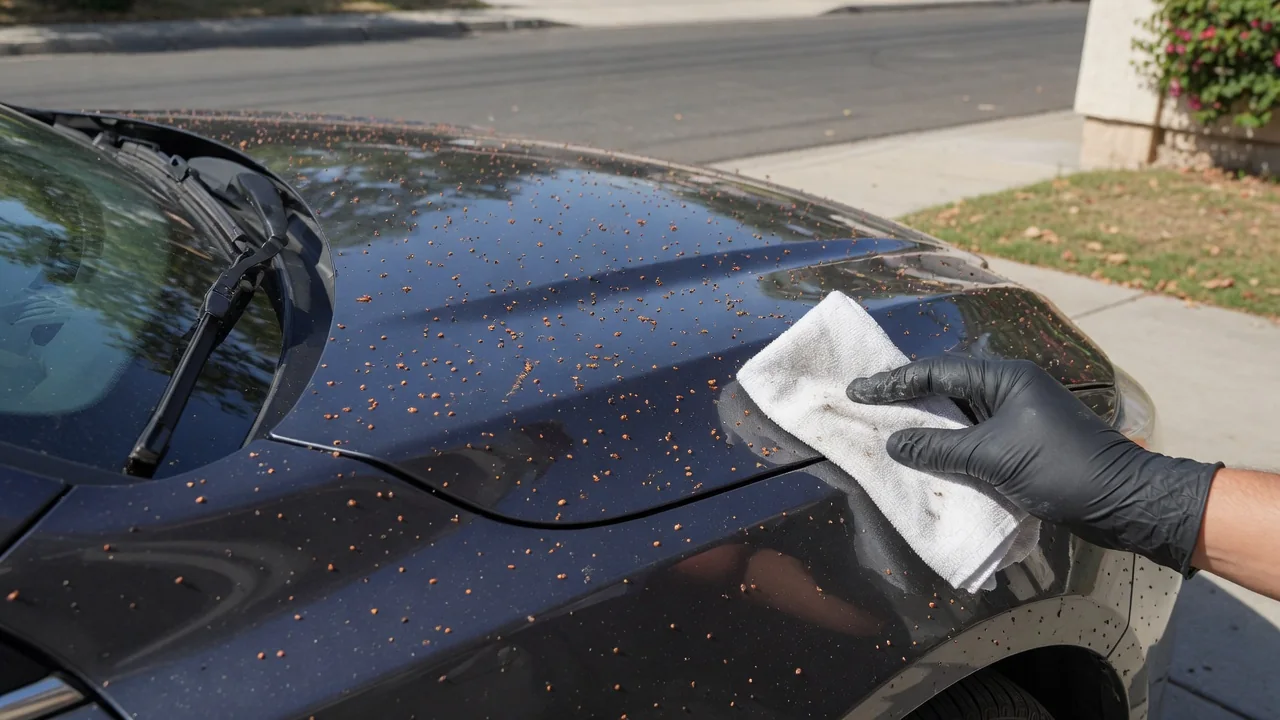
Anyone asking what is iron fallout on car paint is usually looking at tiny orange or brown specks that washing will not shift. Iron fallout is airborne metal particles that land on a vehicle, embed in the clear coat, and begin to oxidize. This article explains where the particles come from, how they feel, how they are removed safely, and where visual identification stops being reliable.
Sources
Most iron fallout begins as brake dust. Each time a cast iron rotor is squeezed by the pads, fine metal shavings are thrown off hot, and they settle on the wheels, lower doors, rocker panels, and rear bumper. A vehicle's own brakes are only part of the picture, because traffic ahead sheds the same material into the air stream. Cars that spend their days in dense stop-and-go driving therefore tend to collect more than vehicles used mainly on open rural roads.
Rail dust is the other classic source. Steel wheels grinding against steel track release particles that drift over nearby parking lots and over new vehicles shipped by train, which is why a car can arrive at a dealership already contaminated. Industrial sites such as foundries, fabrication shops, and construction zones where metal is cut or ground add to the load. Exposure varies widely with where a vehicle is parked and driven, so two identical cars can show very different amounts.
Surface feel
Bonded iron particles are often felt before they are seen. After a thorough wash and dry, clean paint should let a fingertip glide across it, while contaminated paint feels gritty, almost like fine sandpaper. Detailers often slide a hand inside a thin plastic sandwich bag and pass it lightly over the panel, because the film exaggerates small bumps. Horizontal surfaces such as the hood, roof, and trunk lid, along with the panels behind each wheel, usually feel roughest.
Roughness alone does not prove the contamination is iron. Tree sap mist, paint overspray, road tar, hard water mineral deposits, and industrial pollution of other kinds can all produce a similar texture. The orange pinpoint specks that show up on white, silver, and other light colors are a stronger clue, since they are the visible rust bloom around each particle. On black or dark metallic finishes those specks are nearly invisible, so touch becomes the main evidence and the cause stays less certain.
Safe removal
The gentlest approach is chemical rather than mechanical. Dedicated iron remover sprays are formulated to react with ferrous particles and dissolve them so they rinse away, and many turn purple or red as they work, which is often called bleeding. They are generally used on a cool, washed surface out of direct sun, left for the time stated on the label, and rinsed thoroughly before drying. Product directions matter here, because dwell times and surface compatibility differ between formulas.
A clay bar or synthetic clay mitt with plenty of lubricant can then lift whatever remains bonded, though clay shears contamination off mechanically and may leave light marring that needs polishing. Using the chemical step first reduces how much the clay has to do. Caution is sensible around matte finishes, vinyl wraps, paint protection film, bare aluminum trim, and fresh repaint work, where a small test spot and the manufacturer's care guidance should come first. Gloves, eye protection, and good ventilation suit these strong-smelling products.
Everyday Use and Observations
In daily driving, fallout builds gradually and rarely announces itself. Owners tend to notice that the paint has lost its slickness, that water no longer beads cleanly, or that a drying towel drags instead of gliding. Wax and sealant seem to fade sooner because they are sitting on a contaminated surface rather than on clean clear coat. Wheels show the effect earliest, taking on a brown film that returns quickly after washing, especially on the front axle where braking loads are highest.
Patterns on the body can hint at the source. Heavy speckling low on the sides and across the tailgate of a hatchback or SUV points toward brake dust and road spray, while an even scatter over the roof and hood suggests particles settling from the air near rail lines or industry. Vehicles parked outdoors beside tracks or work sites typically need decontamination more often than garaged ones. Ceramic coatings and sealants can make particles release more easily, but they do not stop them landing.
Limits and Next Steps
Identification has real limits. A color-changing reaction from an iron remover is supporting evidence of ferrous contamination, but the intensity of the purple run-off is not a precise measure of how much is present, and a weak reaction does not rule out other bonded material. Orange spots can also be rust rising from beneath the paint through a stone chip or failed seam. If a speck returns in the same place after decontamination, or the surrounding paint is bubbled, the problem is likely corrosion rather than fallout.
Particles left for long periods can etch small pits into the clear coat that remain after the metal is gone, and those need polishing or professional paint correction rather than more chemical treatment. When a newly delivered vehicle shows widespread speckling, raising it with the dealer before attempting aggressive work is worthwhile. For everything else, a regular wash routine, periodic decontamination as the surface feel demands, and a fresh layer of protection afterward keep the finish smooth and make future deposits easier to remove.