What Is Indirect Tire Pressure Monitoring?
What is indirect tire pressure monitoring? It is a way of detecting low tire pressure without a pressure sensor inside each wheel. Instead, the vehicle uses the wheel-speed sensors already fitted for anti-lock braking and stability control to infer when a tire has lost air. Understanding how that inference works, and why recalibration matters, helps drivers trust the warning light and respond to it properly.
Detection method
An underinflated tire sags slightly under the vehicle's weight, which reduces its effective rolling radius. A smaller radius means that wheel must turn a little faster to cover the same distance as the other three. The system's software compares the rotational speeds reported by the wheel-speed sensors, looking across axles and diagonals for a wheel that consistently spins faster than its stored reference. When the difference persists beyond a threshold chosen by the manufacturer, the warning lamp in the instrument cluster comes on.
Some systems add a second technique that analyzes the vibration pattern within the wheel-speed signal. A tire behaves like a spring, and its resonant frequency shifts as pressure drops, so the software can spot a change even when several tires lose air together. Whether a vehicle uses simple speed comparison, frequency analysis, or both depends on the manufacturer and model year. Drivers usually see only a general warning light or message rather than a pressure figure for each wheel, because pressure is never measured directly.
Limitations
Because the system infers rather than measures, it cannot display actual pressure readings, and it often cannot say which tire is low unless the vehicle's software supports that. Systems relying only on speed comparison can struggle when all four tires lose pressure at a similar rate, as happens gradually through natural seepage or a seasonal temperature drop. The relative wheel speeds stay matched, so nothing looks wrong to the software even though every tire has fallen below the recommended placard pressure.
Detection also takes time. The software needs a period of driving to gather enough data, so a warning may arrive well into a trip rather than at startup, and a parked vehicle cannot be checked at all. Driving conditions affect the calculation too: sustained cornering, heavy loads, towing, snow chains, slippery surfaces, or mismatched tires can delay a warning or prompt a false one. Sensitivity to these influences varies between vehicles, so the owner's manual is the right reference for specific behavior.
Reset after tire work
The system judges every wheel against a learned baseline, so that baseline must be refreshed whenever the tires change. Adjusting inflation pressures, rotating tires, fitting replacements, or switching between summer and winter sets all alter rolling radius slightly. New tread is deeper than worn tread, and different brands of the same nominal size can differ in true circumference. Without recalibration, the software compares the new setup against old reference values and may either warn falsely or overlook a genuine pressure loss.
Recalibration is usually started by the driver through a dashboard button, an instrument cluster menu, or the infotainment screen, with the exact route depending on the vehicle. The essential preparation is setting all four tires to the placard pressure while they are cold, because the system accepts whatever condition exists at reset as correct. Resetting with a tire already low teaches the software a faulty baseline. Afterward, the system relearns during normal driving, and full sensitivity may not return until that learning period is complete.
Everyday Use and Observations
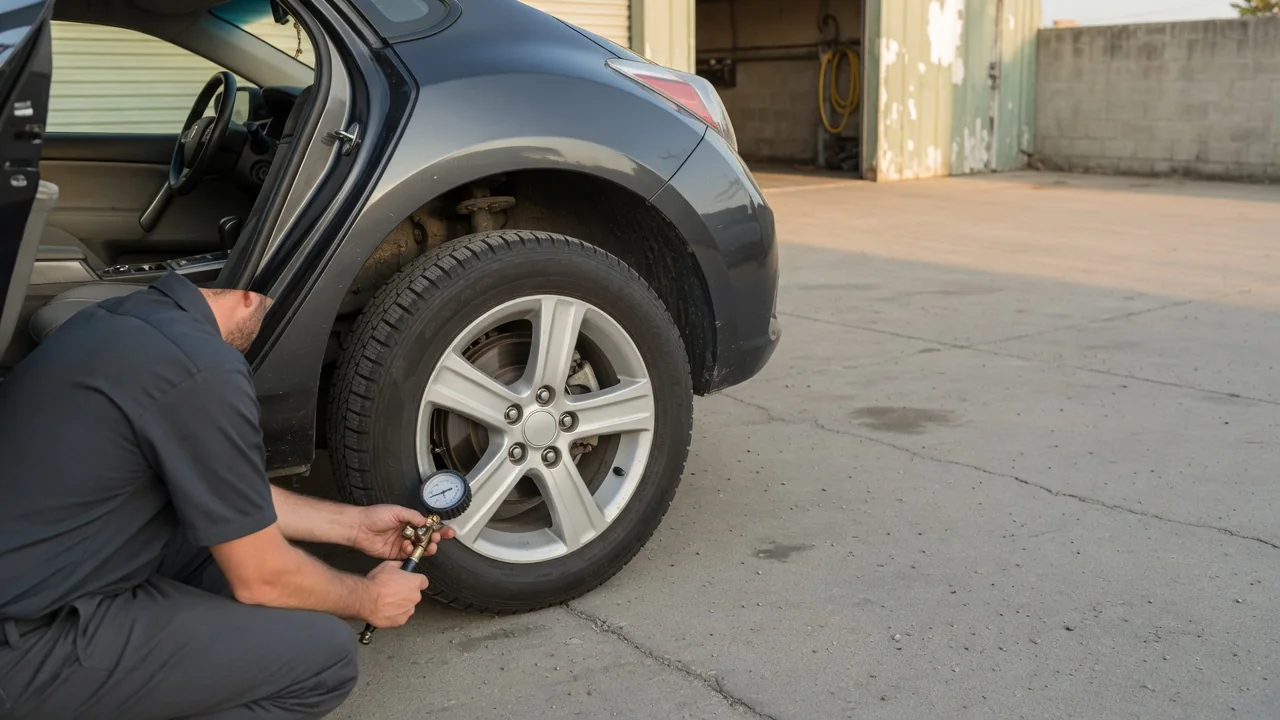
In daily driving, an indirect system stays out of sight until it has something to report. There are no in-wheel sensor batteries to wear out and no valve-mounted sensors to damage during tire mounting, which keeps ownership simple. What the driver gives up is detail: the light only says that something has changed in how a wheel rolls. That makes a handheld gauge a necessary companion, since only a manual check reveals which tire is affected and by how much.
A warning that appears soon after a cold snap, a tire rotation, or a pressure top-up without a reset often points to a stale baseline rather than a puncture, though a gauge should confirm that instead of assumption. A light that returns repeatedly after correct inflation and recalibration suggests a slow leak, such as a nail in the tread or a seeping valve. Because monitoring depends on the anti-lock braking sensors, a fault in that hardware may also disable it, often with a separate malfunction indication.
Limits and Next Steps
The warning light is evidence to interpret, not a diagnosis. When it comes on, the sensible response is to ease off, avoid harsh steering or braking, and stop somewhere safe to look for visible deflation or damage. If nothing is obviously wrong, measure all four pressures with a gauge at the next opportunity, compare them with the placard on the door jamb, correct them, and then recalibrate. Simply resetting the system without checking the tires defeats its purpose and can hide a real problem.
Indirect monitoring supplements routine checks rather than replacing them. Regular gauge readings, especially before long trips, catch the slow, uniform pressure loss that speed comparison can miss, and the spare tire is not covered at all. If the warning persists despite correct pressures and a proper reset, or if brake and stability lights appear alongside it, professional inspection with vehicle-specific diagnostic information is appropriate. Stored codes differ between manufacturers, and a code alone does not prove that any particular component has failed.