What Is Hydrodynamic Lubrication? How Engine Oil Keeps Moving Parts Apart
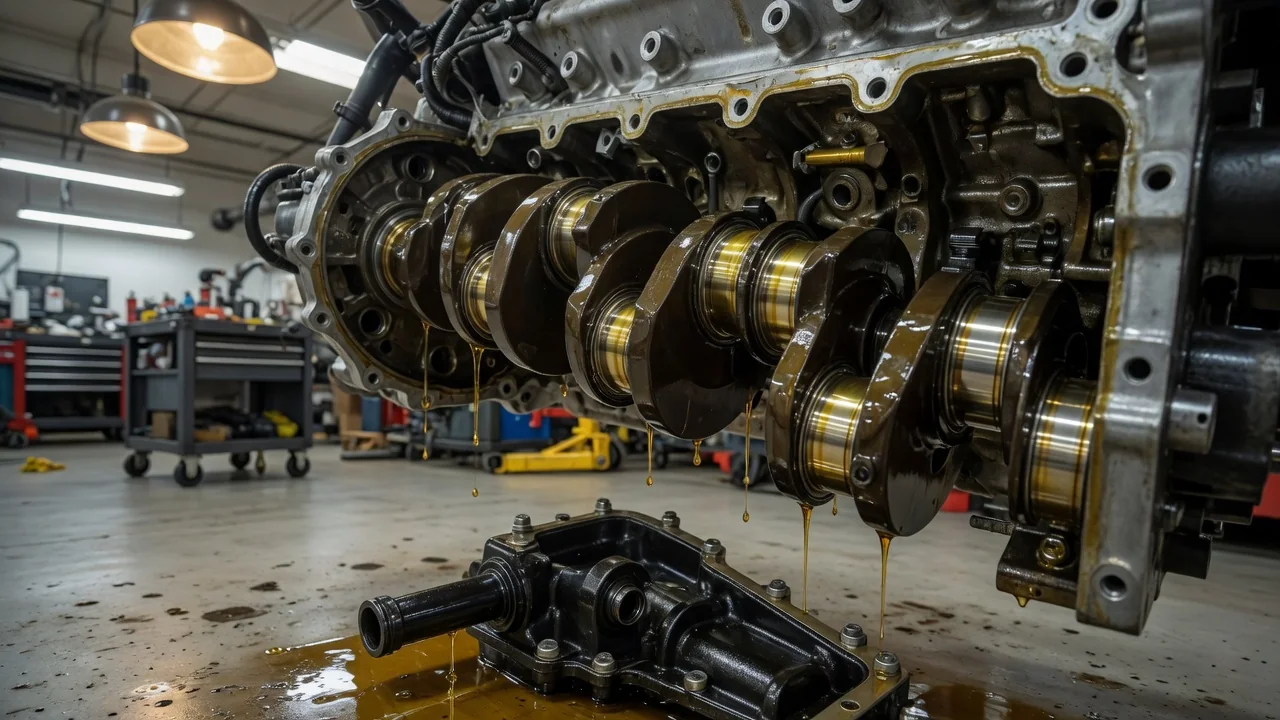
Hydrodynamic lubrication is the condition in which motion between two surfaces drags oil into a narrowing gap and builds enough pressure to hold the parts completely apart. In an engine, this is what keeps the crankshaft from grinding against its bearings while it spins. The principle is simple, but it depends on speed, oil viscosity, load, and clearance working together, and it has real limits, especially in the first moments after the engine starts.
Moving oil wedge
Oil is viscous, so it clings to the surfaces it touches. When one surface slides past another and the gap between them narrows in the direction of motion, the moving surface drags oil into that tapering space. The oil cannot escape as fast as it is being pulled in, so pressure rises inside the gap. That pressure pushes the surfaces apart and carries the load. The shape of the pressurized film is why engineers describe it as an oil wedge. A familiar comparison is a tire hydroplaning on a wet road: speed and a converging gap of water lift the tread off the pavement. In an engine, the same effect is useful rather than dangerous.
The thickness of the film depends on a balance of factors. Higher sliding speed and higher oil viscosity tend to build a thicker film, while heavier load and higher temperature, which thins the oil, tend to make it thinner. Clearance between the parts also matters, because the wedge needs a gap that is small enough to generate pressure but large enough to let oil flow through and carry heat away. An important point is that the oil pump does not create the pressure that holds the parts apart. The pump supplies oil to the gap; the relative motion of the surfaces generates the load-carrying pressure, which can be much higher than the supply pressure shown on a gauge.
When the film is fully established, the metal surfaces do not touch at all. Friction then comes from shearing the oil itself rather than from metal rubbing on metal, and wear in that zone is very low. Engineers distinguish this full-film regime from mixed lubrication, where the highest points of the surfaces occasionally touch through a thin film, and boundary lubrication, where contact is carried mainly by surface layers and additive chemistry. The relationship between these regimes is often shown on a Stribeck curve, which plots friction against a combination of speed, viscosity, and load.
Bearings
The clearest example of engine hydrodynamic lubrication is the plain journal bearing, used for crankshaft main bearings and connecting rod bearings. These bearings are smooth half-shells rather than rolling elements. Under load, the rotating journal does not sit perfectly centered in its bore. It runs slightly offset, which leaves a crescent-shaped gap that narrows on the loaded side. Rotation drags oil into that converging region, the wedge forms, and the journal effectively floats on pressurized oil. Oil reaches the bearing through drilled passages and feed holes or grooves, which are generally positioned so that fresh oil enters away from the highest-pressure part of the film.
Bearing shells are typically made in layers, with a stronger backing and a softer bearing surface. The softer material can embed small debris particles so they are less likely to score the crankshaft, and it can conform slightly to minor misalignment. These properties matter because the shells must survive the moments when the film is not fully formed. Running clearance is equally critical. If it is too tight, oil flow and cooling suffer; if it is too loose, oil escapes too easily, pressure drops, and the film loses some of its load capacity.
Not every lubricated contact in an engine works the same way. Camshaft journals in many engines also run in plain bearings and rely on the same wedge principle. Cam lobes, followers, and gear teeth, however, have concentrated contacts where the load acts on a very small area; they operate in a related regime called elastohydrodynamic lubrication, in which the metal deforms slightly and the oil's viscosity rises sharply under pressure. Piston rings face a different challenge: they stop and reverse direction at each end of the stroke, so their sliding speed briefly drops to zero and the film there tends toward mixed or boundary conditions.
Startup limits
Because the wedge depends on motion, it disappears when the engine stops. With no rotation, the weight of the crankshaft and other parts gradually squeezes oil out of the bearing gap, leaving only a thin residual layer and the protective film that additives leave on the metal. When the engine is cranked, speed is low and oil must travel from the pump through the filter and galleries before it reaches the bearings. For that short interval, parts can run in mixed or boundary lubrication until the full film is rebuilt. Startup is therefore widely regarded as a period of elevated wear compared with steady running.
Temperature changes the picture in both directions. Cold oil is thicker, which would support a robust film once it arrives, but it flows more slowly through passages and clearances, so it can take longer to reach every bearing. This is a major reason multigrade oils are formulated to flow at low temperatures while still providing adequate viscosity when hot. A very hot engine has the opposite issue: the oil is thin, so the film is thinner, although flow is quick.
Startup is not the only situation where the wedge is weak. Shutdown, very low speed under heavy load, and frequent restarts all reduce the time the bearings spend in full-film conditions. In those moments, protection depends less on the oil wedge and more on the anti-wear additives in the oil and on the bearing materials themselves. Hydrodynamic lubrication is highly effective, but it is a running condition, not a permanent state.
Practical implications and limits
For owners, the most direct link to this mechanism is the oil viscosity grade specified by the vehicle manufacturer. That specification reflects the engine's clearances, operating temperatures, and loads, so it is the safest reference for balancing film strength against cold flow and friction. Choosing a grade outside the recommendation can shift that balance in ways that are hard to predict for a particular engine. The exact grade, oil standard, and change interval are vehicle-specific, so the owner's manual or service manual is the authoritative source rather than general rules of thumb.
Oil condition matters as much as oil choice. Hard particles larger than the film thickness can bridge the gap and scratch bearing surfaces, which is why filtration and timely changes are important. Fuel dilution, overheating, and age can lower viscosity or deplete additives, reducing both the full-film margin and the boundary protection that covers startup. Short trips that never let the engine reach full temperature can make contamination more likely, so they deserve attention when following the maintenance schedule.
Driving habits can support the film as well. Avoiding heavy throttle in the first moments after a cold start gives oil time to reach every bearing, and avoiding high load at very low engine speed reduces the conditions that thin the film. A low oil pressure warning means the supply to the bearings may be compromised, so stopping safely and investigating is the prudent response; a knocking sound from the lower engine can indicate bearing damage that needs diagnosis. Keep in mind that an oil pressure reading shows supply, not actual film thickness, so a normal gauge does not prove every bearing is fully protected.