What Is Hybrid Battery State-of-Charge Buffer?
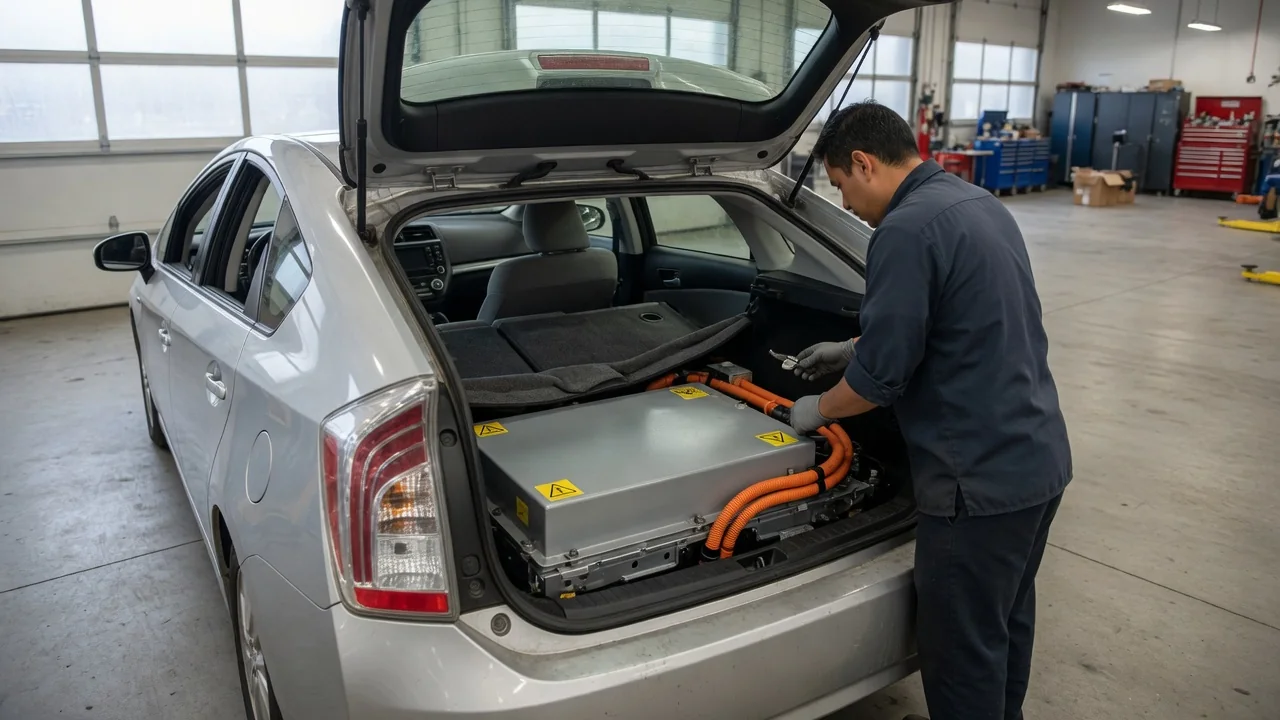
A hybrid battery state-of-charge buffer is the share of the battery's capacity that the vehicle's control system deliberately keeps out of normal use. Instead of cycling the pack from completely empty to completely full, the hybrid controller works inside a narrower window and holds reserves at the top and bottom. This hybrid battery reserve buffer shapes how the system charges and discharges, how long the battery is likely to last, and what the dashboard gauge actually shows.
Operating range: the window the controller actually uses
Every traction battery has a gross capacity, the total energy the cells could store between their absolute limits, and a usable capacity, the part the control system lets the vehicle draw on. The difference between the two is the buffer. The battery management system estimates state of charge continuously, and the hybrid controller decides moment by moment whether to charge the pack with the engine or regenerative braking, discharge it to drive the electric motor, or leave it alone. Those decisions are made against target thresholds inside the gross range, not against the cells' true empty and full points. In a conventional, non-plug-in hybrid the working band tends to be relatively narrow and sits around the middle of the pack. Plug-in hybrids typically use a much wider window in electric mode before switching to charge-sustaining operation, which behaves like a conventional hybrid around a lower reserve. Exact thresholds vary by manufacturer, chemistry and software, and they are generally not published in a form owners can verify.
Both ends of the buffer have a functional job. The lower reserve keeps enough energy available for tasks the system cannot afford to lose, such as starting the engine through the motor-generator in designs that work that way, supplying short bursts of electric assist, and powering high-voltage loads while the engine is off. The upper reserve leaves headroom to absorb regenerative braking energy; if the pack were held near full, there would be nowhere to put the energy recovered when slowing down. The buffer also covers uncertainty. State of charge cannot be measured directly; it is estimated from current flow, voltage, temperature and models of cell behavior, and those estimates drift. A margin on each side keeps an estimation error from pushing real cells past their safe limits.
Longevity: why the buffer protects the pack
Battery cells age faster when they spend time at, or are cycled to, the extremes of their charge range. In general terms, sitting at a very high state of charge, especially when warm, accelerates chemical side reactions inside many lithium-ion cells, while very deep discharge can stress electrodes and, in some chemistries, cause damage that is hard to reverse. Nickel-metal hydride packs, still common in hybrids, have their own sensitivities to overcharge, heat and deep discharge. Keeping the cells inside a moderate band and favoring many shallow cycles over fewer deep ones is a widely used way to reduce wear. A hybrid may go through a very large number of small charge and discharge events in ordinary driving, so limiting the depth of each one matters over the life of the vehicle.
The buffer also interacts with cell balancing and capacity fade. A pack is made of many cells or modules that never age at exactly the same rate. The weakest group reaches its limits first, and the management system has to respect that group, so margins help keep mismatched cells within safe voltage. As the pack loses capacity over the years, the same nominal window holds less real energy. Depending on how a given system is designed, that can show up gradually as more frequent engine running, less electric assist or reduced regenerative capture rather than as a sudden change. Because the buffer is a design choice made for durability and safety, it is not wasted capacity in the usual sense; it is part of what the manufacturer budgets to meet its service-life targets.
Display: what the gauge is really showing
The battery gauge on a hybrid's instrument cluster or center screen typically represents the usable window, not the gross capacity of the pack. When the display shows the battery as empty, the cells still hold the lower reserve; when it shows full, the upper reserve remains unused. Many systems rescale the controller's working range into a simple bar graph or percentage, which is why the indicator in a conventional hybrid can rise and fall noticeably during a short drive. The battery is not filling and emptying completely; small movements within a narrow band are being stretched across the whole gauge.
This difference becomes visible when owners compare the dashboard with a diagnostic scan tool. A tool reading the battery management system may report a state-of-charge value that does not match the gauge at all, because it shows the controller's estimate against the gross range rather than the rescaled figure. Neither number is necessarily wrong; they describe different things. In plug-in hybrids the same logic applies to electric range: a display showing no electric range left usually means the charge-depleting portion is used up and the vehicle has moved to hybrid operation around its reserve, not that the high-voltage battery is flat.
Practical implications and limits
For everyday driving, the buffer explains several behaviors that can otherwise look like faults. The engine may start while the vehicle is parked or stopped in traffic because the controller wants to bring the charge back to its target band. On a long downhill grade, regenerative braking may weaken once the upper limit is reached, and the friction brakes or engine braking take over more of the work. In cold or very hot conditions the system may restrict the power it allows into or out of the pack, so electric assist and regeneration can feel reduced even when the gauge looks normal. These responses come from the same protective logic and are generally expected rather than signs of failure.
There are limits to what an owner can do with this information. The buffer is set in software and is not normally adjustable through the vehicle's settings, and modifying it with third-party tools can affect durability, warranty coverage and safety margins in ways that are hard to predict. Displayed charge levels are not a reliable indicator of battery health on their own; capacity tests, module voltage comparisons and stored diagnostic data give a clearer picture and are usually handled with service equipment. After battery replacement or repair, some systems may need time or a specific procedure to relearn their state-of-charge estimate. For the thresholds, behaviors and service procedures of a particular vehicle, the owner's manual and the manufacturer's service information remain the authoritative sources.