What Is Horsepower in a Car?
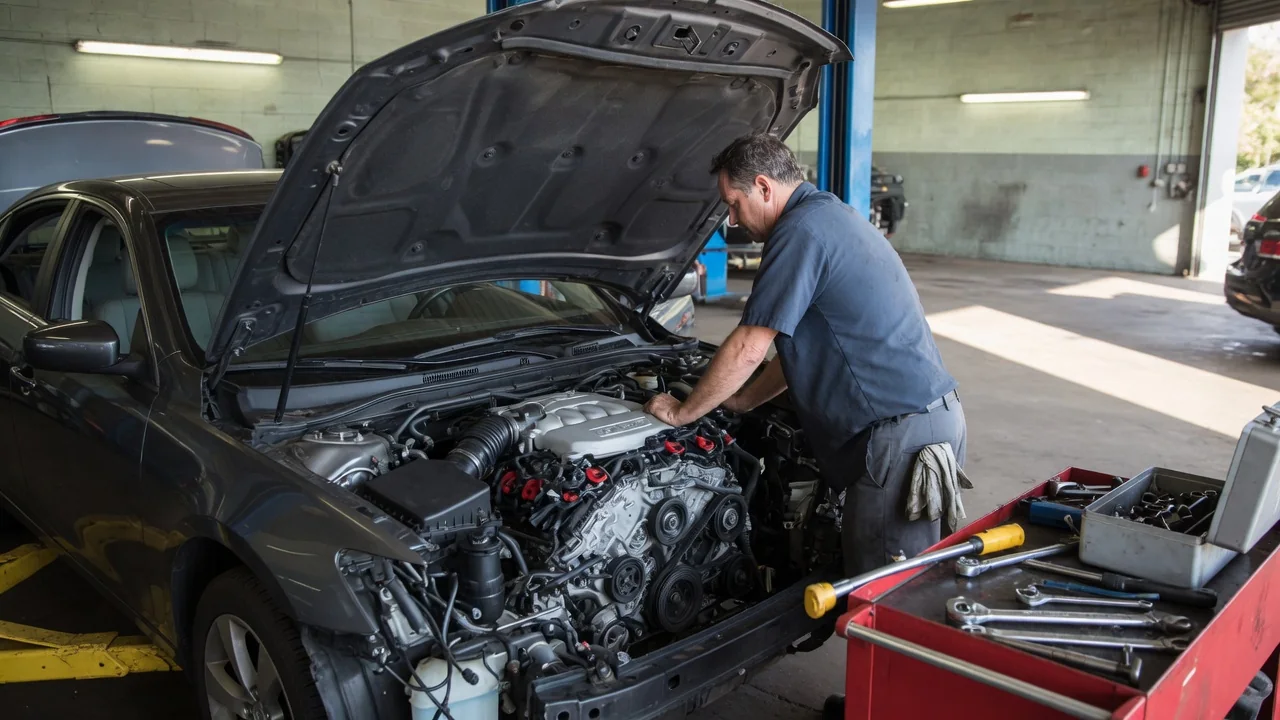
Anyone asking what is horsepower in a car is really asking how quickly an engine or motor can do work. Horsepower is not a measure of raw force; it describes the rate at which force moves a vehicle over distance. That rate changes with engine speed, which is why the same car can feel lazy at one moment and urgent the next.
Power concept
Work, in physical terms, is force applied across a distance, and power is how fast that work gets done. Lifting a heavy crate onto a loading dock takes the same work whether it happens in two seconds or twenty, but the quicker lift demands far more power. A car follows the same rule: moving its mass up a hill requires a fixed amount of work, and horsepower determines how quickly the drivetrain can deliver it.
The unit itself dates to the era of steam engines, when output was compared with the pulling ability of draft horses, and it remains the common rating in the United States alongside kilowatts. Drivers experience it as the ability to keep accelerating as speed rises, to merge briskly, or to hold pace on a long grade. Published ratings differ by measurement standard and by whether output is taken at the crankshaft or the wheels, so figures from different sources are not always directly comparable.
Engine speed
Torque is the twisting force at the crankshaft, and horsepower is that torque multiplied by how fast the shaft is spinning. An engine making modest torque at high revolutions per minute can therefore produce more power than one making strong torque at low speed. This is why a combustion engine's rated horsepower usually arrives well up the rev range, where each minute contains many more combustion events contributing work, even though the force of each individual push may have started to fade.
Delivery changes with engine speed because breathing and friction change too. At low rpm the cylinders fill well but work is done infrequently; at very high rpm, airflow restrictions, valve timing limits, and internal friction reduce torque faster than rising speed can compensate, so power levels off and drops. Turbocharged engines, diesels, and electric motors each shape this relationship differently, with electric motors typically offering strong torque from a standstill and a broad span of steady power, so behavior varies considerably by powertrain design.
Reading a curve
A dynamometer chart plots torque and power against engine speed, and reading it reveals more than a single peak figure. The horizontal axis shows rpm, while the lines show how much twisting force and how much power are available at each point. When torque is in pound-feet and power in horsepower on the same scale, the two lines cross at a fixed engine speed a little above five thousand rpm, a result of the unit math rather than any trait of the engine.
The shape matters as much as the height. A broad, flat curve means useful power across a wide range, so the car pulls consistently without frequent downshifts. A narrow, peaky curve rewards keeping the engine spinning near its upper range and can feel weak elsewhere. The area under the curve between shift points is a better guide to real acceleration than the peak number alone, and charts from different dynos or correction methods should be compared cautiously.
Everyday Use and Observations
On the road, most driving uses a small fraction of rated output. Cruising at a steady highway speed only requires enough power to overcome aerodynamic drag, rolling resistance, and drivetrain losses. The full figure matters during hard acceleration, passing, towing, or climbing, when the transmission downshifts to raise engine speed toward the region where more power is available. That kickdown, with the tachometer needle jumping and the engine note rising, is the gearbox trading gearing for access to horsepower.
Vehicle weight and gearing shape how a given rating feels. A light car with moderate output can accelerate more eagerly than a heavy truck with a larger number, because each horsepower has less mass to move. Aerodynamic drag also grows steeply with speed, so the power needed to gain each additional increment climbs rapidly, which is why acceleration tapers at higher speeds. Altitude, heat, cargo, and the transmission's shift programming all influence what a driver notices, and these effects differ between vehicles.
Limits and Next Steps
A horsepower rating has limits as a predictor. It says nothing directly about traction, gearing, weight, or how quickly a transmission responds, and it describes one point on a curve under controlled test conditions. Two cars with identical peak figures can perform very differently if one carries more mass or delivers its power in a narrower band. Ratings also do not indicate fuel economy, durability, or towing capability, which depend on cooling, chassis, and driveline design as well as engine output.
For a fuller picture, look at the rating alongside peak torque, the engine speeds at which both occur, curb weight, and transmission type in the manufacturer's published specifications. A test drive that includes a highway merge and a hill shows how accessible the power is in practice. If a vehicle feels noticeably weaker than it once did, that is a reason for a qualified diagnosis rather than an assumption, since reduced output can stem from many causes that require vehicle-specific testing to identify.