What Is EV Charging Power Sharing? Site Capacity, Multiple Cars and Speed
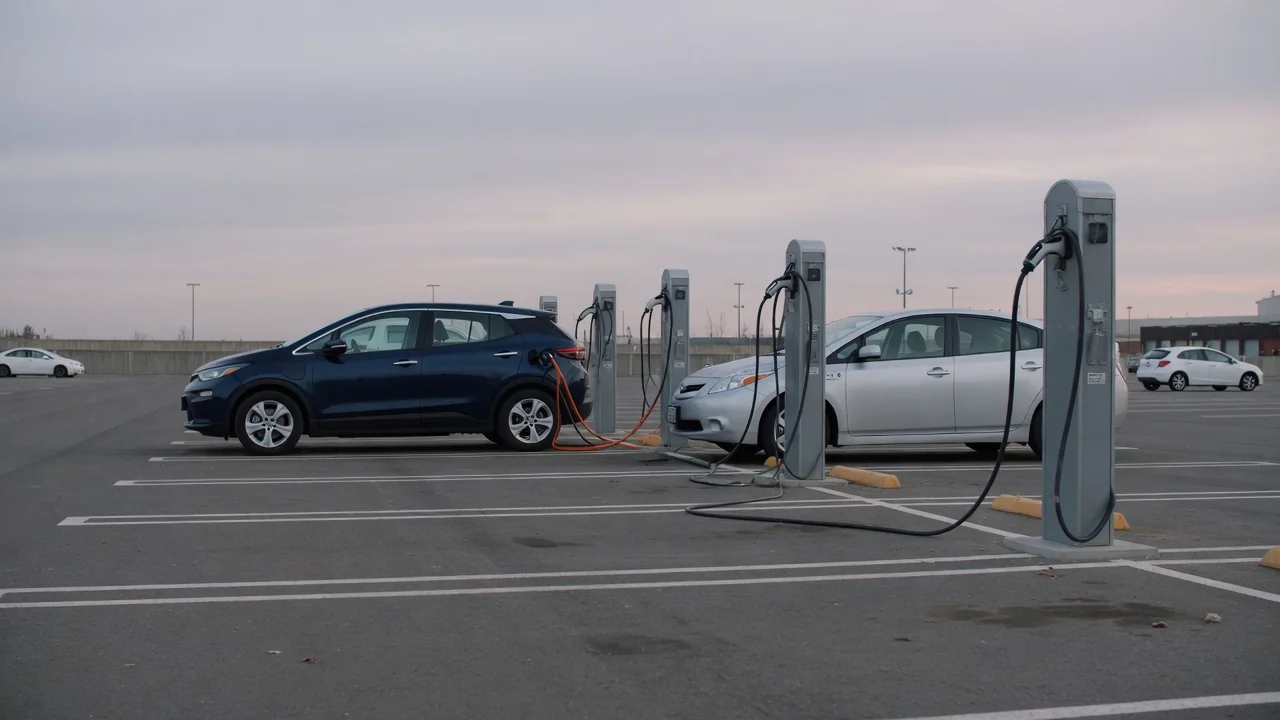
EV charging power sharing divides a limited supply of electrical power among two or more charging points so the total draw never exceeds what the site can safely deliver. Instead of giving every charger its full rated output at all times, a controller adjusts how much current each connected vehicle is offered. The approach is used in home garages with two EVs, workplaces, apartment buildings and public stations. It affects both how many cars can plug in at once and how fast each one charges.
Site capacity: the limit power sharing works within
Every charging location has a ceiling set by its electrical supply: the utility service, the main panel, the feeder conductors and the circuit breakers that protect them. In the US, EV charging is generally treated as a continuous load, so a circuit is typically sized to keep the charger's sustained current at or below 80 percent of the breaker rating. When several chargers would together exceed the site's ceiling, there are two broad options. One is to upgrade the supply, which can mean new wiring, a larger panel or utility work. The other is to install equipment that shares the capacity already available. Power sharing is the second option. It does not create more electricity; it manages the existing amount so the protective devices are never overloaded.
Sharing schemes are usually described as static or dynamic. A static arrangement assigns a fixed total limit to a group of chargers, often on a single shared circuit, and splits it among whichever ports are in use. A dynamic arrangement, often called dynamic load management, also measures other loads on the site, typically with current sensors on the main supply, and lowers charging current when air conditioning, an electric range or other building equipment is drawing heavily. Dynamic systems can make better use of spare capacity, but they depend on accurate metering and on the site limit being configured correctly during installation.
Multiple vehicles: how the available power is divided
When only one car is plugged into a shared group, it can usually receive up to its charger's full allowance, provided the site limit permits it. When a second or third vehicle connects, the controller recalculates and reduces each port's allocation so the group total stays within bounds. With AC Level 2 equipment, this is done through the control pilot signal defined in the SAE J1772 standard. The station advertises a maximum current to the vehicle, and the vehicle's onboard charger is expected to stay below it. Changing the advertised value is how the station throttles a car without interrupting the session.
How shared EV charger power is divided depends on the system. Common approaches include an equal split among active ports, first-come priority where the earliest connected vehicle keeps more power, and priorities set by the user or operator, such as favoring a fleet vehicle that must leave soon. Better controllers also reassign power a vehicle is not using. A car whose battery is nearly full, or whose onboard charger accepts less than its share, draws less than it is offered, and that unused current can be redirected to other ports. Networked commercial chargers often handle this through a central management platform, while some home units coordinate directly with a paired second unit.
DC fast charging uses a similar idea in a different form. Some installations rely on a central power cabinet built from modules that can be switched between several dispensers. A vehicle charging alone may receive a large share of the cabinet's output, while two vehicles at neighboring stalls split it between them.
Speed: what sharing means for charging time
Charging speed is set by the lowest of several ceilings: the power the station offers, the capacity of the vehicle's onboard charger during AC charging, the battery's acceptance at its current state of charge and temperature, and, under sharing, the portion of site capacity assigned to that port. Power sharing affects only the station side. If a car's onboard charger is already the bottleneck, a modest reduction in offered current may make no difference. If the shared allocation drops below what the car could accept, the session slows in proportion to the lost power.
Because energy delivered equals power multiplied by time, a vehicle receiving half the power needs roughly twice as long to add the same energy, ignoring small differences in efficiency. In practice, the effect is often milder than this worst case. Vehicles plugged in overnight or during a workday usually have more time than they need, and dynamic systems can raise each car's share again when another vehicle finishes or when building demand falls. With DC charging, battery charging curves taper as state of charge rises, so a car near the end of its session may naturally free up power for a newcomer.
Practical implications and limits
For owners and property managers, the main benefit is that more charging points can often be added to an existing electrical service without immediately paying for a service upgrade. The trade-off is predictability. A driver using a shared port cannot assume the rated output printed on the unit; arrival time, other users and building load all influence the result. Apps or station displays that show the current actually being delivered help set expectations, but they report conditions at that moment rather than guaranteeing a finish time.
Power sharing also has engineering boundaries. Chargers generally need to be compatible before they can coordinate, which often means the same brand or a management system supporting a common protocol such as OCPP. The site limit must match the real wiring and breaker; a wrong value can either waste capacity or defeat the protection the system is meant to provide. Communication failures are another consideration, and well-designed equipment falls back to a conservative current rather than drawing its maximum. Finally, sharing cannot help when every vehicle needs a full charge in a short window. In that case, adding supply capacity is the only way to raise total throughput, so a qualified electrician should assess the site before choosing between sharing and an upgrade.