What Is EV Charging Efficiency?
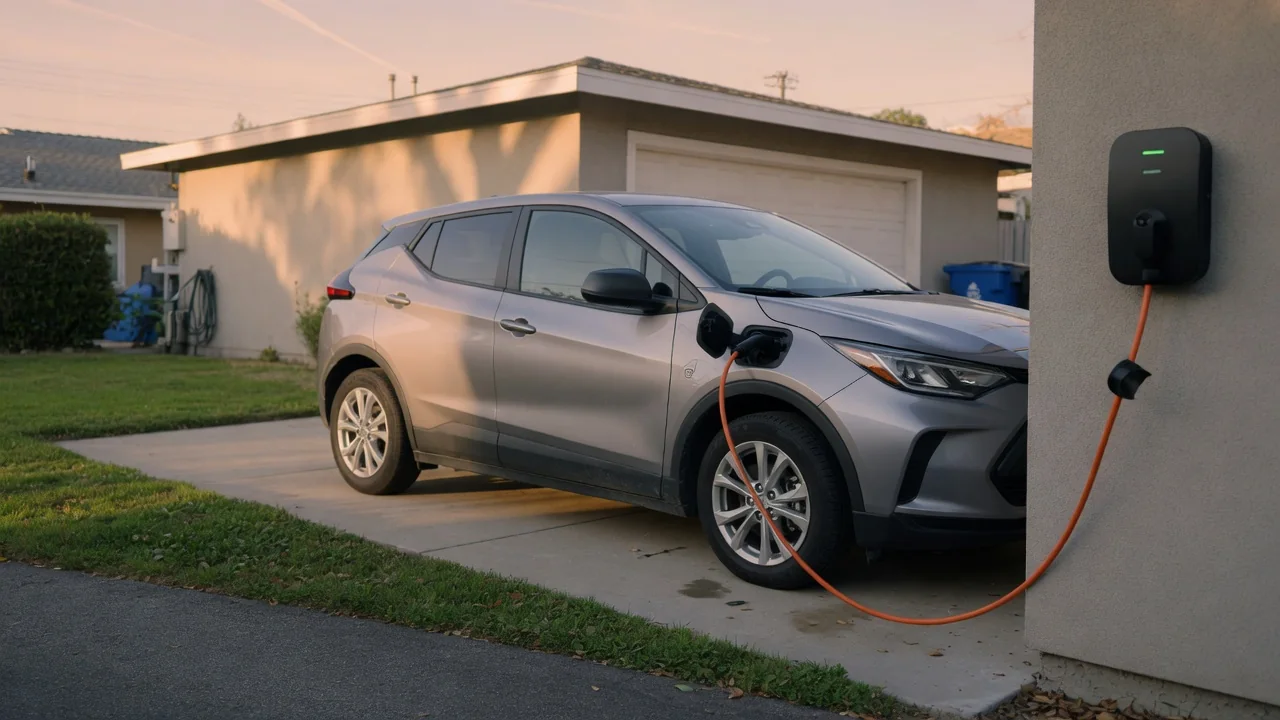
Anyone asking what is EV charging efficiency is really asking how much of the electricity drawn from the wall ends up stored in the battery. The two figures never match exactly, because energy is lost as heat in electronics and cables and consumed by the car's own systems during a session. Understanding where that energy goes makes charging bills and dashboard readouts easier to interpret.
Conversion losses
Household and public Level 2 outlets supply alternating current, while a battery pack stores direct current. During AC charging, the onboard charger inside the vehicle rectifies and regulates that power, and every stage of the conversion sheds a little energy as heat. Additional resistance losses occur in the charging cable, the connector contacts, and the wiring between the charge port and the pack. The battery itself adds a final loss, because its internal resistance turns part of the incoming current into warmth rather than stored chemical energy.
With DC fast charging, the conversion hardware sits in the station rather than in the car, so a meter on the station's output side may not capture the losses that happened upstream. Drivers can sometimes notice the evidence directly: a warm cable handle, a humming cooling fan, or a charger housing that feels warm to the touch. How large the losses are depends on the onboard charger design, the charging power selected, and the supply voltage, so figures quoted for one model should not be assumed for another.
Heating or cooling
Lithium-ion cells accept charge best within a moderate temperature window, so the battery management system often runs thermal hardware while the car is plugged in. In cold weather, a pack heater or heat pump may warm the cells before or during charging, and that energy passes through the wall meter without ever raising the state of charge. In hot conditions or during high-power sessions, coolant pumps, chillers, and radiator fans work to remove heat, drawing power in the same unrecorded way.
The effect is most visible on a winter morning, when a session can deliver noticeably more energy from the outlet than the battery gain suggests. Preconditioning the cabin while plugged in adds to the gap, since the climate system is fed from the same supply. Owners may hear the compressor or fans running in a quiet garage. Thermal strategy differs widely between manufacturers; some vehicles lack active liquid temperature control altogether, and others heat the pack aggressively before a fast-charging stop.
Interpreting displays
Different screens measure energy at different points, which is why they rarely agree. A home wall unit or utility meter typically reports what left the supply, while the vehicle's display or companion app may report energy added to the battery, or sometimes energy received at the charge port. Comparing the two figures for the same session gives a rough efficiency: battery energy divided by wall energy. Knowing which point each device measures is essential before drawing any conclusion from the difference.
State-of-charge percentages add another layer of uncertainty. The percentage shown is an estimate calculated by the battery management system, and it usually refers to usable capacity rather than the full pack, with a buffer held back at the top and bottom. Multiplying a percentage gain by an advertised battery size can therefore mislead. Trip computers that show consumption per mile commonly count only energy leaving the battery while driving, so charging losses are missing from that figure unless the manufacturer states otherwise.
Everyday Use and Observations
In routine ownership, the choice of charging power shapes how much is lost. The car's computers, contactors, and pumps stay awake for the entire session and draw a roughly fixed amount of power, so a slow charge from a standard household outlet lets that overhead run for many hours and take a larger share of the total. A higher-power Level 2 circuit usually shortens the session and dilutes the overhead, although the outcome depends on the vehicle's onboard charger and the installation.
Seasonal patterns are easy to observe with a simple log. Recording the wall-side energy and the reported battery gain for each session often shows efficiency falling in cold months and recovering in mild weather. Parking in a garage, charging soon after a drive while the pack is still warm, and scheduling preconditioning sensibly can all narrow the gap. For budgeting, the cost of running the car is best calculated from wall energy, since that is what the utility actually bills.
Limits and Next Steps
No charging system returns every unit of electricity it draws, so some gap between wall and battery energy is normal rather than a sign of trouble. Home comparisons are also limited by measurement accuracy: plug-in meters, charger apps, and vehicle displays each carry their own tolerances and rounding. A single session is weak evidence, particularly a short top-up where fixed overhead dominates or one that ends near full, when the charge rate tapers and cell balancing may extend the session.
What deserves attention is a clear change from the vehicle's own established pattern under similar conditions, rather than a difference from someone else's numbers. A sudden drop in apparent efficiency, repeated interrupted sessions, a discolored or very hot plug, or charging warnings on the dash justify having the outlet and circuit inspected by a qualified electrician and the vehicle checked by a technician trained in high-voltage systems. The owner's manual and the manufacturer's published information remain the right references for model-specific charging behavior.