What Is EV Battery Preconditioning?
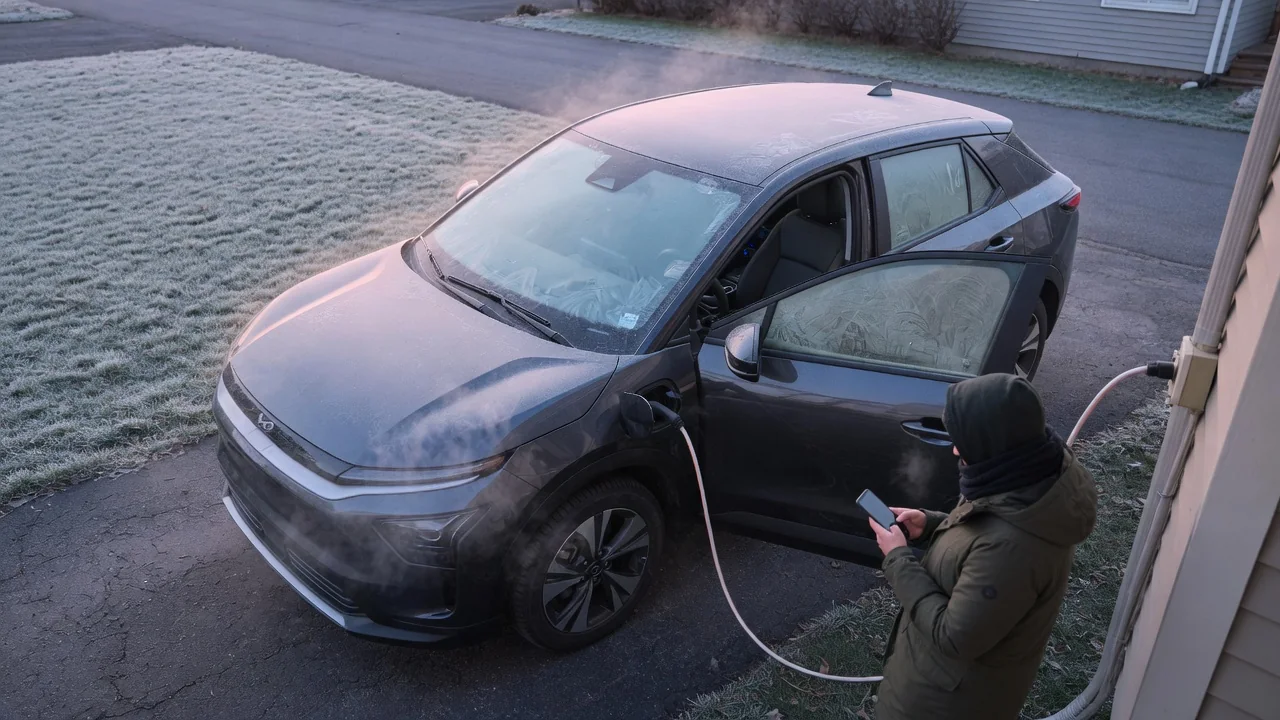
Drivers who ask what is EV battery preconditioning are really asking how an electric vehicle prepares its battery pack for the work ahead. Preconditioning brings the pack toward a temperature range where it can accept a fast charge or deliver power efficiently. The vehicle does this on its own schedule or on request, using heat or cooling before you plug in or pull away.
Heating and cooling
Lithium-ion cells are sensitive to temperature. When a pack is cold, the chemical reactions inside slow down, internal resistance rises, and the battery management system limits how much current the cells may accept or release. Preconditioning addresses this by warming the pack before a charging session or a drive. Depending on the vehicle, the heat may come from a dedicated electric heater in the coolant loop, a heat pump, or waste heat deliberately generated by the motor and power electronics and routed through the battery's liquid circuit.
Cooling is the other half of the process. After sustained highway driving in hot weather, a pack can arrive at a charger already warm, and fast charging adds more heat. A preconditioning routine may then run the chiller and coolant pumps to pull the temperature down so the charging session can sustain higher power for longer. Drivers may hear pumps, fans, or the air conditioning compressor running while parked or approaching a station. Hardware differs widely between models, and some vehicles with simpler thermal systems offer only limited conditioning.
Navigation triggers
In many electric vehicles, the most common trigger for preconditioning is the built-in navigation system. When a driver sets a fast charging station as the destination or as a stop along a route, the car estimates arrival time and current pack temperature, then begins heating or cooling at a point calculated to have the battery ready on arrival. This is why owners are often advised to route to a charger through the vehicle's own navigation rather than a phone app that the car cannot read.
The details depend heavily on the manufacturer and software version. Some vehicles display a message or icon confirming that the battery is being prepared for fast charging, while others do it silently. Certain models add a manual button in the charging or battery menu so preconditioning can be started without a destination. Others tie it to scheduled departure times set in the vehicle or its companion app. Because smartphone projection systems do not always share destination data with the car, checking the owner's manual for the supported trigger methods is worthwhile.
Energy tradeoffs
Preconditioning is not free. Warming a large, heavy battery pack takes a meaningful amount of electricity, and when the car is not plugged in, that energy comes from the pack itself. A driver may see the range estimate fall faster than usual during the final stretch before a charging stop on a cold day. The return on that investment is a shorter charging session, because a pack at a suitable temperature can accept higher power from the moment the connector locks in rather than ramping up slowly.
Whether the trade is worthwhile depends on the situation. Before a high-power DC fast charge on a road trip, spending some energy to save significant time at the station usually makes sense. Before slow overnight charging at home, intense heating offers little benefit, since low charging power is far less limited by temperature. When the vehicle is plugged in before departure, conditioning can draw from the grid instead of the pack, preserving driving range. On short trips, the heating energy may never be recovered through efficiency gains.
Everyday Use and Observations
In daily driving, the effects of a cold, unconditioned pack are easy to notice. Regenerative braking may be reduced or unavailable at first, so the car coasts more freely and relies more on the friction brakes, often with a dashboard indicator showing limited regeneration. Available acceleration may be capped, and energy consumption runs higher until the pack warms. Preconditioning before departure, particularly while plugged in, can restore more normal regeneration and power from the first mile and is often paired with warming the cabin.
At the charger, the difference shows up in the power figure on the station display or the vehicle's screen. A properly prepared pack tends to reach its higher charging rates quickly, while a cold one may sit at a fraction of the station's capability for much of the session. Owners can also watch for conditioning icons, a battery temperature readout where one is provided, or the sound of thermal hardware operating. Not every vehicle exposes this information, so the charging curve itself is often the clearest evidence.
Limits and Next Steps
Preconditioning has practical limits. A short drive to the charger may not give the system enough time to bring a deeply cold pack up to temperature, so charging still starts slowly. Many vehicles also suspend or decline conditioning when the state of charge is low, protecting the remaining range for reaching the station. In extreme cold or heat, the thermal system may be unable to reach its target at all. The charger's own output, the pack's state of charge, and the car's charging curve continue to cap speed regardless.
The sensible next step is to learn how a specific vehicle handles the feature. The owner's manual and in-car menus explain whether conditioning is automatic, manual, schedule-based, or absent, and software updates sometimes change that behavior. If charging stays unusually slow despite proper preparation, or warnings appear about the battery or its cooling system, the cause could lie with the station, the conditions, or the vehicle, and a qualified technician should evaluate it. High-voltage battery and coolant components are not suitable for owner disassembly or improvised repair.