What Is Engine Knock? Abnormal Combustion, Detection and Response
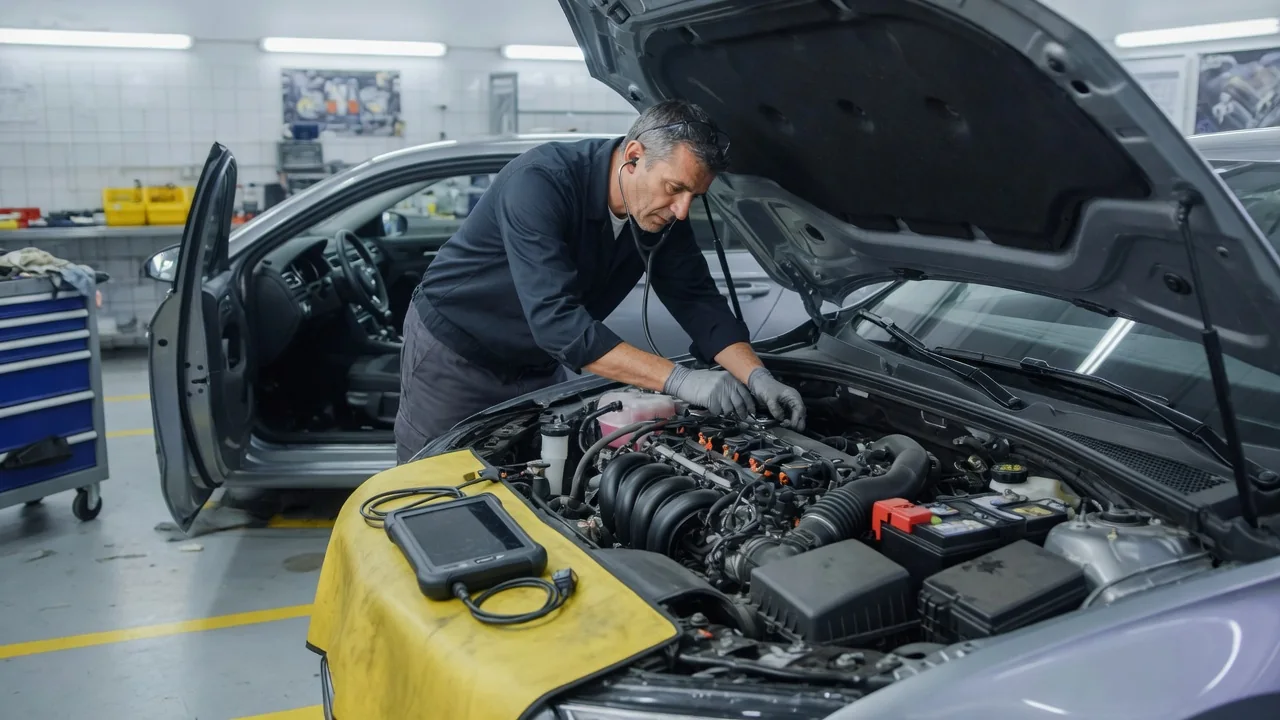
Engine knock is abnormal combustion in a spark-ignition engine. Part of the air-fuel mixture ignites on its own instead of burning smoothly from the spark plug's flame front. The result is a sudden, sharp pressure spike inside the cylinder, often heard as a metallic pinging or rattling under load. This engine knock combustion explanation covers why the pressure rise becomes abnormal, how modern engines detect it, and what the control system does in response.
Abnormal Pressure Rise in the Cylinder
In normal combustion, the spark plug fires near the end of the compression stroke. It starts a flame front that travels across the chamber in an orderly way. As the burned gas expands, cylinder pressure climbs smoothly and peaks shortly after the piston passes top dead center, pushing the piston down with a steady force. The unburned mixture ahead of the flame, called the end gas, is squeezed and heated by two things: the rising piston and the expanding burned gas behind the flame front.
Knock happens when the end gas autoignites before the flame front arrives. Instead of burning progressively, a pocket of mixture releases its energy almost all at once. That causes a rapid local pressure rise and pressure waves that bounce around the combustion chamber. The waves make the cylinder walls, head and block resonate, which produces the characteristic pinging sound. Because the pressure rise is so abrupt, it also disrupts the thin insulating layer of gas next to metal surfaces. That increases heat transfer into the piston crown, ring lands and cylinder head.
Several conditions make end-gas autoignition more likely: high compression or boost pressure, ignition timing that is too far advanced, high intake air or coolant temperature, lean mixtures, carbon deposits that raise effective compression or create hot spots, and fuel with less resistance to autoignition than the engine was designed for. A fuel's octane rating describes exactly this resistance. Knock is different from preignition, where a hot surface ignites the mixture before the spark fires. It is also different from mechanical noises such as worn connecting rod bearings, which people sometimes call knocking but which have nothing to do with combustion.
How Knock Is Detected
Most modern gasoline engines use one or more knock sensors mounted on the engine block or cylinder head. A typical knock sensor is a piezoelectric device that produces a small voltage when vibration shakes it. The pressure waves from knocking combustion set up structural vibrations at frequencies tied to the engine's combustion chamber geometry. In effect, the sensor listens for that signature through the metal of the engine.
The raw sensor signal also contains other noise, including valves closing, injectors operating, pistons moving and accessory drives. To separate knock from that background, the engine control module filters the signal to the relevant frequency band. It examines the signal only during a defined crankshaft angle window after each cylinder fires. Because the module knows which cylinder is burning at that moment, it can often attribute knock to an individual cylinder. It compares the processed signal against a reference level for the current speed and load, and it flags a knock event when the signal exceeds that threshold.
Other detection methods exist. Some engines measure ionization current through the spark plug after firing, since that current changes in a recognizable way during knock. In engine development work, in-cylinder pressure transducers measure the pressure trace directly, but they are mainly used for testing and calibration. Whatever the method, detection relies on calibration specific to each engine design, so exact strategies vary between manufacturers.
How the Engine Responds to Knock
The main response is to retard ignition timing. Firing the spark later lowers peak cylinder pressure and temperature, which gives the end gas less chance to autoignite before the flame front consumes it. When the module detects knock, it typically pulls timing quickly, often only on the affected cylinder. Once knock stops, it advances timing back in small steps. This cycle lets the engine run close to the knock limit, where efficiency and power are usually best, without staying in the damaging region.
Many engines also use adaptive learning. If knock keeps recurring, the module can shift its overall timing toward a more conservative baseline, which helps when the fuel has a lower octane rating than the calibration expects. Turbocharged engines may also reduce boost pressure. Some strategies enrich the mixture under heavy load, because the extra fuel cools the charge. All of these measures give up some power and fuel economy in exchange for protection. If the knock sensor circuit itself fails, many systems fall back to fixed, conservative timing and store a diagnostic trouble code. That code may also turn on the malfunction indicator lamp.
Practical Implications and Limits
For owners, the most direct way to stay within the engine's knock control range is to use the fuel grade specified in the owner's manual. Higher octane fuel than required typically offers little or no benefit unless the engine's calibration can use it. Lower octane fuel in an engine that requires premium may cause continuous timing retard, cutting performance and efficiency even when no noise is audible. Whether a particular engine tolerates lower octane fuel is a vehicle-specific question that only the manufacturer's documentation can answer.
Knock control has limits. A sensor can only report what it detects, and timing can only be retarded so far before power loss and exhaust heat become unacceptable. Persistent audible pinging under acceleration therefore suggests that something is pushing the engine beyond what its control strategy can handle. Possible causes include heavy carbon buildup, an overheating cooling system, a lean condition from a vacuum leak or fuel delivery problem, a faulty exhaust gas recirculation system, incorrect spark plugs, or a failed knock sensor. Prolonged severe knock can damage pistons, ring lands, head gaskets and bearings.
It also helps to know what knock control does not cover. Preignition happens before the spark, so retarding timing cannot correct it. This includes the low-speed preignition that can affect some downsized, direct-injected turbocharged engines; manufacturers address that through calibration, hardware and oil specifications. A deep knocking sound from the bottom of the engine usually points to mechanical wear, not combustion. A scan tool that shows knock retard or knock counts can help confirm whether combustion knock is actually present, but reading those values correctly depends on the specific engine's normal ranges.