What Is Differential Fluid?
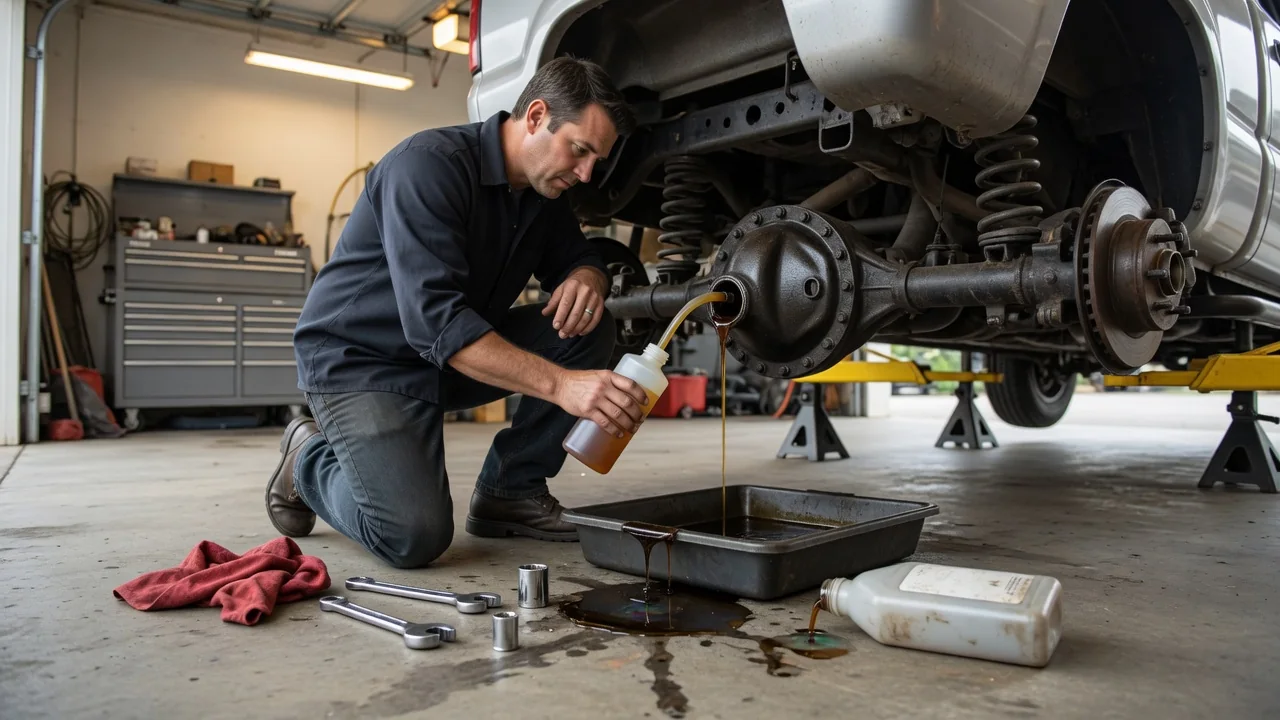
Anyone asking what is differential fluid is really asking how an axle survives its own workload. It is the gear oil held inside the final drive housing, where it coats the ring and pinion, the smaller internal gears, and the bearings that support them. Without that film, the parts that turn engine torque into wheel rotation would grind metal against metal.
Gear contact
Inside a typical final drive, a small pinion gear turns a much larger ring gear, changing the direction of rotation and multiplying torque before it reaches the axle shafts. Many of these gearsets use a hypoid design, where the pinion sits below the ring gear centerline. That layout makes the teeth slide across each other as well as roll, which puts intense pressure on a very small contact patch. Differential fluid has to stay between those surfaces even when the load tries to squeeze it out.
That is why gear oil is formulated differently from engine oil. It is usually thicker and carries extreme pressure additives that react with the metal surface to form a sacrificial protective layer when the oil film gets very thin. The same fluid also lubricates the spider and side gears that let the left and right wheels turn at different speeds in a corner. Limited slip units with clutch packs may need friction modifiers, so the correct specification depends on the axle design the manufacturer chose.
Heat
Sliding gear contact generates heat, and the differential has no radiator of its own in most vehicles. The fluid does the cooling work by picking up heat at the tooth faces and bearings, then carrying it to the housing as the ring gear slings oil around the inside of the case. The metal housing sheds that heat to passing air. Some axles have finned covers, and some heavy duty or performance applications add a dedicated cooler, but many rely on the housing alone.
Workload changes how hard that cycle is pushed. Towing a trailer, hauling a full bed, climbing long grades, or sustained high speed driving all raise axle temperatures well above what a light commute produces. Repeated high heat thins the oil, breaks down its additives, and darkens it over time, leaving less protection at the gear teeth. A vent on the housing lets expanding air escape as temperatures rise, and if that vent clogs, pressure can push fluid past the seals instead.
Service context
Differential fluid is not a lifetime fill in every vehicle, though the schedule varies widely. Some manufacturers list a change interval in the maintenance guide, others shorten it for severe use such as towing or off-road driving, and a few specify inspection only. Because there is no filter in most axles, fine metal worn from the gears stays suspended in the oil or collects on a magnetic drain plug. Changing the fluid removes that material along with oil that has lost its additive strength.
The number of fluids involved also depends on the drivetrain. A rear wheel drive truck has one rear differential, while four wheel drive and all wheel drive vehicles add a front differential and usually a transfer case, each with its own requirements. Many front wheel drive cars house the differential inside the transaxle, where it shares the transmission fluid rather than using separate gear oil. The owner's manual or service information for the specific vehicle is the reliable guide to type, viscosity, and capacity.
Everyday Use and Observations
Most drivers never see this fluid, so the first clues tend to be indirect. A dark, damp film or drips around the pinion seal where the driveshaft enters, at the axle seals near the wheels, or along the cover gasket suggests oil is escaping. Gear oil has a strong, distinctive sulfur odor that makes it easy to tell apart from engine oil or coolant. Spots on the driveway under the center of an axle deserve a closer look before the level drops far.
Sounds can also point toward the final drive. A whine or howl that changes with road speed, or that differs between accelerating and coasting, is often associated with gear or bearing wear, and low or degraded fluid is one possible contributor. Chatter or shudder during tight, slow turns may relate to a limited slip unit and its fluid. These are only indications, though, since tires, wheel bearings, and driveline joints can produce very similar noises and need to be ruled out.
Limits and Next Steps
Fresh fluid has limits. It can restore proper lubrication and sometimes quiets a limited slip unit that was filled with the wrong product, but it cannot rebuild gear teeth or bearings that are already pitted or scored. Thicker oil or additives used to mask a noise tend to hide a problem rather than solve it. If drained fluid contains large metal flakes or chunks, or looks milky from water entering during deep water crossings, the axle needs inspection rather than just a refill.
A sensible next step is to confirm what the vehicle actually has and what its maker specifies, including whether a limited slip or electronically controlled differential calls for a particular fluid. Having the level and condition checked during routine service is a low effort way to catch leaks early. Persistent noise, vibration, or visible leakage is worth showing to a qualified technician, who can examine the fluid, seals, and gear wear pattern and determine whether a simple service is enough.