What Is Cooling Drag in a Car? How Radiator Airflow Adds Resistance
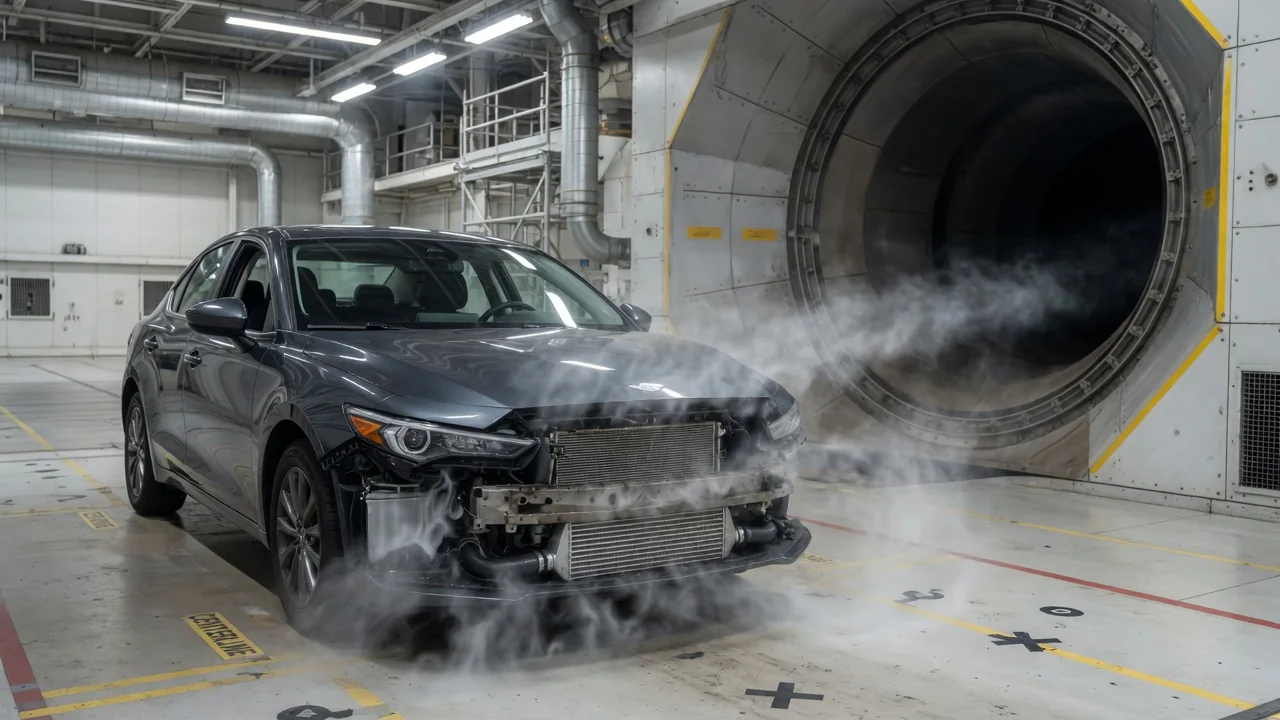
Cooling drag is the part of a car's aerodynamic resistance caused by air that flows through the front openings, across the radiator and other heat exchangers, and out through the engine bay. That air has to be slowed, pushed through tight passages, and released back into the flow around the car, and each step costs energy. Understanding vehicle cooling drag explains why grille openings, undertrays, and shutters are shaped the way they are, and why cooling and efficiency constantly compete.
Air through radiator
At speed, the front of a car creates a zone of high pressure, and openings in the bumper or grille let part of that oncoming air into the cooling package. In a typical combustion vehicle, the package may include the engine radiator, the air conditioning condenser, and sometimes a charge air cooler or a transmission or oil cooler. Electric vehicles use similar heat exchangers for the battery, motors, power electronics, and cabin climate system. After passing through these cores, the air enters the engine compartment, flows around components, and leaves through gaps underneath the car, into the wheel wells, or through vents in the hood or fenders. At low speed or when idling, an electric fan pulls air through the cores; at higher road speed, the pressure difference between the front opening and the exit areas does most of that work.
Cooling drag arises because this internal flow loses momentum. Air that would otherwise slip around the body is captured, slowed down in front of the core, forced through narrow passages, and then released at a lower speed and often in a direction that does not match the surrounding flow. The car effectively has to drag that slowed mass of air along with it, which shows up as extra resistance. The exiting air can also disturb the flow under the car or around the front wheels, so part of the penalty appears as interference with the external aerodynamics rather than inside the radiator itself. That is why engineers treat cooling drag as a system effect: it depends on the inlet, the internal path, and the exit together.
Pressure losses
As air moves through the cooling path, it loses pressure at several points. The grille or bumper opening itself adds resistance, especially if it includes mesh, bars, or sensor housings. The radiator core is a major contributor: thin fins packed closely together, multiple tube rows, and a thick core all increase the resistance air must overcome. When several heat exchangers are stacked one behind another, their losses add up, and air reaching the rear core is already warmer, which reduces how much heat it can absorb. Behind the cores, the engine, intake system, and other components act as obstructions, and a crowded engine bay makes it harder for air to escape.
Leakage matters as much as the core. If gaps exist around the edges of the radiator, air takes the easier path around it instead of through it. That air still contributes to drag but does little cooling, and hot air from the engine bay can even recirculate back toward the front of the core. Foam seals, shrouds, and ducts that close these gaps help direct the incoming flow where it is useful. The exit side is equally important: the pressure in the region where air leaves the engine bay limits how much air can flow through. A well-placed outlet in a low-pressure area lets the system breathe with a smaller inlet, while a poorly placed one forces a larger opening to achieve the same cooling.
Design tradeoffs
The central tradeoff is that the cooling system must be sized for the hardest conditions the vehicle is expected to face, such as climbing a long grade in hot weather, towing, or sitting in slow traffic, while most driving involves far less heat to reject. An inlet large enough for the worst case lets in more air than necessary during ordinary highway cruising, and that surplus flow adds drag without any useful benefit. Designers therefore try to match airflow to actual demand rather than simply maximizing it.
Several approaches help close that gap. Active grille shutters or flaps can close part of the opening when cooling demand is low and open when temperatures rise. Ducting the inlet tightly to the core reduces wasted flow, and shaping the exit so air rejoins the outer flow smoothly limits its disturbance. Core design is another lever: a larger frontal area with lower air velocity can reject the same heat with less pressure loss, but it takes up packaging space and adds weight and cost. Heating the air as it passes through the core can in principle recover a small amount of the lost energy, but at typical road speeds this effect is generally small compared with the losses.
Cooling design also competes with priorities outside aerodynamics. Front openings must work with styling, crash structures, pedestrian protection requirements, and the placement of radar or camera sensors. Air conditioning condensers need steady airflow even when the engine is cool. Electric vehicles typically need less radiator airflow at steady cruise than combustion engines, which is one reason many use smaller openings, but fast charging and sustained high loads can still create significant cooling demands. Every vehicle ends up with a compromise that reflects its intended use.
Practical implications and limits
For owners, the most direct point is that cooling drag matters most at higher speeds, since aerodynamic resistance grows rapidly as speed increases. Around town, its effect on energy use is small; on long highway trips, the condition of the airflow path can play a larger role. Missing or damaged undertrays, splash shields, and air deflectors may change how air leaves the engine bay, sometimes reducing cooling performance as well as increasing drag. Debris, insects, or bent fins on the face of the condenser or radiator reduce effective flow, and a stuck active shutter can either restrict cooling or leave the opening permanently wide. The owner's manual or service manual is the right reference for inspection and replacement guidance on these parts.
There are also clear limits to what general principles can tell you. The size of cooling drag depends on the specific inlet geometry, core selection, underbody design, and operating conditions, and it is normally measured in wind tunnels or estimated through simulation during development. Covering part of the grille or modifying vents might look like an easy efficiency gain, but it can raise operating temperatures in ways that are hard to predict without data, especially in hot weather or under heavy load. Unless the vehicle manufacturer specifically approves such a change, keeping the factory airflow path intact and in good condition is the safer approach.