What Is Coolant Bleeding? Trapped Air, Fill Steps and Symptoms
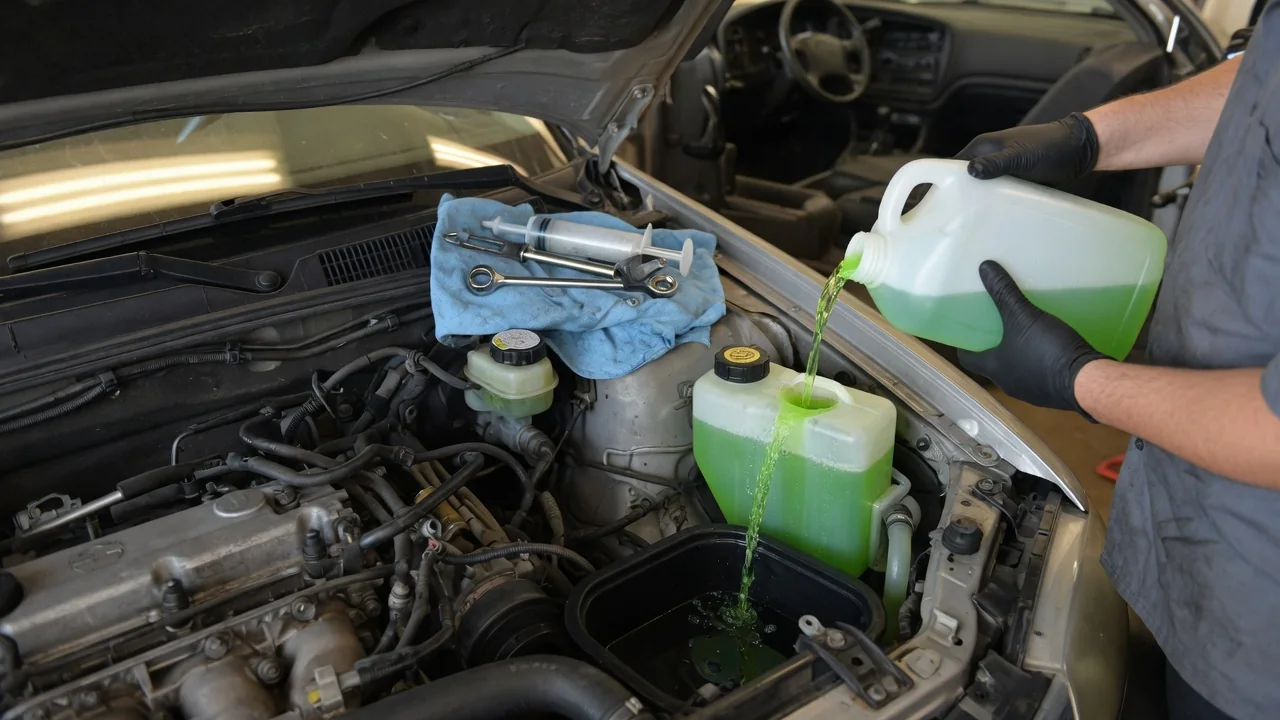
Coolant bleeding is the process of removing trapped air from a car's cooling system after it has been drained, refilled, or opened for repair. Air pockets interrupt coolant flow and can create local hot spots, so car cooling system bleeding is a routine part of almost any coolant-related job. This article explains where the air comes from, how a typical fill and bleed procedure works, and which symptoms suggest air is still trapped inside.
Trapped air
A liquid cooling system is a closed loop of passages running through the engine block and cylinder head, the radiator, the heater core, and the hoses that connect them, with the water pump keeping coolant moving. Whenever the system is drained or a component such as a hose, thermostat, water pump, radiator, or heater core is replaced, air takes the place of the lost coolant. Simply pouring fresh coolant back in does not push all of that air out. Liquid follows the easiest path downward and through open passages, while air rises and collects at high points: the upper part of the cylinder head, the heater core, upper hoses, and the area around the thermostat housing.
Air matters because it carries heat far less effectively than liquid coolant. A pocket sitting in the cylinder head can let the metal around it run hotter than the rest of the engine. A pocket near the temperature sensor can produce misleading gauge readings, because the sensor is surrounded by air instead of coolant. Air gathered near a closed thermostat can keep hot coolant from reaching it, delaying the moment it opens. Air drawn toward the water pump inlet can also reduce how effectively the pump moves coolant. Bleeding gives this air a deliberate route out and replaces it with coolant.
How easily air escapes depends heavily on design. Engine layout, the height of the radiator relative to the engine, and the location of the filler neck or pressurized reservoir all influence where air collects. Some systems are fitted with bleed screws or valves at high points, some route air to a reservoir where it separates out during normal operation, and others require a specific sequence described in the manufacturer's service information. These details are vehicle-specific, so the general principles below should be read alongside the instructions for the actual car.
Fill procedure
Bleeding normally starts with a cold engine, because opening the cap on a hot, pressurized system can release scalding coolant. The coolant should be the type specified for the vehicle, mixed or premixed as the owner's manual or service information directs, since different coolant chemistries are not always compatible. Before filling, any bleed screws at high points are usually opened so air has an exit, and the heater control is set to maximum heat so coolant can flow through the heater core once the engine runs.
Coolant is then added slowly through the filler neck or reservoir, giving air time to rise instead of being trapped behind the incoming liquid. Many technicians use a spill-free funnel that seals to the filler neck and holds a column of coolant above the engine's highest point, encouraging air to bubble out through the funnel. When coolant flows steadily from an open bleed screw without bubbles, that screw is closed. The engine is then started and allowed to idle; as the thermostat opens and circulation increases, more bubbles appear and the level often drops, so it is topped up as needed.
Once bubbles stop and the level holds steady, the funnel is removed, the level is set to the correct mark, and the cap is reinstalled. Some shops use a vacuum fill tool instead, drawing a vacuum on the sealed system so it pulls coolant in with little air left behind. Certain vehicles call for extra steps, such as a scan tool routine to run an electric coolant pump or open electronically controlled valves. After the first drives and a full cool-down, the reservoir level should be checked again, since remaining air often works its way out over several heat cycles.
Symptoms
Signs of trapped air usually appear soon after cooling system work. A temperature gauge that rises quickly, swings up and down, or reads erratically can point to air around the sensor or a pocket blocking flow. Weak or intermittent cabin heat is another common clue, because air collected in the heater core stops hot coolant from passing through it. Some drivers also hear gurgling or sloshing behind the dashboard, especially at startup or when engine speed changes.
Other signs include a reservoir level that keeps falling during the first days of driving as air is pushed out, coolant expelled from the overflow, or an upper radiator hose that stays relatively cool while the engine is fully warm. None of these signs is unique to air. A stuck thermostat, a failing water pump, a clogged radiator, an external leak, or combustion gases entering the coolant through a damaged head gasket can produce similar behavior, so symptoms that continue after a careful bleed deserve further diagnosis rather than repeated topping up.
Practical implications and limits
In everyday terms, bleeding is a short step that protects the rest of the repair. Air left in the system can let an engine overheat even though a new part has just been installed, and sustained overheating can damage components such as the cylinder head and head gasket. It therefore makes sense to plan for bleeding whenever the cooling system is opened, allow enough time for the engine to warm up fully during the procedure, and watch the gauge and reservoir over the next few drives.
Bleeding also has clear limits. It removes air that entered during service, but it cannot fix the reason coolant was lost in the first place, and it will not stop air from returning if a hose, clamp, or gasket is letting air in or combustion gas is leaking into the coolant. Because bleed point locations and electronic procedures differ between vehicles, general guidance cannot replace the manufacturer's service information. If the correct method is unclear, or overheating continues after bleeding, having a qualified technician inspect the system is the safer option.