What CCA Means on a Car Battery
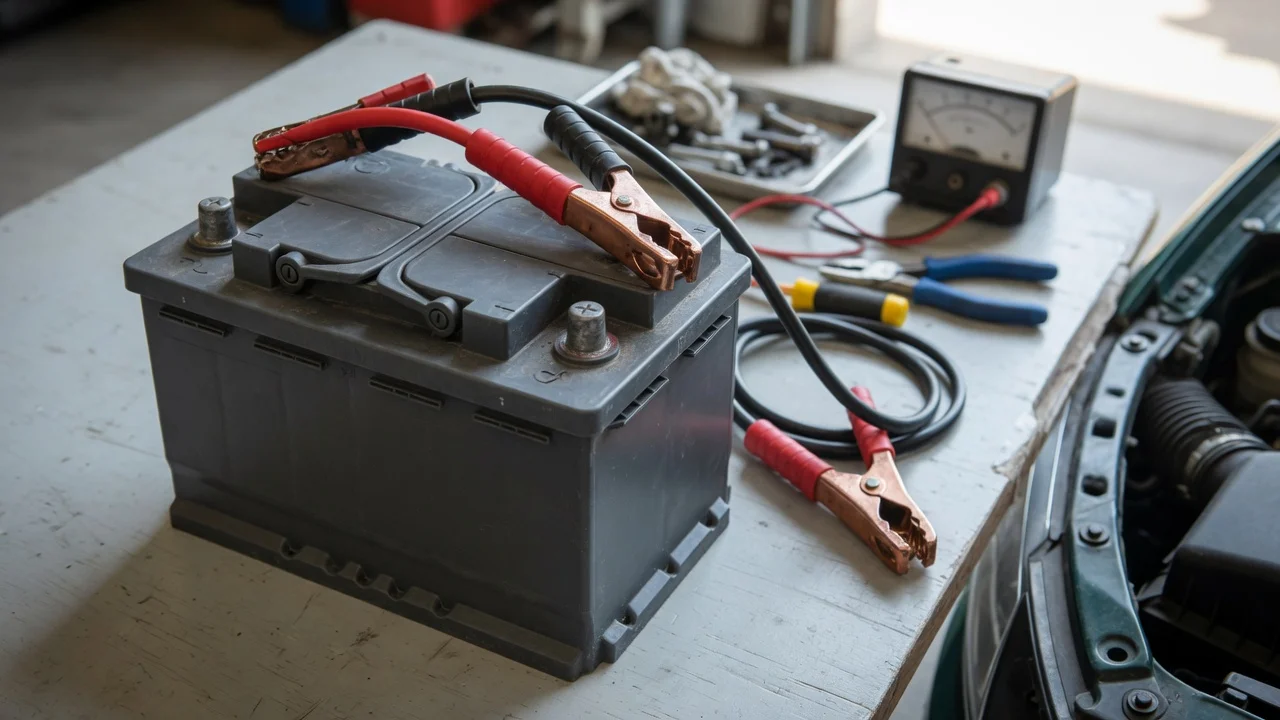
CCA stands for cold cranking amps. It is a rating printed on most automotive starting batteries that indicates how much current the battery can deliver in cold conditions, which is when starting an engine is hardest. A higher CCA figure means the battery can supply more current for cranking in the cold.
The short answer
Under the widely used SAE and BCI definition, CCA is the number of amps a new, fully charged 12-volt battery can deliver for 30 seconds at 0°F (-18°C) while keeping its voltage at or above 7.2 volts, which works out to 1.2 volts per cell across six cells. If a battery is rated at a given CCA, it has met that load under those test conditions.
One qualification matters: the figure depends on the test standard. European (EN), German (DIN) and Japanese (JIS) standards use different procedures, so a CCA number under one standard is not directly comparable with a number under another. When comparing batteries, check that the ratings come from the same standard.
Why cold temperatures are the benchmark
A lead-acid battery produces current through a chemical reaction between its plates and the electrolyte. Cold slows that reaction and raises the battery's internal resistance, so less current is available. At the same time, engine oil thickens in the cold, which makes the engine harder to turn over and increases the current the starter motor needs. CCA measures performance at the point where the battery is weakest and the demand is highest.
The voltage floor in the test is also practical. If voltage drops too far during cranking, the starter turns slowly and the vehicle's electronics, including the ignition and fuel systems, may not operate reliably. A battery that holds its voltage under a heavy cold load is more likely to start the engine.
Related ratings you may see on the label
CA (cranking amps): the same kind of test run at 32°F (0°C) rather than 0°F, so the CA figure is higher than the CCA figure for the same battery. MCA (marine cranking amps): also measured at 32°F (0°C); common on marine batteries and not equivalent to CCA. HCA (hot cranking amps): measured at 80°F (27°C), giving a larger number that says little about cold-weather starting. RC (reserve capacity): the number of minutes a fully charged battery can supply 25 amps at 80°F (27°C) before voltage falls to 10.5 volts. It describes how long the battery can power electrical loads if the charging system fails, not cranking power.
Because CA, MCA and HCA are tested at warmer temperatures, their figures look larger than CCA. When a label shows several numbers, CCA is the one to use for judging cold starting ability.
How to use CCA when choosing a replacement battery
The CCA a vehicle needs depends on its engine, starter and electrical system, so there is no single correct number. The usual guidance is to meet or exceed the CCA specified by the vehicle manufacturer, which is typically listed in the owner's manual or shown on the original battery's label. No vehicle-specific requirements were supplied for this article, so check your own vehicle's specification rather than relying on a general figure.
A battery with a higher CCA rating than required will not harm the vehicle, because the starter draws only the current it needs. The extra margin can help in colder climates and as the battery ages. However, CCA is only one measure. Physical size, terminal layout, battery type (such as flooded, EFB or AGM, particularly on vehicles with start-stop systems) and reserve capacity also need to match the vehicle.
CCA changes as a battery ages
The rated CCA describes a new, fully charged battery. As a battery ages, and if it is left partly discharged, its ability to deliver current declines. Many battery testers estimate a battery's current cranking capability and compare it with the rating on the label. A result well below the rated CCA indicates the battery has lost capacity, even if it still starts the vehicle in mild weather. Results should be taken with the battery fully charged, since a low state of charge also lowers the reading.
Key takeaway
CCA tells you how much current a 12-volt battery can deliver at 0°F (-18°C) for 30 seconds without its voltage dropping below 7.2 volts. Use it to compare batteries tested under the same standard, aim to meet or exceed your vehicle's specified figure, and consider it alongside size, battery type and reserve capacity rather than on its own.