What Is Caster in Wheel Alignment?
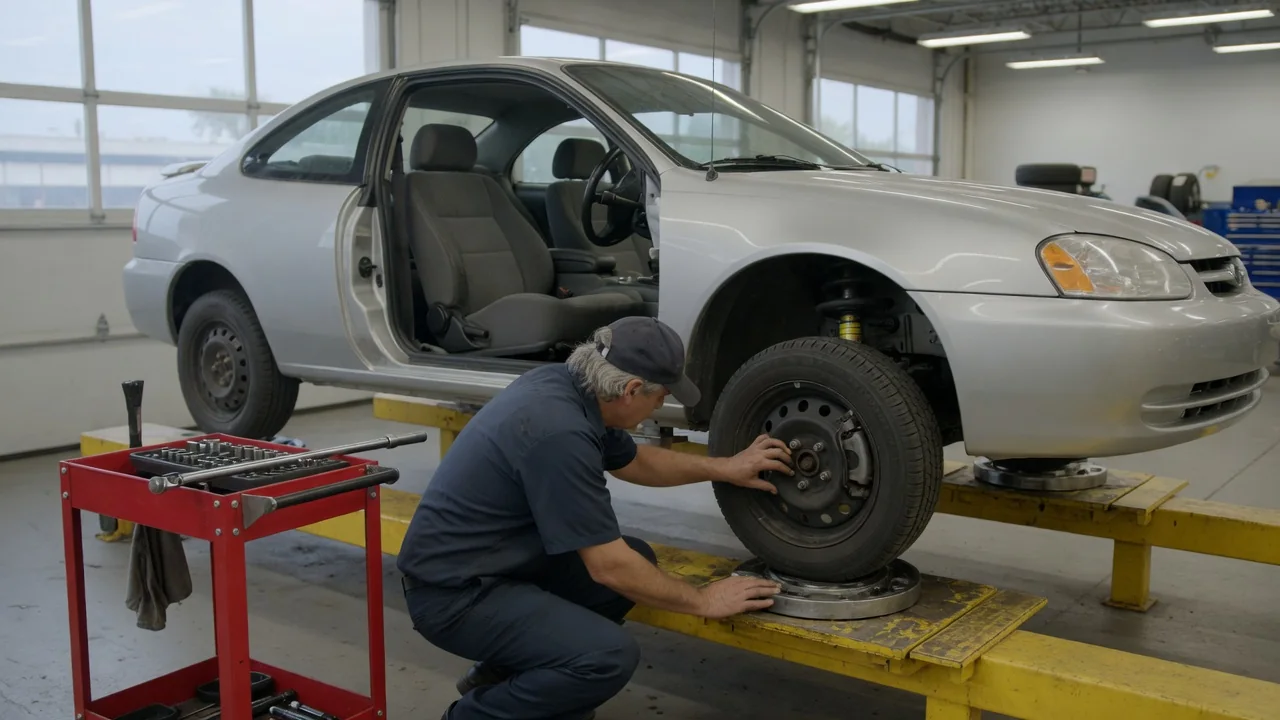
Drivers who ask what is caster in wheel alignment are really asking why a steering wheel straightens itself after a turn. Caster is the forward or rearward tilt of the steering axis when a front wheel is viewed from the side. It shapes straight-line stability, steering effort, and return-to-center behavior far more than it affects tire wear.
Geometry view
Picture a front wheel from the side of the vehicle and draw an imaginary line through its steering pivots. On a strut suspension that line runs from the upper strut mount down through the lower ball joint; on a double-wishbone design it passes through the upper and lower ball joints. Caster is the angle between that line and true vertical. When the top of the line leans toward the rear of the vehicle, the caster is positive, which is the arrangement used on nearly all modern road cars.
Because the axis is tilted, it meets the road ahead of the center of the tire's contact patch. That distance is called trail, and it is the reason the tire follows the steering axis much as a shopping cart wheel swings in behind its pivot. A bicycle fork shows the same idea in plain sight, with the front axle carried behind the line of the steering head. On a car the angle is hidden behind bodywork, and the designed amount differs between vehicles, so the correct figure always comes from the manufacturer's alignment specifications.
Steering feel
Trail gives the road a lever to work with. Whenever the wheel is steered away from straight, the cornering force acting on the tire sits behind the steering axis and pushes the wheel back toward center. Drivers feel this as self-aligning torque: the steering wheel unwinds on its own when exiting a corner, and the car holds a straight path on the highway with little correction. Generally, more positive caster produces a stronger, more settled on-center feel and a firmer pull back to straight.
The trade-off is effort. More caster makes the steering heavier, especially at parking speeds, which is one reason vehicles without power assist were historically set up with less of it. Caster also changes camber as the wheels turn, leaning the outside tire into the corner in a way that helps grip. Too little caster tends to produce light, vague steering that wanders and returns lazily. How much assist the steering system provides, along with tire size and suspension design, shapes how strongly any of this comes through at the rim.
Adjustment limits
Not every vehicle allows caster to be changed during a routine alignment. Many strut-type front suspensions have no factory caster adjustment at all, so the angle is fixed by the position of the strut mount, the lower control arm, and the subframe. Other designs provide eccentric bolts, shims, slotted mounts, or adjustable strut rods that let a technician move a pivot forward or backward. Where adjustment exists, it usually covers a modest range intended for fine correction rather than large changes to the geometry.
When a non-adjustable caster reading falls outside specification, the number is a clue rather than a setting to dial in. It can point toward a bent control arm, a damaged strut, a shifted subframe, or worn bushings, but each possibility needs inspection before any part is blamed. Changes in ride height, such as lift or lowering kits, also move caster and may exceed what the stock adjusters can recover. Aftermarket adjustable components exist for some platforms, though their suitability depends on the specific vehicle and intended use.
Everyday Use and Observations
The simplest observation is how the steering wheel behaves after a turn. On a typical car with healthy geometry, loosening your grip slightly while leaving an intersection lets the wheel glide back toward center smoothly. If it stays where it was left, returns slowly, or needs to be steered straight by hand, reduced caster is one possible explanation, alongside binding steering or suspension joints and low tire pressure. Heavy steering paired with a very strong return can suggest the opposite condition.
Side-to-side difference matters as much as the total. A vehicle generally drifts toward the side with less positive caster, so a steady pull on a flat road can originate here even when the tires look fine. Some manufacturers deliberately specify a small split between left and right to offset the slope of crowned roads. Unlike camber and toe, caster on its own is not a major source of tire wear, which means a caster problem often shows up in the driver's hands long before it appears in the tread.
Limits and Next Steps
Caster cannot be judged reliably by eye or by road feel alone. Alignment equipment calculates it by measuring how camber changes as the front wheels are swept through a set steering arc, and the result is only meaningful when compared with the specification for that vehicle. Pulling, wandering, and poor return-to-center also overlap with other causes, including uneven tire pressures, tire conicity, dragging brakes, worn steering components, and toe or camber errors. Treating caster as the answer before those are checked can lead to the wrong repair.
A sensible next step is a full alignment check with a printout showing the before and after readings for caster, camber, and toe on each wheel. Comparing left and right caster values, and noting whether either is outside the specified range, gives a clearer picture than a description of symptoms. If the readings changed after a pothole strike, curb impact, or collision, mention that to the shop so the suspension and its mounting points are inspected for damage. Any correction beyond the factory adjustment range deserves a vehicle-specific discussion with a qualified alignment technician.