What Is Camshaft Phasing? Timing Shift, Oil Control and Fault Signs
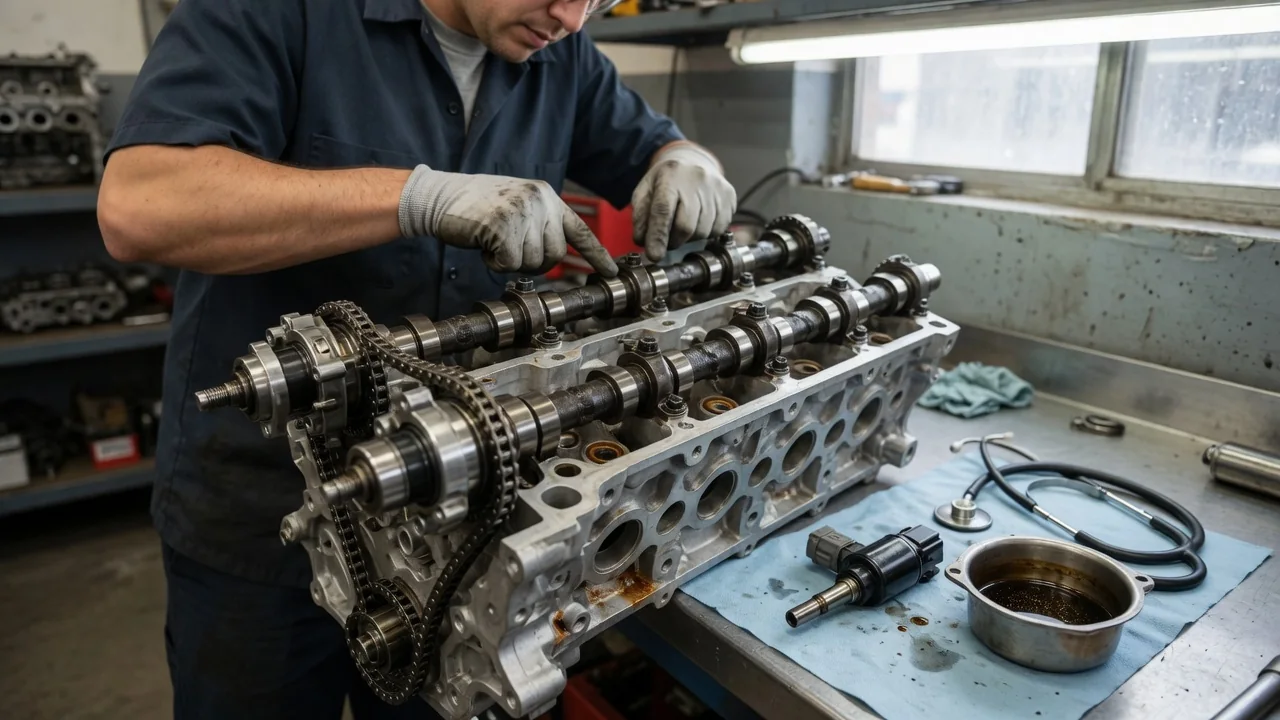
Camshaft phasing lets an engine change when its valves open and close relative to the crankshaft while it is running. Without phasing, valve timing stays locked at one compromise setting. With phasing, a cam phaser rotates the camshaft slightly ahead of or behind its base position. This guide explains what camshaft phasing is, how engine oil and a control solenoid move the phaser, and which symptoms commonly point to a phasing problem.
Timing Shift: How Phasing Moves Valve Events
In a conventional engine, the timing belt or chain locks the camshaft to the crankshaft in a fixed relationship. Every valve event happens at the same crankshaft angle whether the engine is idling, cruising, or at full throttle. That fixed timing is always a compromise. Timing that helps low-speed torque and a smooth idle is not ideal at high rpm, and timing that suits high rpm is not ideal at low speed.
A cam phaser sits between the timing drive and the camshaft, usually at the front of the camshaft where a solid sprocket would otherwise be. The belt or chain drives the outer housing, and the inner rotor is bolted to the camshaft. When the rotor turns relative to the housing, the phaser either advances the camshaft so valve events happen earlier, or retards it so they happen later. The cam lobes still set the lift and duration. Only the timing of the valve events moves. Systems that also change lift or duration are a separate technology, although some engines use both.
Depending on the design, phasing may control the intake cam only, the exhaust cam only, both cams independently, or a single camshaft that operates both sets of valves. Shifting intake and exhaust timing changes valve overlap, which is the period when both valves are open. Overlap affects cylinder filling, internal exhaust gas recirculation, emissions, and fuel economy. The engine control module chooses the target cam position from inputs such as rpm, load, and temperature, so the exact strategy varies from engine to engine.
Oil Control: How the Phaser Is Moved
Most cam phasers are hydraulic and use pressurized engine oil as their working fluid. A common type is the vane phaser. The rotor carries vanes that sit inside chambers in the housing, and each vane divides its chamber into an advance side and a retard side. Filling one side with oil while draining the other turns the rotor. Trapping oil on both sides holds the rotor at the desired angle.
An oil control valve, often called a VVT solenoid, directs oil flow to those chambers. The engine computer sends the valve a pulse-width-modulated signal, which moves a spool that opens passages to either the advance circuit or the retard circuit. Camshaft and crankshaft position sensors report the actual cam angle, and the computer adjusts the solenoid command until the measured position matches the target. Because this is closed-loop control, the system keeps correcting itself during normal driving.
Oil pressure can be low at startup and at hot idle. For that reason, many phasers include a locking pin that holds the rotor at a default position until there is enough pressure to control it. Hydraulic designs generally depend on adequate oil level, clean oil of the correct viscosity, and clear screens or filters in the oil passages. Some engines use electrically driven phasers that do not rely on oil pressure for actuation, so the details differ between designs.
Fault Signs of a Camshaft Phasing Problem
When phasing does not work as commanded, the engine computer usually detects a gap between the target and actual cam position. This often turns on the check engine light and stores diagnostic trouble codes. Typical codes relate to camshaft position correlation, timing that is over-advanced or over-retarded, or the oil control solenoid circuit. A code identifies a system rather than a specific failed part, so treat it as a starting point for diagnosis, not a final answer.
Drivers may also notice a rough or unstable idle, hesitation, reduced power, poorer fuel economy, or stalling, especially if the phaser is stuck away from its default position. A brief rattling or knocking noise right after a cold start is commonly linked to a worn phaser or a locking pin that is not holding. Worn timing chains, tensioners, and guides can make similar noises, though. Symptoms that appear only when the engine is hot, or only after an oil change, can point to an oil-related cause.
Common underlying causes include low oil level, sludged oil or oil of the wrong viscosity, a clogged solenoid screen, a faulty solenoid or damaged wiring, a sensor fault, a stretched timing chain or worn tensioner, and internal wear in the phaser itself. Many of these produce overlapping codes and symptoms. That is why a common diagnostic approach is to check the simple, oil-related items before condemning more expensive parts.
Practical Implications and Limits
In everyday driving, camshaft phasing works without any input from the driver. It lets one engine combine responsive low-speed behavior with better breathing at higher rpm, and it helps manufacturers meet efficiency and emissions goals. The trade-off is that a hydraulic phasing system adds parts that are sensitive to oil condition. On these engines the oil does control work as well as lubrication. Following the oil type, capacity, and change interval in the owner's manual for the specific vehicle therefore matters more than many owners expect.
General information about cam phaser engine operation has clear limits. Phaser design, default lock position, the number of phased camshafts, control strategy, and service procedures all vary by engine. Some repairs require special tools to hold the camshafts and crankshaft in a fixed position while work is done. Installing a phaser with incorrect timing alignment can cause poor running and, on interference engines, valve damage. The reliable way to confirm a fault before buying parts is to use the factory service information for the vehicle, or a qualified technician with access to live data such as commanded versus actual cam angle.