What Is Breakover Angle?
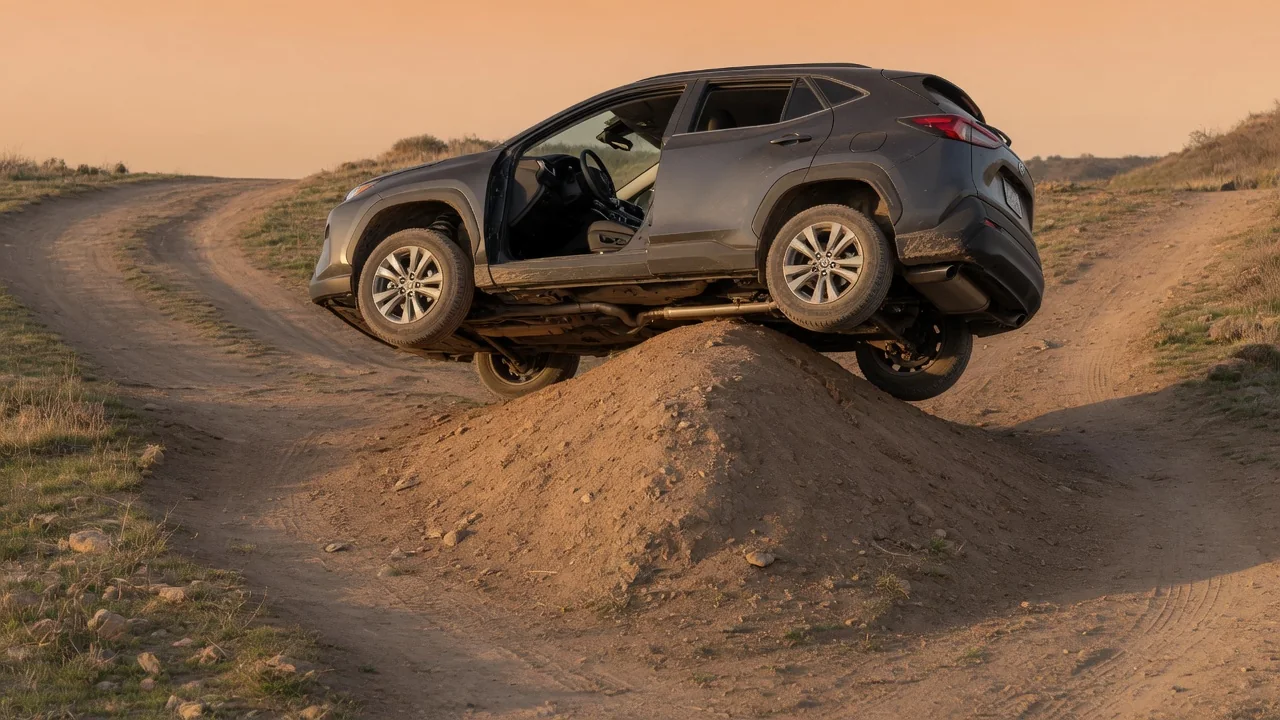
Anyone asking what is breakover angle is really asking how sharp a crest a vehicle can drive over before its belly touches the ground. It describes the clearance between the front and rear axles, and it explains why some vehicles glide over a ridge while others stop on top of it with a scrape.
Wheelbase and clearance
Breakover angle is shaped by two measurements working together: wheelbase and ground clearance. Picture a line drawn from the bottom of the front tire up to the lowest point of the underbody midway between the axles, then another line from that point down to the rear tire. The angle those lines leave open beneath the vehicle is the breakover angle. A larger figure means the vehicle can straddle a sharper peak without its midsection touching the surface.
Wheelbase pulls the number in one direction and clearance pulls it in the other. A long pickup with a crew cab and extended bed spreads its axles far apart, so the middle of the frame hangs over a wider gap and meets a crest sooner. A short two-door off-roader with similar ride height clears the same ridge easily. Raising clearance through taller tires or suspension changes improves the angle, though published figures differ by trim, tire size and load, so vehicle-specific data matters.
Crest example
Imagine driving straight over a steep ridge shaped like the peak of a roof. The front wheels climb the face and roll down the far side while the rear wheels are still climbing. At that moment the vehicle is perched across the peak, and the highest point of the terrain sits directly under the midpoint of the wheelbase. If the peak is sharper than the breakover angle allows, the underbody lands on it before the front tires regain useful grip.
The same geometry appears on a smaller scale in ordinary places. A tall speed hump, a steep driveway transition, a railroad crossing set on a raised bed or the hinge point at the top of a loading ramp all present a crest between the axles. A compact crossover and a long-wheelbase van can approach the same hump at the same speed and have very different outcomes, simply because the van has more body suspended between its contact points.
Underbody contact
When the breakover angle is exceeded, the first thing to touch is whatever hangs lowest between the axles. Depending on the vehicle, that could be frame rails, rocker panels, exhaust piping, a transfer case, a driveshaft, fuel tank shielding or, on an electric vehicle, the protective casing beneath the battery pack. Layout varies widely, so looking underneath or consulting the manufacturer's information is the only reliable way to know which component sits most exposed on a particular model.
Contact is more than a noise. Once the underbody carries weight, the tires are unloaded and lose traction, which can leave a vehicle balanced on the crest with wheels spinning, a situation off-road drivers call being high-centered. Dragging across the obstacle can scrape coatings, bend shields or dent components. Skid plates and rock sliders are designed to take that abuse, but they protect parts rather than add clearance, and some designs hang slightly lower than the unprotected underbody.
Everyday Use and Observations
Most drivers encounter breakover limits without naming them. A scrape heard from the middle of the car while cresting a parking garage ramp, rather than from the front bumper, is a breakover event. Lowered sports cars, long sedans and stretched vans are the usual candidates. Crossing a hump at a diagonal can sometimes help because the wheels climb one at a time, although that changes how the suspension flexes and does not guarantee clearance on every vehicle.
Load also changes the picture. Passengers, cargo and trailer tongue weight compress the springs, lowering the underbody and reducing the angle below its unladen figure. Vehicles with adjustable air suspension may gain clearance in a raised mode and lose it in a lowered highway setting. Fresh scuff marks on the underside of plastic shields or along the rocker seams are a visible sign that the vehicle has been touching down, and they show where the low point actually sits.
Limits and Next Steps
Breakover angle is one of three related measurements, alongside approach angle at the front and departure angle at the rear, and none of them tells the whole story alone. A published figure assumes a rigid vehicle at a stated ride height on a perfectly shaped crest. Real terrain is irregular, suspension compresses as weight shifts, and momentum can push the body lower than a static measurement suggests. Treat the number as a comparison tool between vehicles rather than a promise about any specific obstacle.
For someone choosing a vehicle or planning a route, the practical step is to find the manufacturer's stated angle for the exact configuration, including wheelbase, tire size and suspension option, since those details shift the result. On a questionable crest, getting out to look, or having a spotter watch the gap beneath the midsection, gives better information than guessing from the driver's seat. Persistent scraping or visible underbody damage deserves a professional inspection before the vehicle goes back over rough ground.