What Is Brake Torque? Friction, Rotor Radius and Tire Grip Explained
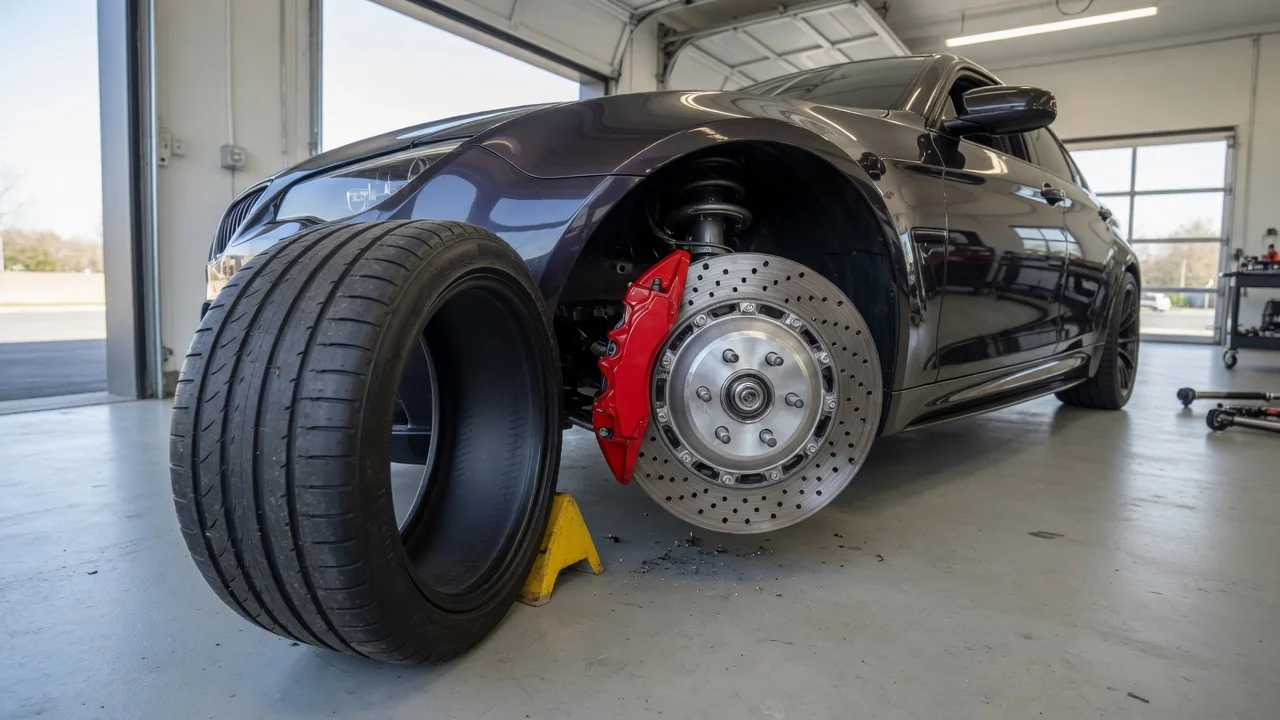
Brake torque is the twisting effort a brake applies to a wheel to slow its rotation. In a disc brake, it comes from the pads clamping a spinning rotor. The friction force they generate, multiplied by how far from the wheel's center that force acts, equals the torque. Whether that torque actually stops the car depends on one more factor: the grip between tire and road. This guide explains all three pieces.
Friction force
Torque is a force acting at a distance from a center of rotation, and in a brake that force is friction. When the driver presses the pedal, the master cylinder pressurizes brake fluid, and the caliper pistons convert that pressure into clamping force. Clamp force equals hydraulic pressure multiplied by the total piston area pushing on the pad. Larger pistons, or more of them, produce more clamp force from the same pedal input, which is one reason caliper design matters so much in brake engineering.
Clamp force alone does not slow anything; it has to be turned into friction. The friction force at each pad face is roughly the clamp force multiplied by the friction coefficient between the pad material and the rotor surface. A typical disc brake has two pad faces gripping the rotor, one on each side, so the total friction force is about twice the single-face value. The coefficient is not a fixed constant. It changes with pad compound, temperature, rotor surface condition, moisture and contamination, which is why the same pedal pressure can produce noticeably different braking from a cold, wet brake than from a properly warmed one. Drum brakes follow the same basic principle, although their shoe geometry can add a self-energizing effect that changes how friction force builds.
Rotor radius
Once friction force is known, brake torque depends on where that force acts. The relevant distance is the effective radius, measured from the center of the hub to roughly the center of the pad's contact area on the rotor. The basic relationship is simple: brake torque equals total friction force multiplied by effective radius. Torque is commonly expressed in newton-meters or pound-feet.
This explains why rotor diameter is a design lever. A larger rotor lets the caliper act farther from the hub, so the same clamp force and the same pad material produce more braking torque at the wheel. It is the same principle as using a longer wrench: identical effort, more leverage. Larger rotors also tend to carry more mass and surface area, which helps them absorb and shed heat, but that thermal benefit is separate from the leverage effect and should not be confused with it.
Effective radius is bounded by the wheel. The rotor and caliper must fit inside the rim with clearance, so wheel size limits how large a brake package can be. The pad's own height also matters: a tall pad spreads contact over a band of radii, and engineers use a representative effective value rather than the outer edge of the pad when estimating torque.
Tire grip
Brake torque acts on the wheel, but the car slows only because of a force at the tire's contact patch. Dividing brake torque by the tire's effective rolling radius gives the longitudinal braking force the tire tries to transmit to the road. That makes the rotor and the tire two ends of a lever: torque generated near the hub becomes a rearward force at the outer edge of the tire, so a taller tire turns the same torque into slightly less force at the road.
The road can only accept so much of that force. Maximum braking force at a tire is limited by the friction between rubber and pavement and by the vertical load pressing the tire down. On dry pavement the limit is relatively high; on wet, snowy or loose surfaces it drops considerably. If brake torque asks for more force than the tire can deliver, the wheel slows faster than the vehicle, slip rises, and the wheel can lock. Peak grip generally occurs at a modest amount of slip rather than with the wheel fully locked, and anti-lock braking systems modulate brake pressure to keep each wheel near that useful slip range.
Load also moves during braking. Deceleration shifts weight toward the front axle, increasing the grip available at the front tires and reducing it at the rear. That is why front brakes are generally built to produce more torque than rear brakes, and why systems such as proportioning valves or electronic brake-force distribution limit rear brake torque so the rear wheels do not lock first.
Practical implications and limits
For everyday driving, these relationships explain a common misunderstanding about brake upgrades. Brakes in good working condition are typically able to generate enough torque to reach the tires' grip limit in a single hard stop. Once that limit is reached, extra torque from bigger rotors or more aggressive pads cannot shorten that stop, because the tires, not the brakes, are the bottleneck. Where larger or higher-capacity brakes can help is repeated or sustained braking, such as long descents, towing or track use, where heat would otherwise reduce pad friction and cause fade.
Changes elsewhere on the car also interact with brake torque. Fitting tires with a noticeably different overall diameter alters the leverage between brake and road, and changing tire type or condition changes how much braking force the road will accept. Worn tires, shallow tread in wet conditions or incorrect inflation can reduce usable stopping capability even when the brake hardware is unchanged. Modifying brake components on one axle only can also shift the front-to-rear balance the vehicle was engineered around, which may change how the anti-lock and stability systems behave.
Finally, the values that determine brake torque on a real vehicle, such as piston sizes, rotor dimensions, pad friction ratings and system pressures, are specific to each design and are not interchangeable between models. For maintenance or replacement parts, the vehicle's service information is the authoritative source. The general principle, however, holds across disc-braked cars: brake torque is friction force times effective radius, and the tires decide how much of it becomes deceleration.