What Is Brake Bias? Front-to-Rear Braking Balance Explained
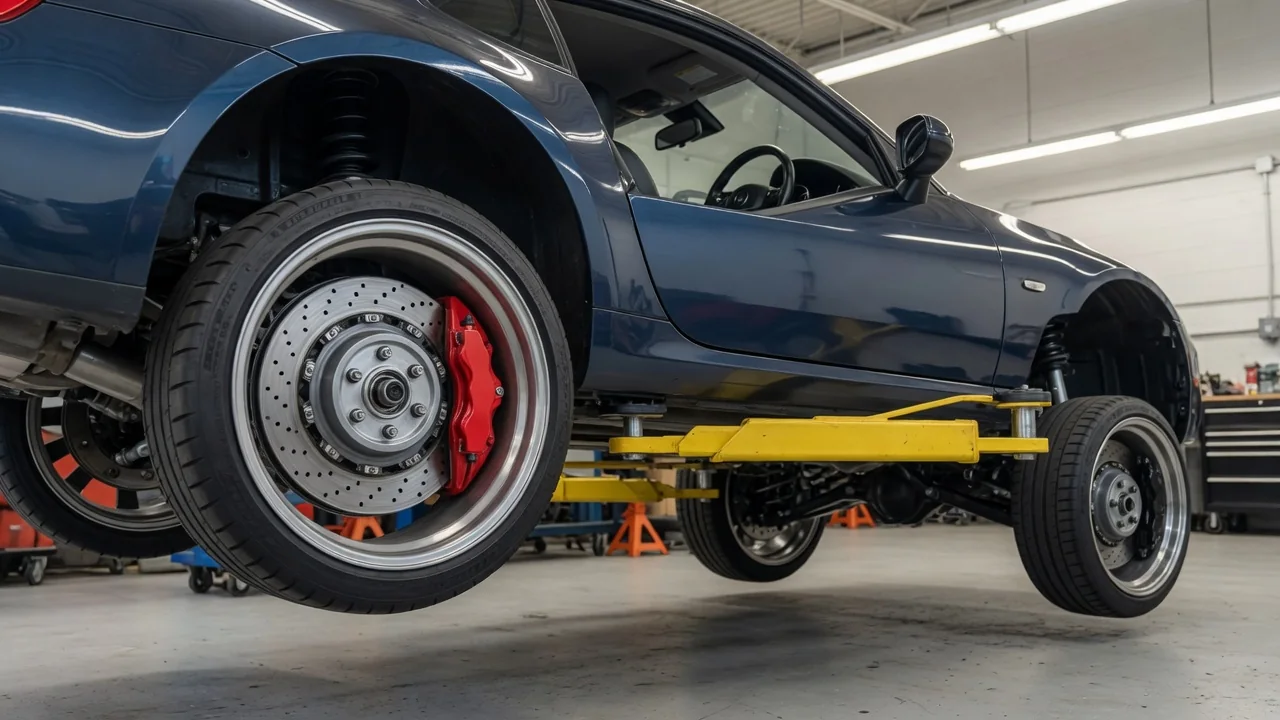
Brake bias is the way a vehicle divides its total braking effort between the front and rear axles. If you have wondered what brake bias is, or what front rear brake bias means when a car is described as front-biased, the short answer is balance. The goal is to let each axle contribute as much stopping force as its tires can grip without locking up first. This article explains why that balance shifts, how it is set, and where its limits lie.
Weight transfer
When a car slows down, its mass keeps trying to move forward. Because the center of gravity sits above the road surface while the stopping forces act at the tire contact patches, deceleration creates a pitching moment that loads the front axle and unloads the rear. The suspension shows this as nose dive, but the important effect is on the tires: the front tires are pressed harder into the pavement, and the rear tires carry less vertical load than they did at rest. The harder the stop, the larger this shift becomes. Its size depends mainly on the height of the center of gravity, the length of the wheelbase, and the rate of deceleration. A tall vehicle with a short wheelbase transfers proportionally more load forward than a low, long one under the same braking.
Tire grip rises with vertical load, although not in a perfectly linear way. That is why weight transfer sits at the heart of brake bias. During a hard stop, the front tires can generate much more braking force than the rear tires, so most of the useful stopping work naturally belongs at the front. If the rear brakes were asked to do the same share as the front, the lightly loaded rear tires would reach their grip limit and lock early. A car whose rear wheels lock tends to become unstable, because the rear axle loses its ability to resist sideways motion and the vehicle can rotate. Front lockup is generally the more controllable failure, since the car tends to slide straight ahead, but it removes steering ability. Brake bias is the engineering answer to this asymmetry.
Pressure distribution
In a conventional hydraulic system, the driver's pedal effort, usually multiplied by a brake booster, pressurizes fluid in the master cylinder. That pressure travels through brake lines to the calipers or wheel cylinders at each corner. The torque each brake produces depends on the pressure it receives, the area of its pistons, the friction of its pads or shoes, and the effective radius at which that friction acts on the rotor or drum. Brake bias is therefore the combined result of hydraulic pressure and hardware. Two axles can receive identical line pressure and still produce very different braking torque because their components differ.
A fixed split, however, cannot match a load distribution that keeps changing with deceleration. As a stop becomes harder, the ideal share for the rear axle shrinks. For that reason, many vehicles limit rear brake pressure once it rises past a certain point. Mechanical solutions include proportioning valves, which reduce the rate at which rear pressure increases above a set threshold, and load-sensing valves, which adjust that behavior according to how heavily the rear suspension is loaded. On vehicles with anti-lock braking, electronic brakeforce distribution, often abbreviated EBD, uses wheel speed sensors and the ABS modulator to manage rear pressure dynamically, holding or reducing it when the rear wheels begin to slow faster than the fronts. Which method a specific vehicle uses is a matter for its own service documentation.
When people describe front rear brake bias, they often express it as a percentage split, with the front figure listed first. A notation such as 60/40 would mean the front axle provides sixty percent of total braking force under the stated conditions. Such numbers are only meaningful alongside those conditions, since the effective split can change with pressure, temperature, and load.
Design
Engineers set brake bias by choosing hardware rather than by turning a single dial. Rotor diameter, caliper piston size and count, pad compound, and the choice between discs and drums all shift torque toward one axle or the other. The master cylinder design matters too: most modern passenger vehicles use a dual-circuit arrangement so that a single leak does not remove all braking, and the circuits may be split front and rear or diagonally. A diagonal split pairs one front wheel with the opposite rear wheel, which influences how proportioning hardware is placed and how the car behaves if one circuit fails.
The design target is a distribution that keeps the front wheels reaching their limit slightly before the rears across the expected range of loads and road surfaces, preserving stability while still using the rear tires productively. Designers have to account for an empty vehicle and a fully loaded one, for wet and dry pavement, and for brake components that heat up and change friction during repeated stops. Some competition vehicles use dual master cylinders linked by an adjustable balance bar, letting the driver or team move bias for track conditions. Road vehicles rarely offer that kind of adjustment; their balance is fixed by component selection and governed by valves or software.
Practical implications and limits
For everyday owners, the most useful takeaway is that brake balance depends on parts that are often treated as interchangeable. Fitting different pad compounds front and rear, larger rotors at one end, or calipers from another application can move bias away from what the original system was designed around. Changes that alter the vehicle's load or stance, such as heavy cargo, towing, lifted or lowered suspension, and a different tire size, can also affect how load shifts during a stop and how sensors and valves respond. Uneven tire condition between axles changes available grip as well. None of these automatically makes a car unsafe, but each is a reason to consult the manufacturer's specifications before modifying the braking system.
It also helps to know what brake bias cannot do. It does not shorten stopping distances on its own; total stopping ability is ultimately limited by tire grip and the road surface. Electronic distribution and ABS can manage pressure within the limits of the hardware and sensors, but they cannot create traction that is not there. Symptoms such as the rear stepping out during firm braking, persistent pulling, or a warning light related to ABS or brake distribution point to a system that needs inspection rather than an adjustment by feel. Exact bias figures, valve settings, and diagnostic procedures differ from vehicle to vehicle, so the repair manual for the specific model remains the authoritative reference.