What Is Brake Assist in a Car?
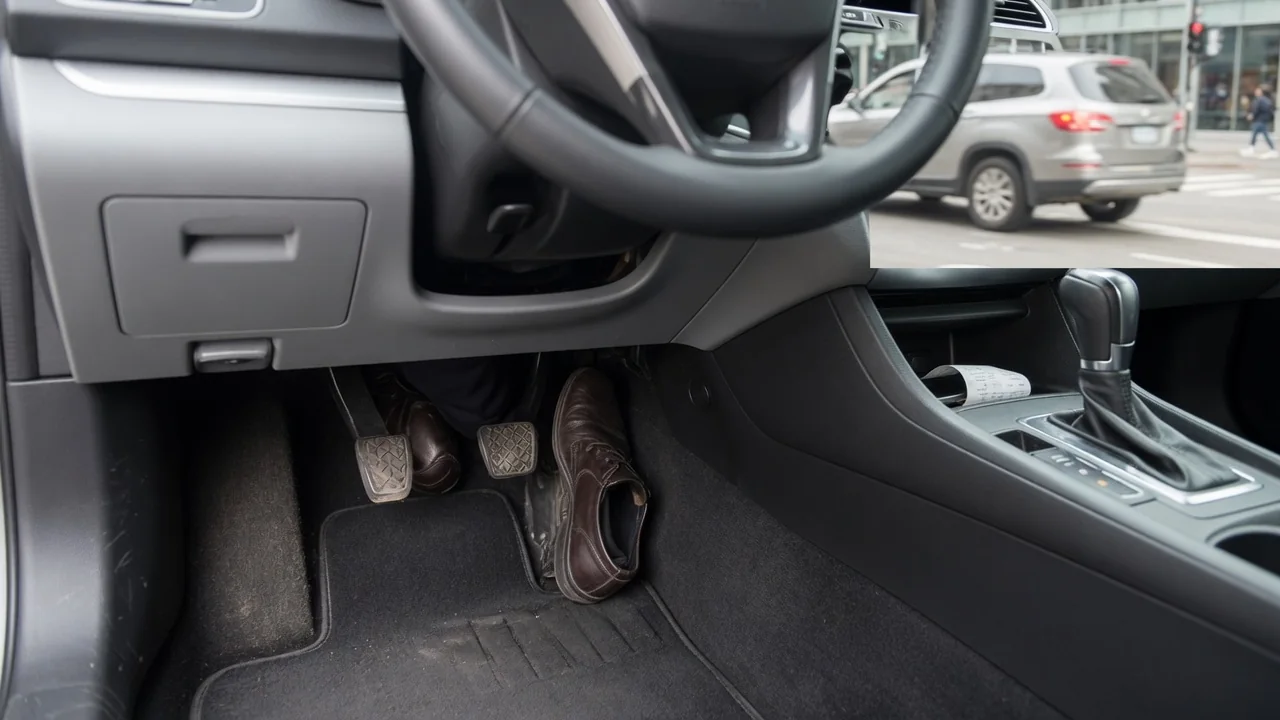
Brake assist is a driver aid that helps a car reach full braking force when the driver reacts to an emergency but does not press the pedal hard enough. In short, here is what brake assist in a car does: it watches how you apply the brake, decides whether the situation looks like a panic stop, and adds hydraulic pressure for you. It works with the driver's input. It does not replace that input.
Pedal Input: How the System Recognizes a Panic Stop
Brake assist starts with the brake pedal. In everyday driving, people press the pedal gradually and adjust their effort as the car slows. In a sudden emergency, the foot usually reaches the pedal very quickly, but many drivers then fail to push hard enough. Studies of driver behavior have repeatedly found this pattern. Surprise, fear of locking the wheels, or a habit of light pedal effort can all cause it. The foot moves fast but not far, and the car slows less than its tires and brakes could allow. That gap between what the driver applies and what the vehicle could deliver is the problem brake assist was designed to address.
To detect a panic stop, the system looks mainly at how quickly the pedal is applied rather than only how far it travels. Different designs measure this in different ways. Some use a pedal travel or position sensor. Some combine brake switch timing with a pressure sensor at the master cylinder. Others use a mechanical element inside the brake booster that reacts to rapid movement. Certain systems also consider how abruptly the driver lifted off the accelerator before braking. The control logic compares these inputs against activation thresholds. Manufacturers set the exact inputs and thresholds themselves and generally do not publish them, so the safest general description is simple: a fast, urgent pedal application is the main trigger.
Pressure Boost: What Happens Once Brake Assist Activates
Once the system decides an emergency stop is underway, it raises brake line pressure beyond what the driver's foot would produce through the normal booster. It typically pushes toward the level at which the anti-lock braking system starts regulating wheel slip. The boost can come from several places, depending on the design. In many electronic systems, the ABS or stability control hydraulic unit uses its pump and valves to build pressure actively. With an electronically controlled vacuum booster, a solenoid lets atmospheric pressure into the booster to provide maximum assistance. Purely mechanical designs use a valve that holds the booster at full assist when the pedal moves quickly. In vehicles with electric boosters or brake-by-wire systems, the control unit can command higher pressure directly.
Brake assist and ABS work as a pair. Brake assist drives pressure toward the limit of grip. When a wheel begins to approach lockup, ABS takes over and rapidly modulates pressure at that wheel to keep the tire rotating near its peak friction. This is why the emergency brake assist function is so closely tied to anti-lock braking: one pushes the car toward maximum deceleration, and the other keeps the wheels from going past it. Stability control may also intervene if the car begins to yaw. When the driver releases the pedal or clearly reduces effort, the system withdraws the extra pressure and returns to normal braking, where pressure follows the pedal. Release criteria and how smoothly this transition feels differ between vehicles.
Driver Role: What Brake Assist Does and Does Not Do for You
Brake assist depends entirely on the driver starting the stop. It does not decide to brake on its own; it reacts to the decision the driver has already made. This separates it from automatic emergency braking, which uses cameras, radar, or other sensors to detect an obstacle and can apply the brakes with no pedal input at all. Many modern vehicles have both technologies. On some of them, forward-facing sensors can prepare the brake system or make brake assist more sensitive when a collision looks likely. That behavior is vehicle-specific, so do not assume it exists in any given car.
The driver's job in an emergency stays the same with or without brake assist. Press the pedal firmly and decisively, and keep pressing until the car has stopped or the danger has passed. On a vehicle with ABS, do not pump the brakes. Pumping repeatedly interrupts both the pressure boost and the anti-lock control. Because ABS helps the wheels keep turning, you can usually still steer around a hazard while braking hard, and looking toward an escape path helps. The driver also controls how long the assistance lasts, since lifting off the pedal ends the boost. Brake assist covers the gap in pedal force. Judgment, steering, and timing remain the driver's responsibility.
Practical Implications and Limits
When brake assist activates, the experience can be startling for a driver who has never felt it. The car may slow down far more sharply than the pedal effort seems to justify. The pedal may feel unusually firm or move slightly under the foot. If ABS joins in, you may feel pulsing through the pedal and hear buzzing or grinding from the hydraulic unit. These sensations are normal signs that the system is working. On some vehicles, a quick but non-critical stop can occasionally trigger the assistance. This is generally a consequence of how the activation logic interprets fast pedal movement, not a malfunction.
Brake assist cannot create grip that is not there. On wet pavement, snow, ice, gravel, or worn tires, the maximum possible deceleration is lower, and the system only helps the car reach that lower limit sooner. Worn pads, old brake fluid, air in the lines, or other hydraulic problems reduce the performance of the whole braking system, including any emergency boost. Because brake assist usually shares sensors and hydraulic hardware with ABS and stability control, a fault in those systems may disable it as well. A lit ABS or stability control warning light is a reason to have the vehicle inspected. Brake assist generally works automatically without a driver control. The owner's manual is the reliable place to confirm whether a specific vehicle has the feature, what the manufacturer calls it, and which warning indicators apply.