What Is Boundary Lubrication? Thin Films, Additives, and Wear Explained
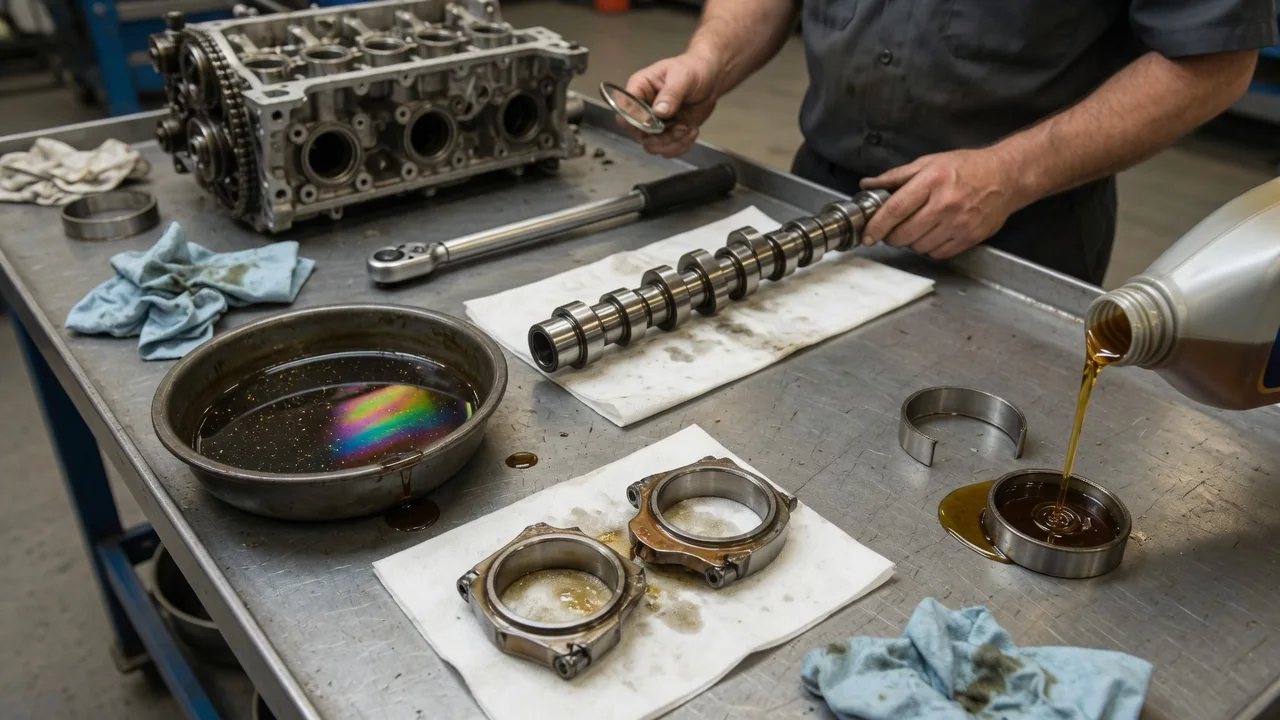
Boundary lubrication is the condition in which moving metal surfaces are so close together that the oil film can no longer keep them fully apart, and their microscopic high points touch through it. Protection then depends less on the bulk oil and more on extremely thin chemical layers attached to the metal. Engine boundary lubrication is common at startup, at the ends of piston travel, and in heavily loaded valvetrain contacts, which makes it central to understanding how motor oil prevents wear.
Thin-Film Contact: When the Oil Film Runs Out
No machined surface is perfectly smooth. Under magnification, even a polished crankshaft journal or cam lobe shows peaks and valleys, and the peaks are called asperities. In full-film, or hydrodynamic, lubrication, the motion of one part drags oil into a narrowing gap and builds enough pressure to lift the surfaces apart. The asperities never meet, friction comes mainly from shearing the oil itself, and wear is very low. How thick that film becomes depends on three main factors: the oil's viscosity, the relative speed of the surfaces, and the load pressing them together. Lower speed, higher load, or thinner oil all reduce film thickness.
Engineers often describe these conditions with the Stribeck curve, which plots friction against a combination of viscosity, speed, and load. At one end is full-film lubrication. As the film thins, the system passes through mixed lubrication, where the oil carries part of the load and asperities carry the rest. At the far end is boundary lubrication, where the film is thinner than the combined roughness of the two surfaces and most of the load passes through direct asperity contact. In this regime, bulk viscosity has little influence on friction. What matters instead is whatever molecular or chemical layer sits on the metal at the points of contact.
In an engine, boundary conditions appear wherever speed drops toward zero or load becomes concentrated. Piston rings momentarily stop at the top and bottom of each stroke, so the oil wedge collapses there, particularly near top dead center where combustion pressure pushes the rings hardest against the cylinder wall. Cam lobes and followers, especially sliding designs, operate under high contact pressure. During a cold start, parts can move before oil pressure is fully established, and the residual film left from the last run is all that separates them.
Additives: Chemistry That Works When Viscosity Cannot
Because viscosity alone cannot protect surfaces in the boundary regime, motor oils rely on additives designed to act at the metal surface. The best known anti-wear additive in engine oil is zinc dialkyldithiophosphate, usually shortened to ZDDP. Under the heat and pressure found at contacting asperities, ZDDP reacts to form a thin, glassy phosphate-based tribofilm on the metal. This film is sacrificial: it is sheared away in the hardest contacts and continually rebuilt as long as active additive remains in the oil. The goal is for the film, rather than the underlying steel or iron, to take the damage.
Friction modifiers serve a related but different purpose. Organic friction modifiers have polar heads that adsorb onto metal and long tails that form a low-shear layer, a bit like a microscopic carpet. Molybdenum-based compounds can form layered films that slide easily under load. These additives mainly reduce friction in mixed and boundary conditions, which is why they are associated with fuel economy goals. Extreme pressure additives, typically sulfur and phosphorus compounds that react aggressively with metal, are more characteristic of gear oils, where tooth contacts face loads beyond what typical engine anti-wear chemistry is designed for.
An oil formulation is a balance rather than a simple sum of ingredients. Detergents, dispersants, anti-wear agents, and friction modifiers can compete for the same metal surface, and formulators adjust their proportions to suit the intended application and industry or manufacturer specifications. Phosphorus content, for example, is constrained in many modern passenger car oil specifications because phosphorus can degrade catalytic converters over time. Additives are also consumed in service, so the boundary protection an oil offers when fresh is not the same protection it offers near the end of its change interval.
Wear: What Happens at the Contact Points
When asperities touch, several kinds of wear can occur. Adhesive wear happens when contacting peaks momentarily bond under pressure and then tear apart, transferring or removing tiny amounts of metal. Protective surface films reduce this by preventing clean metal from touching clean metal. Abrasive wear occurs when hard particles, such as dirt that passed the air filter, combustion soot agglomerates, or metal debris, are trapped between surfaces and scratch them. Because the film is thinnest in the boundary regime, even small particles can bridge the gap and cut grooves.
Corrosive or chemical wear involves surface material being removed through reactions with acids, moisture, or overly aggressive additive chemistry, followed by mechanical removal of the reaction layer. Scuffing is a more severe failure in which the protective film breaks down under load and heat, local welding and tearing escalate, and surfaces are visibly damaged. Not all wear is harmful. During break-in, a controlled amount of mild boundary wear smooths the highest asperities so that later operation runs closer to mixed or full-film conditions. The engineering aim is to keep wear mild and steady, not to eliminate contact entirely.
Practical Implications and Limits
For owners, the most useful takeaway is that oil selection should follow the viscosity grade and specification listed in the vehicle's owner's manual or service information. Those requirements reflect the engine's clearances, valvetrain design, and emissions hardware, and they cover both the hydrodynamic film and the additive package that handles boundary contact. Choosing a thicker oil on the assumption that more viscosity means more protection does not address the boundary regime and can slow oil flow during cold starts, which is exactly when the surfaces most need oil to arrive quickly.
Operating patterns matter as well. Frequent short trips, extended idling, and repeated cold starts increase the share of time spent in thin-film conditions, and they can allow fuel and moisture to accumulate in the oil. Those contaminants dilute the oil and consume additives, which is why many manuals define a separate severe-service maintenance schedule. Owners of older engines with sliding flat tappet camshafts often hear concerns about oil formulations; in such cases the engine builder's or manufacturer's guidance on suitable oils and break-in procedures is the appropriate reference, rather than general assumptions.
There are also limits to what this general explanation can tell you about a particular vehicle. Boundary lubrication is a normal, unavoidable part of engine operation, not a malfunction, and its severity varies with design, materials, temperature, and duty cycle. Unusual noise, rising oil consumption, or metal in the oil calls for proper diagnosis, which may include inspection or used oil analysis, rather than conclusions drawn from theory alone. Aftermarket oil supplements are best approached with caution, since adding chemistry to a finished, balanced formulation can change how its components interact at the surface.