What Is Battery Cell Balancing? How EVs Keep Cells in Line
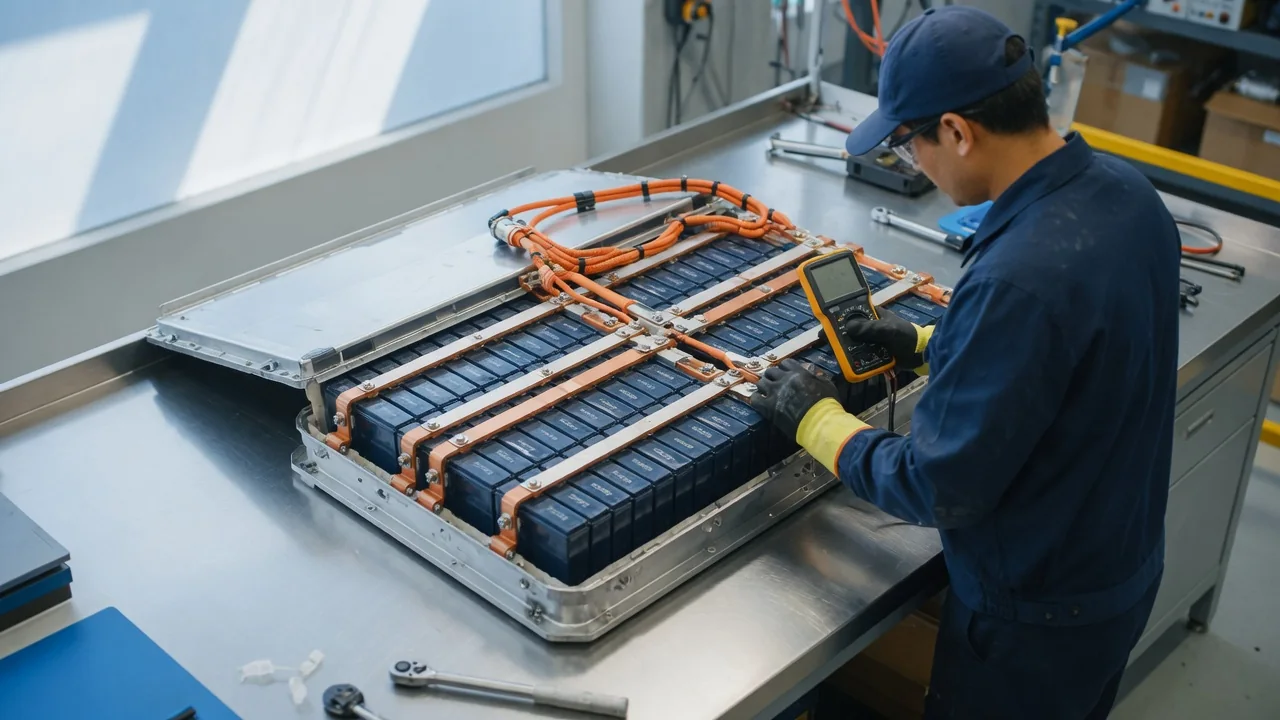
Battery cell balancing is the process an electric vehicle's battery management system uses to keep the individual cells in a pack at a similar state of charge. Cells connected in series share the same current but never behave identically, so small differences build up over time. Balancing corrects that drift. It lets the pack use more of its capacity, avoids stressing any single cell, and keeps charging and discharging predictable within safe voltage limits.
Cell voltage differences
An EV traction battery is built from many cells grouped into modules. The cell groups are connected in series to reach the pack's operating voltage. In a series string, the same current flows through every group, so in theory each group should charge and discharge by the same amount. In practice, no two cells are identical. Manufacturing tolerances leave small differences in capacity, internal resistance, and self-discharge rate. A cell with slightly less capacity reaches a given state of charge sooner than its neighbors. A cell with higher self-discharge slowly loses charge while the car is parked. Over many cycles and idle periods, these small differences add up.
Temperature is another source of mismatch, which is why balancing is closely tied to thermal management. Cells near a coolant inlet, at the edge of a module, or close to a heat source may run at different temperatures than cells in the center. Temperature affects the rate of chemical side reactions and the pace of aging. Cells that consistently run warmer or cooler can therefore age differently and drift apart in capacity and self-discharge. A thermal system that keeps temperatures uniform helps slow the growth of imbalance, but it cannot eliminate it.
The battery management system sees this mismatch mainly as voltage differences between cell groups. Cell voltage is related to state of charge. At rest, a group with a higher voltage than the others generally holds more charge relative to its capacity. That relationship is clearer for some chemistries than for others. Lithium iron phosphate, for example, has a very flat voltage curve across much of its range, so small state-of-charge differences are hard to detect from voltage alone except near the top or bottom. Voltage under load also differs from resting voltage because of internal resistance, and the system has to take that into account when it reads the measurements.
Control: how the battery management system balances cells
The battery management system directs balancing. Monitoring circuits measure the voltage of each series cell group and report it to a controller. The controller compares the readings, estimates each group's state of charge, and decides which groups need correction. Each manufacturer sets its own rules, thresholds, and timing, and there is no common standard. This section describes general methods, not the behavior of any particular vehicle.
The most common approach is passive balancing. Each cell group has a switchable resistor across it. When a group sits higher than the others, the controller connects the resistor and bleeds off a small amount of energy as heat until the group comes back in line. Passive balancing is simple, inexpensive, and reliable. However, it wastes the energy it removes, and it can only bring high cells down; it cannot raise a low one. The bleed current is kept small to limit heat inside the pack, so the process is gradual and can take a long time to correct a noticeable difference.
Active balancing moves energy instead of discarding it. It uses capacitors, inductors, or small transformer-based converters to transfer charge from higher groups to lower ones, or between a group and the rest of the pack. This recovers energy that passive balancing would turn into heat, and it can raise weak groups as well as lower strong ones. The trade-offs are more complex circuits, more components, and higher cost. The controller may also restrict balancing when temperature or other operating conditions are unfavorable.
Charge behavior
Imbalance shows up most clearly at the ends of the charge range. During charging, the battery management system watches for any cell group approaching its upper voltage limit. If one group is higher than the rest, it reaches that limit first. The system must then slow or stop charging to protect that group, even though the others could still accept energy. The pack reports full while part of its capacity goes unused. Discharge works the opposite way: the lowest group reaches its minimum voltage first, and the system must limit power or end usable range to protect it. In a series pack, the most out-of-line group sets the limit for every other group.
For this reason, many systems do much of their balancing near the top of the charge. That is where voltage differences are easiest to measure and where they matter most. As the pack approaches full, charging current typically tapers. During this slower final phase, a passive system's small bleed currents have more effect relative to the incoming current. Balancing may also continue after the charger stops or while the vehicle rests, because resting voltages give a clearer picture of each group's state of charge. Whether a vehicle balances during charging, after charging, or at specific charge levels depends on its design and software.
Practical implications and limits
For owners, balancing mostly happens without notice, but its effects can appear indirectly. The displayed range or state of charge may shift after a full charge. A car may seem to gain a little range after sitting plugged in, or a charging session may linger near the end. These behaviors are not necessarily faults. They can reflect the system refining its estimates or finishing a correction. Charging recommendations differ by chemistry and manufacturer. For a specific vehicle, the owner's manual is the authority on whether to do occasional full charges, set a regular charge limit, or leave the car on the charger longer.
Balancing also has firm limits. It corrects differences in state of charge, not differences in capacity or health. If a cell group has lost capacity or developed high internal resistance, balancing can align its charge level but cannot restore what was lost, and that group will keep limiting the pack. A persistent imbalance that the system cannot correct is often logged as a diagnostic condition. It may point to a failing cell, module, sensing circuit, or connection. Diagnosing and repairing that problem requires high-voltage training and equipment; changing charging habits will not fix it.
Long storage at a very low charge level deserves care. Self-discharge differences continue while the car sits, and the lowest groups have the least margin. Following the manufacturer's storage guidance keeps cells in a range the system can manage. Uniform temperatures and regular use support balancing, but they do not replace it.