What Is Anti-Squat Geometry? How Rear Suspension Resists Squat
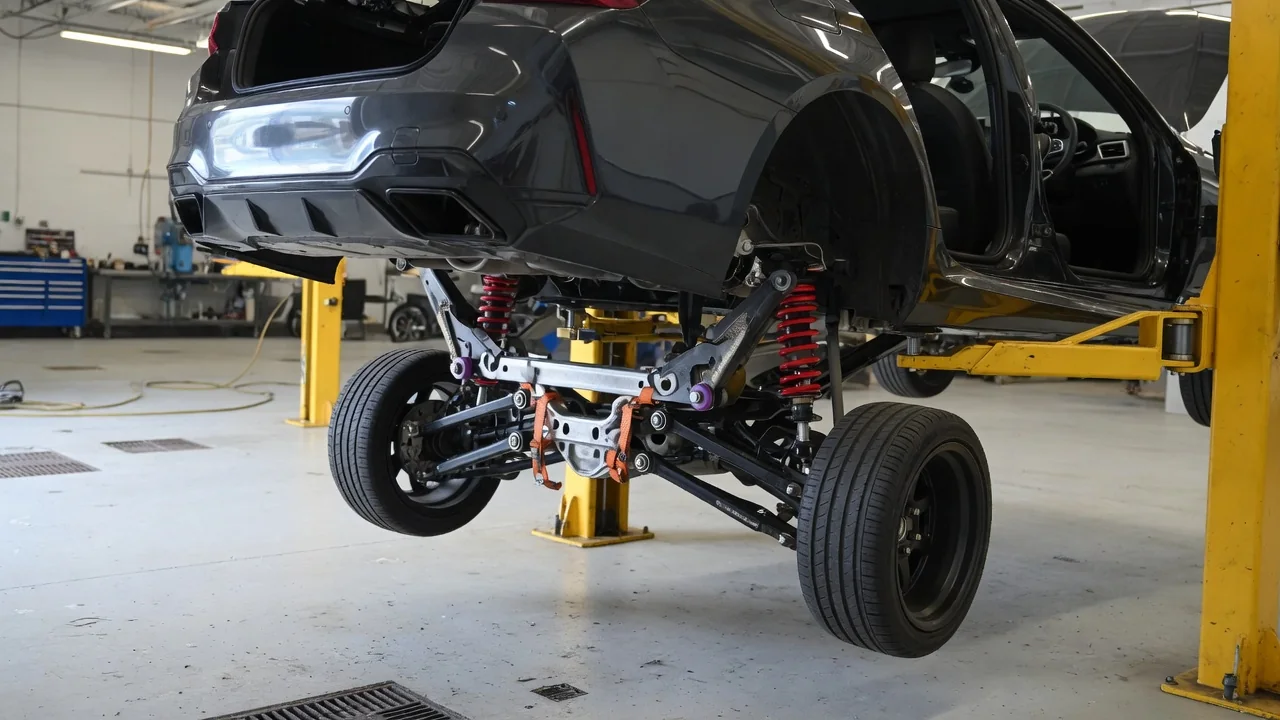
Anti-squat geometry is the way a suspension's linkage is arranged so that the forces from driving the wheels help keep the rear of the vehicle from sinking under acceleration. Instead of relying only on springs and dampers, the angles and pivot points of control arms or links turn part of the drive reaction into an upward force on the body. Rear suspension anti-squat is easiest to understand through three connected ideas: how acceleration moves load, how the vehicle's stance responds, and what that means for traction.
Acceleration forces
When a vehicle accelerates, the tires push it forward at ground level. The vehicle's mass, concentrated at its center of gravity, sits well above the road. That height difference creates a pitching moment, which causes longitudinal load transfer: weight shifts off the front tires and onto the rear tires. The amount transferred depends on the rate of acceleration, the height of the center of gravity, and the wheelbase. Suspension geometry does not change this total. At the same acceleration, a vehicle with a high center of gravity and a short wheelbase will always transfer more load than a low vehicle with a long wheelbase, no matter how its links are arranged.
What geometry does change is the path the transferred load takes into the body. Without anti-squat, the rear springs carry all of the extra rear load, so they compress and the tail drops. With anti-squat, the drive force at the tire is reacted through suspension links whose angles produce an upward component on the chassis. Designers locate this effect with the side-view instant center, the point where the lines of the suspension links effectively meet when viewed from the side. To gauge how strongly the geometry resists squat, a line is drawn through that instant center. For a live axle, where the axle housing reacts drive torque, the line starts at the tire contact patch. For independent suspension with a chassis-mounted differential, it starts at the wheel center.
Anti-squat is usually expressed as a percentage. At 100 percent, the geometric reaction exactly balances the load transfer, so the springs see no added compression during steady acceleration. Below 100 percent, some squat remains. Above 100 percent, the rear of the body can actually rise under power, a behavior sometimes called jacking. The percentage is calculated from the geometry together with center of gravity height and wheelbase, so the same hardware can produce different values on different vehicles.
Ride height
Anti-squat geometry and ride height affect each other in two directions. The first is the more obvious one: anti-squat directly controls how much the rear ride height changes when the driver applies throttle. A vehicle with little anti-squat settles noticeably at the rear during hard acceleration, which raises the nose and changes body pitch. A vehicle with substantial anti-squat holds a more level attitude. Pitch changes matter beyond appearance. They shift headlight aim and can alter aerodynamic balance on vehicles that are sensitive to it. In many independent rear suspensions, they also change camber and toe as the wheels move through their travel.
The second direction is that static ride height changes the anti-squat itself. The percentage depends on link angles and on where the instant center sits, so lowering or lifting a vehicle tilts the links and moves the instant center. Depending on the design, a lowered car may end up with noticeably more or less anti-squat than it had from the factory, and a lifted truck can see a similar shift. The geometry also changes continuously as the suspension compresses and extends, so a value quoted at static ride height is only a snapshot. This is one reason some aftermarket suppliers offer adjustable link mounting points or relocation brackets for certain platforms: they are meant to restore or tune link angles after a ride height change.
Load plays a role too. Adding passengers or cargo moves the center of gravity and compresses the rear springs, which changes both the load transfer and the link angles at the same time.
Traction context
Many people assume that more anti-squat means more traction, but the reality is more nuanced. During steady acceleration, the total vertical load on the rear tires is set by load transfer, not by the linkage, so anti-squat does not add grip in that steady state. Its influence shows up in transients: how quickly load reaches the tires when the throttle is applied, and how consistently it stays there. High anti-squat can load the tires almost immediately, because the force goes through the links instead of waiting for the springs to compress. That can help a launch. It can also make tire loads more abrupt and contribute to wheel hop, where the tires repeatedly grip and slip.
Lower anti-squat lets the body squat, which stores energy in the springs and gives the dampers a chance to smooth the transition. That can feel more progressive and handle bumps under power better, at the cost of more pitch. Neither direction is universally correct. The right balance depends on the vehicle's purpose, its tire characteristics, and its spring and damper rates.
Drive layout matters as well. Anti-squat as described here comes from drive forces, so it applies to driven axles. On a front-wheel-drive car, the rear axle carries no drive force, so its geometry provides essentially no anti-squat. The related concept at the front axle is anti-lift, which resists the nose rising as load shifts rearward. All-wheel-drive vehicles combine effects at both ends, in proportion to how drive torque is split between the axles.
Practical implications and limits
Owners rarely need to change anti-squat, but the concept helps explain how a vehicle behaves. Suppose a modified vehicle suddenly squats more, hops its tires on launch, or feels harsh over bumps while accelerating. In that case, link angles changed by a different ride height or by replacement parts are a plausible contributor, worth checking against the manufacturer's service information. Worn bushings can also let links deflect, which effectively shifts the geometry under load even when ride height looks correct.
Some things cannot be judged by eye. Anti-squat cannot be read reliably from a glance at the links; working it out requires the pivot locations, center of gravity height, wheelbase, and drive arrangement. On many designs, the same linkage also affects braking behavior, because braking forces at outboard brakes react through similar paths, so improving behavior under acceleration may compromise behavior under braking. Spring rate, damping, tire construction, and bushing compliance all interact with the geometry. Anti-squat is best seen as one design compromise among many. It is useful for understanding why a vehicle pitches the way it does, but it is not a single setting that guarantees better grip or comfort.