What Is Anti-Dive Geometry? Brake Forces, Body Pitch and Ride Tradeoffs
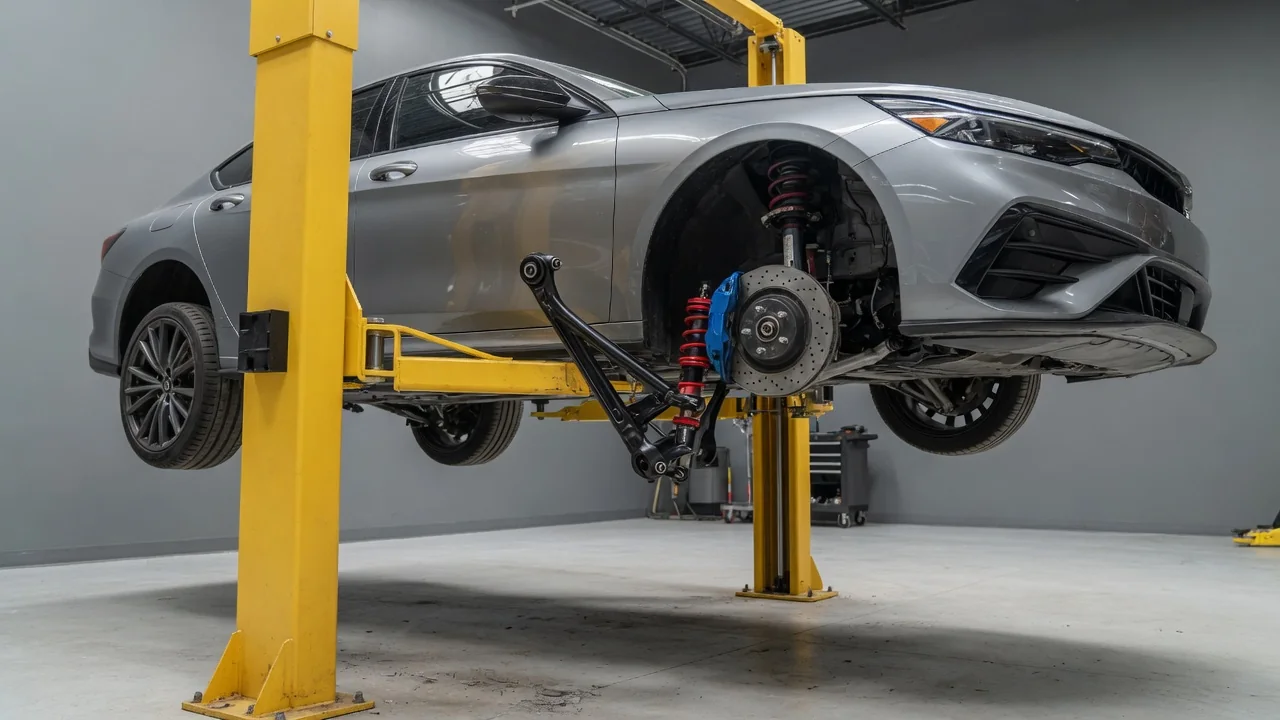
Anti-dive geometry is a way of arranging a vehicle's suspension linkages so that braking forces help hold up the front of the body. Instead of letting the nose drop entirely onto the front springs when the brakes are applied, angled control arms or links turn part of the braking load into an upward push on the chassis. Understanding what anti-dive geometry is, and what it costs, explains why suspension designers rarely use as much of it as they could.
Brake forces: where the load goes
When a car decelerates, the tires generate rearward forces at the road surface, but the vehicle's mass acts through its center of gravity, which sits well above the ground. That height difference creates a pitching moment that shifts load from the rear axle to the front axle. The amount of load transferred depends on the rate of deceleration, the height of the center of gravity and the length of the wheelbase. Suspension geometry does not change that total. A car with anti-dive transfers as much load to the front tires as an otherwise identical car without it; what changes is the path that load takes into the body.
In a layout with no anti-dive, nearly all of the transferred load passes through the front springs, so they compress until their force matches the new load. With anti-dive, the suspension links are inclined in side view so that the braking force at the wheel has a component that pushes up on the body through the links themselves. Engineers describe this with the side-view instant center, the imaginary point about which the wheel moves relative to the body at a given position. With outboard brakes mounted at the wheel, the relevant line runs from the tire contact patch to that instant center; with inboard brakes, which react their torque at the chassis, the line starts at the wheel center instead. The steeper that line compared with the ratio of center-of-gravity height to wheelbase, the larger the share of load carried by the links rather than the springs.
In engineering terms, the meaning of suspension anti-dive is usually expressed as a percentage. Zero percent means the front springs carry all of the front load transfer. One hundred percent means, in theory, the front springs do not deflect under braking because the geometry carries the entire transferred load. The front axle's share of total braking force also matters, since anti-dive only acts on the force generated at that axle.
Body pitch: dive at the front, lift at the rear
Body pitch is the nose-down rotation drivers see and feel when braking. It has two parts: the front suspension compressing, which is dive, and the rear suspension extending, which is rear lift. Anti-dive addresses the front. The equivalent treatment at the rear is usually called anti-lift, and it uses rear linkage geometry to resist extension while the rear brakes are working. Total pitch reflects both ends, so a vehicle can feel flat under braking because of geometry at one axle, the other, or both, in combination with its spring rates.
Limiting pitch matters for more than appearance. As the front compresses, camber and toe change according to the suspension's kinematic curves, so the tires may not meet the road at the angle intended for best grip. Large dive also uses up bump travel, leaving less room to absorb a pothole or ridge encountered while braking. Headlight aim drops, the rear tires unload further as the tail rises, and the body's attitude shifts relative to the airflow. Keeping the body closer to level helps the suspension stay within the range where its alignment settings were chosen. Dampers slow how quickly the body pitches, but they do not set how far it pitches under steady braking; that steady-state amount is what anti-dive influences.
Ride tradeoff: why designers stop short of 100 percent
If anti-dive reduces pitch without stiffer springs, it might seem logical to use as much as possible. In practice, the geometry that produces it has side effects. To create anti-dive at the front with outboard brakes, the side-view instant center generally sits behind and above the tire contact patch. That arrangement makes the wheel move forward as it rises. A wheel striking a bump ideally moves slightly rearward, away from the impact, so a forward-moving wheel path can send sharper jolts into the structure and make the ride feel harsher over sharp edges.
Many anti-dive layouts also change caster as the suspension moves, because the control arm pivots are angled rather than parallel. Caster that shifts during braking and over bumps can alter steering effort and self-centering feel, and it can introduce small steering disturbances. Under hard braking on rough pavement, a suspension carrying much of its load through the links is effectively stiffer in pitch, so wheel load can fluctuate more and the tire may find less consistent grip.
Driver feel is part of the equation as well. Some dive gives the driver a natural cue about how hard the car is braking, and a front end that stays almost perfectly flat can feel disconnected. For these reasons, road vehicles commonly use a partial amount of anti-dive, chosen as a compromise between pitch control, ride comfort, steering behavior and packaging, rather than chasing the theoretical maximum.
Practical implications and limits
For owners, the most relevant point is that anti-dive is built into the mounting points and arm angles of the suspension, not into a separate part that can be adjusted on most cars. Changes that alter those angles can change how the car pitches under braking. Lowering springs, lift kits, relocated control-arm brackets and some aftermarket bushings or caster-correction parts can move the instant center and raise or reduce anti-dive. The size of the effect varies by design, so a modification that seems minor may produce noticeable dive or a different steering feel, while another changes little. Manufacturer service information remains the reference for a specific vehicle's intended geometry and alignment.
Wear plays a part too. Soft or deteriorated control-arm bushings let the arms shift under braking load, which can blur the geometry and add clunks, vague steering or a pull. Worn shocks let the body reach its pitch angle abruptly and oscillate afterward, which can be mistaken for a geometry issue. Diagnosis therefore starts with inspecting bushings, ball joints, springs and dampers before assuming the design is to blame.
Anti-dive also has firm limits. It cannot add braking grip, shorten stopping distances on its own or reduce the total weight transfer created by deceleration. It acts only while the brakes are applied and depends on the braking force at that axle, so it does nothing during steady cruising. How much anti-dive a given vehicle has cannot reliably be judged by eye; it is a design property best understood from the vehicle's engineering data rather than from general rules.