What Is an Outer CV Joint? Purpose, Boot Care and Noise
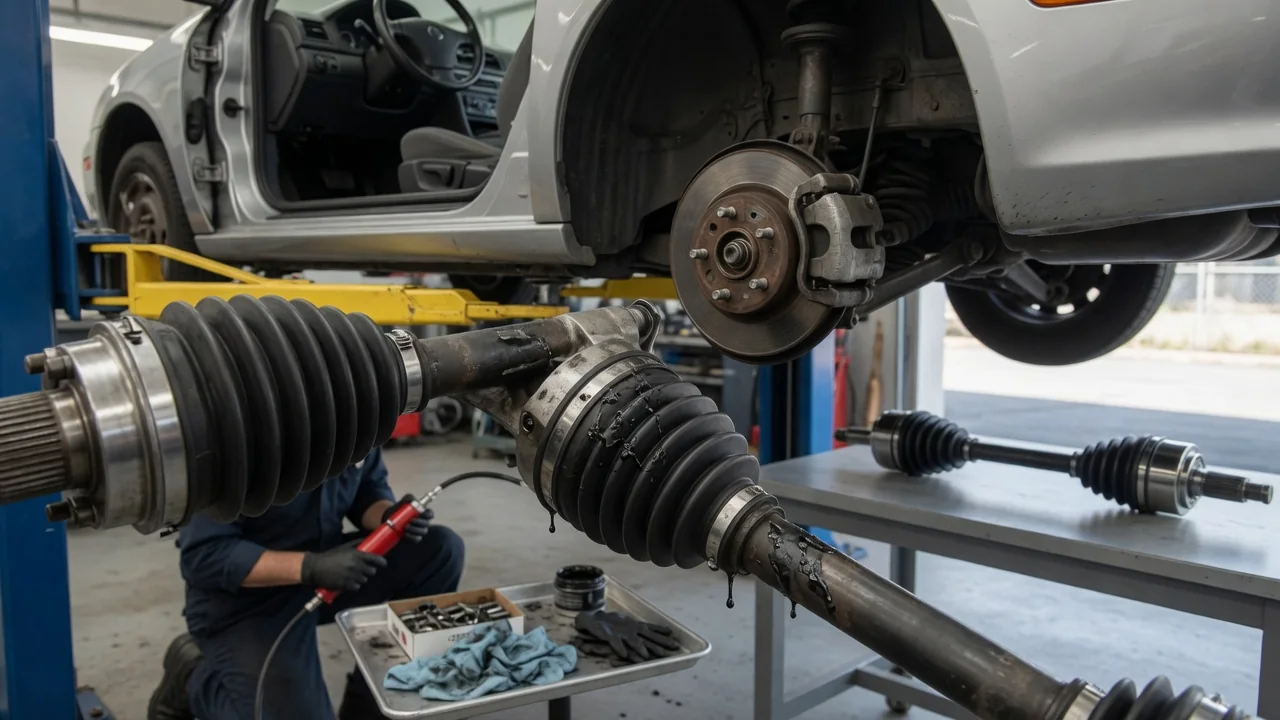
An outer CV joint is the constant-velocity joint at the wheel end of a drive axle, or half shaft. Its purpose is to deliver torque to a wheel that moves up and down with the suspension and, on the front of front-wheel-drive and most all-wheel-drive vehicles, also turns for steering. Knowing how it handles steering angle, why its boot matters and what a worn joint sounds like helps owners catch problems early.
Steering angle: the outer CV joint's main job
CV stands for constant velocity. A simple universal joint makes its output shaft speed up and slow down within each revolution when it runs at an angle, and the effect grows with the angle. A CV joint is built so the output turns at the same speed as the input throughout every revolution, even at a sharp angle. At the wheel, that prevents the vibration and steering tug that speed fluctuations would otherwise cause.
The outer joint faces the largest angles in the drivetrain because it sits beside the steering knuckle, which pivots whenever the steering wheel is turned. The most common outer design is the ball-and-cage, or Rzeppa, joint. An inner race splined to the axle shaft sits inside a bell-shaped outer housing, usually formed together with the stub shaft that passes through the wheel hub. Steel balls ride in curved grooves between the two, held in place by a cage that keeps them in a plane bisecting the angle between the shafts. That geometry is what delivers constant velocity across a wide range of articulation.
The outer joint is normally a fixed type: it bends widely but does not slide. Changes in axle length as the suspension moves are absorbed by the inner joint near the transmission, typically a plunging tripod or double-offset design working at smaller angles. How far an outer joint can articulate depends on its design, and it is one of the limits engineers consider when setting how sharply the front wheels can turn. Driven rear wheels on independent suspensions also use outer joints, but because those wheels generally do not steer, the joints see less angle.
Boot care: why the boot decides joint life
The joint runs in special grease sealed inside a flexible, accordion-shaped boot clamped to the housing at one end and the axle shaft at the other. That boot is the only barrier keeping water, grit and road salt away from the precision surfaces inside. The outer boot works harder than the inner one: its folds stretch and compress through large angles with every steering movement, and it sits where stones and debris can strike it. Age, heat, ozone and loose clamps add to the risk of cracks and splits.
A visual check fits naturally into tire rotations, oil changes or any time the vehicle is raised. Turning the steering to full lock opens the folds and makes small cracks easier to spot. The clearest warning is grease where it does not belong: dark streaks flung across the inside of the wheel, brake parts, suspension components or the fender liner. Clamps should be tight and seated, and the boot should not be split, collapsed or rubbing on nearby parts.
Timing determines what a torn boot costs. Caught before contamination and before any noise, the joint can often be saved by replacing the boot, provided the old grease is cleaned out and the joint is repacked with the grease type and amount specified for it; general chassis grease is not a substitute. Once grit has entered the grooves and the joint clicks, a new boot cannot reverse the wear, and the joint or the complete axle normally needs replacing.
Noise: recognizing a worn outer CV joint
The textbook symptom of a worn outer CV joint is rhythmic clicking or popping when accelerating through a turn, most noticeable in tight, low-speed maneuvers such as parking lots and U-turns. The clicks usually quicken as speed rises. Wear in the ball grooves and cage creates play, and under load at a steep angle the balls snap across worn spots instead of rolling smoothly. Because steering angle exposes the worn surfaces, the noise often fades when the wheels are straight.
Other sounds are less specific. A clunk when shifting between drive and reverse, or when going on and off the throttle, can come from joint play, but worn mounts and suspension parts sound similar. Vibration that builds under acceleration at highway speed is more often linked to a worn inner joint. A hum or growl that changes with speed and load in gentle curves points more often to a wheel bearing. Separating these matters, because a new axle will not cure a bearing or mount problem.
A simple test helps narrow things down: in an empty, open area, drive slowly in full-lock circles in each direction with light throttle and the windows open, noting whether clicking appears and which turn makes it loudest. With the vehicle safely supported, the axle can be checked by hand for excessive play while the boots are inspected. These checks give useful clues, not a final diagnosis.
Practical implications and limits
In practice the outer joint is a wear part whose lifespan depends largely on its boot. With an intact seal and clean grease, it often lasts a long time; once contaminated, wear accelerates at a rate that depends on driving conditions. Failure rarely comes without warning, but an ignored clicking joint keeps deteriorating, and in severe cases it can come apart, leaving that wheel without drive and risking damage to nearby parts. New clicking is a reason to inspect, not just a nuisance to tolerate.
Many repairs replace the entire axle shaft assembly, with joints and boots preassembled, because it saves labor and avoids handling contaminated parts; on some designs individual joints or boot kits are fitted instead. Axle nut torque, whether that nut can be reused, how the inner end is retained and which grease is required are vehicle-specific, so the service manual for the exact model is the reference.
General descriptions also have limits. Joint type, boot material and axle mounting differ between vehicles, and suspension geometry determines how much angle a given outer joint actually sees. Lifting or lowering a vehicle changes those working angles and can add stress to joints and boots. The noise patterns described here are typical rather than conclusive, so a hands-on inspection should confirm the source before parts are bought.