What Is an Open Differential? How It Works, Where It Struggles, and How to Service It
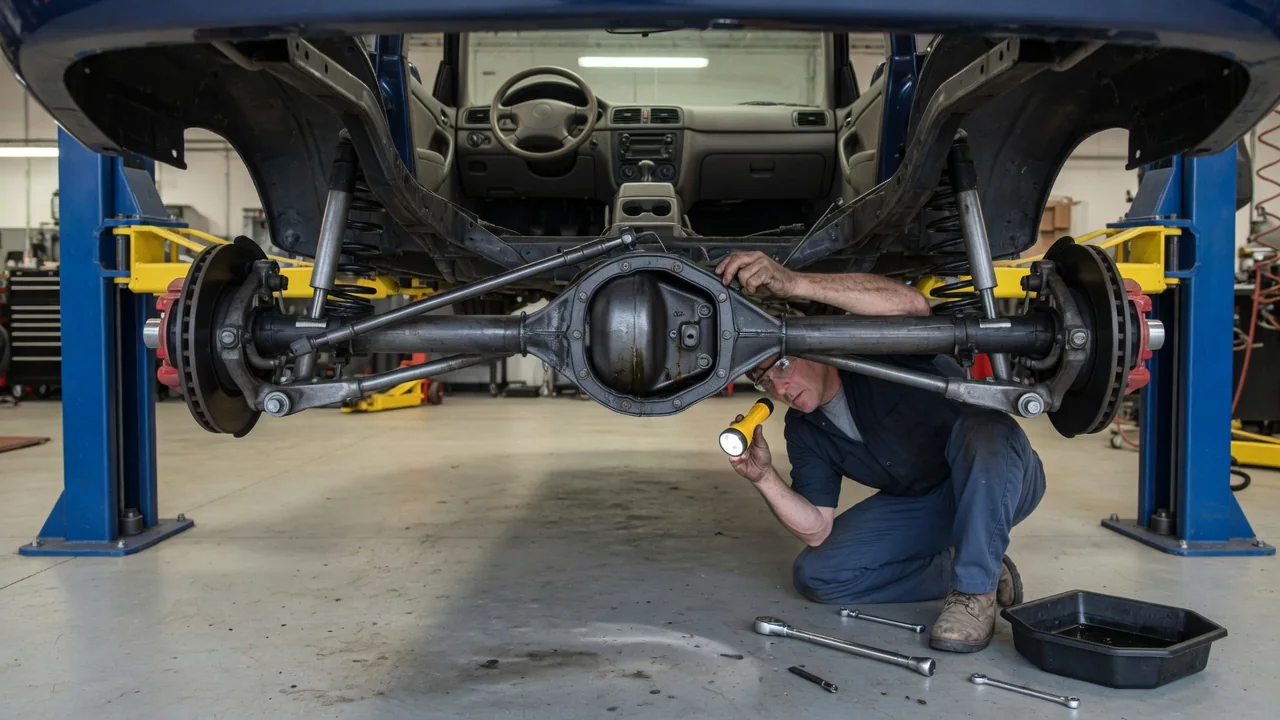
An open differential is the simplest and most common type of differential in cars, trucks, and SUVs. It sits in the drive axle or transaxle, splits engine torque between two wheels, and lets them turn at different speeds. That freedom makes cornering smooth and quiet, but it also explains a well-known weakness: when one wheel loses grip, the vehicle can struggle to move. Understanding open differential behavior helps owners make sense of what they feel on slippery roads and what maintenance the unit needs.
Wheel-speed freedom
When a vehicle turns, the outside wheel travels a longer arc than the inside wheel in the same amount of time, so it must rotate faster. If both driven wheels were tied to a single solid shaft, one tire would have to scrub or skip across the pavement in every corner. That would add tire wear and driveline stress and make the vehicle feel reluctant to turn. The differential solves this by letting the two output shafts rotate at different speeds while both still receive drive.
Inside a typical open differential, the driveshaft or transmission output turns a ring gear bolted to a carrier, also called the case. The carrier holds small pinion gears, often called spider gears, on a cross shaft. These mesh with two side gears, each splined to an axle shaft or half-shaft. When the vehicle drives straight, the spider gears do not rotate on their shaft; the whole assembly turns as one unit, and both wheels spin at the same speed. In a turn, the spider gears begin to rotate on their shaft, letting one side gear speed up while the other slows down by the same amount.
This creates a simple rule: the carrier speed is always the average of the two wheel speeds. If one wheel slows, the other speeds up to keep that average. Nothing in the gearing restrains how large the difference can become, which is why the design is called open. The same principle applies whether the differential is in a rear axle, a front-wheel-drive transaxle, or the front axle of a four-wheel-drive system.
Traction limitation
The other half of the story is torque. In an open differential, the spider gears act like a balance beam, so the torque delivered to each side is essentially equal, apart from small internal friction losses. That equal split works well when both tires have similar grip. It becomes a limitation when they do not, because the wheel with less traction sets the ceiling for the torque both wheels can receive.
Picture one drive wheel on ice and the other on dry pavement. The icy tire can resist only a small amount of torque before it breaks loose. Because the differential sends the same torque to the dry side, the wheel with good grip receives that same small amount, which may not be enough to move the vehicle. Meanwhile, the wheel-speed freedom described above lets the slipping tire spin faster and faster. With the carrier turning and the wheel on pavement stationary, the spinning wheel turns at roughly twice the carrier speed.
The same thing happens when a wheel lifts off the ground over uneven terrain, or when hard acceleration out of a corner unloads the inside tire. Many modern vehicles counter this electronically: traction control can apply the brake on a spinning wheel, creating resistance that allows the differential to pass more usable torque to the wheel with grip. Limited-slip and locking differentials address the problem mechanically, but they are different designs with their own behavior and service needs.
Service
An open differential is mechanically simple, but it depends on clean lubricant of the correct type and level. In a separate axle housing, it usually has its own gear oil, filled through a plug in the housing or cover. In many front-wheel-drive transaxles, the differential shares fluid with the transmission. The correct fluid specification, capacity, and change interval vary by vehicle and are listed in the owner's manual or service information. Severe use, such as towing, off-road driving, or water crossings, may call for more frequent attention.
Routine inspection focuses on leaks and noise. Oil seeping at the pinion seal where the driveshaft enters, at the axle seals, or around the cover gasket can lower the level over time, and a blocked axle vent can push fluid past seals. A whine that changes with throttle or speed often points to ring-and-pinion or bearing wear. Clunking during turns or when getting on and off the throttle can come from worn spider gears or excessive gear backlash, but also from other driveline parts such as CV joints, U-joints, and mounts. Because symptoms overlap, a proper diagnosis matters before replacing components.
A few habits help the unit last. Avoid prolonged one-wheel spinning when stuck, since the spider and side gears then rotate against each other at high relative speed under load and can overheat. Keep tire sizes and wear consistent across a driven axle, because a mismatch forces constant differential action. When changing fluid, follow the specification for that exact unit rather than a general assumption about differential type.
Practical implications and limits
For everyday driving on paved roads, an open differential is largely invisible. It allows quiet, predictable turning, adds little weight or complexity, and has no clutch packs to wear out. That is a large part of why it remains the default in so many passenger vehicles. Its weakness shows up mainly on snow, ice, mud, wet grass, loose gravel, or terrain that unloads one wheel.
In those conditions, gentle throttle usually works better than more throttle, because extra power mostly spins the wheel with the least grip. Tires suited to the conditions often make a bigger difference than driving technique. In vehicles with traction control, leaving the system on typically lets it manage wheelspin, although some vehicles offer modes intended for deep snow or sand where a little wheelspin helps. The owner's manual explains how a particular system is meant to be used.
It also helps to know what a drivetrain label does and does not tell you. A vehicle described as all-wheel drive or four-wheel drive may still use open differentials at one or more axles, so it can lose forward progress when wheels lose grip in the wrong combination unless electronic or mechanical aids intervene. Conversely, an open differential paired with well-calibrated traction control can perform better in slippery conditions than the mechanical layout alone suggests. Exact behavior depends on the specific hardware and software, so manufacturer documentation is the authority for any individual vehicle.