What Is an Iron Remover for Car Paint? Chemistry, Application and Rinsing
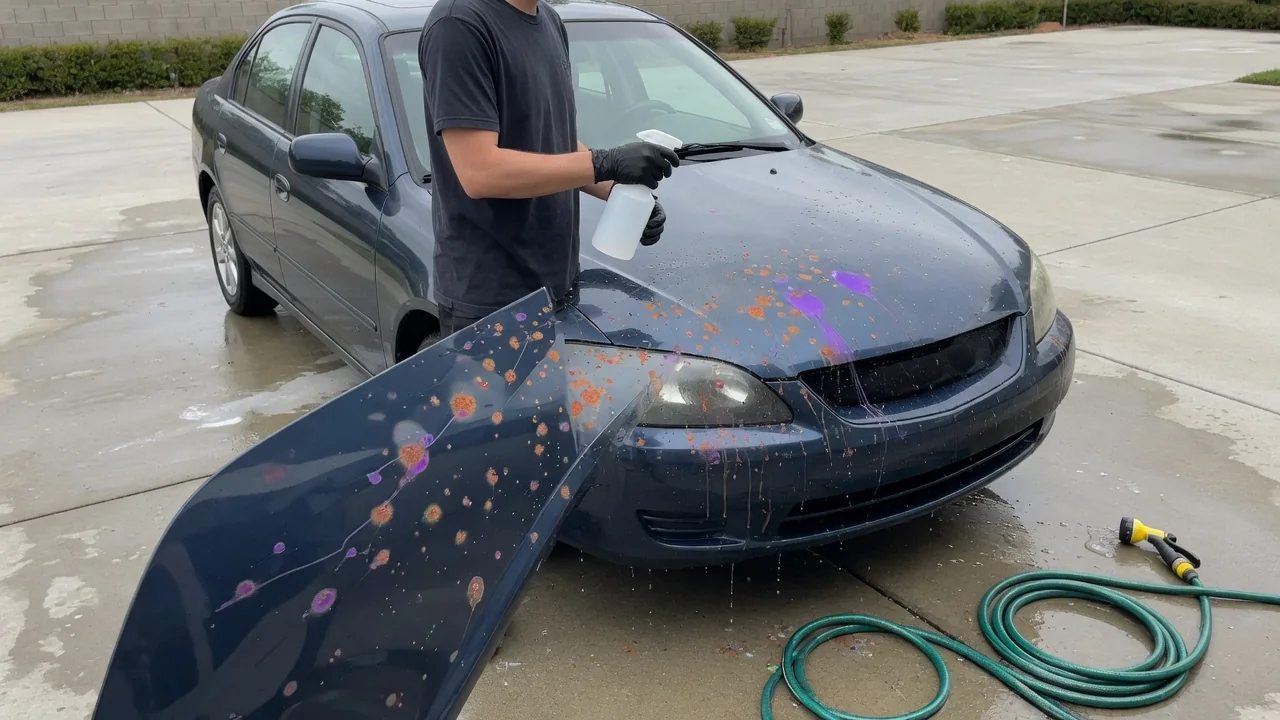
An iron remover is a chemical decontamination product that dissolves tiny iron particles stuck to a car's paint, wheels and glass. These particles come mostly from brake dust and other metallic fallout, and ordinary car shampoo usually cannot lift them because they are lodged in the surface. In iron remover car detailing, the product sits between washing and mechanical decontamination such as claying. Knowing how it reacts, how to apply it and how to rinse it off explains both its usefulness and its limits.
Particle chemistry: how iron removers react with fallout
Iron contamination usually begins as microscopic metal fragments. When brake pads clamp against iron rotors, both surfaces wear and release fine dust containing iron. Some of these particles are hot when they leave the brake and can lodge in the clear coat, especially on wheels and the lower body panels behind them. Rail dust from train lines, grinding debris near industrial sites and metallic fallout from construction can add more. Once lodged, the iron begins to oxidize in the presence of moisture and air. Over time this can appear as tiny orange or brown specks, and the paint may feel rough to the touch even after a thorough wash.
Most consumer iron removers are built around thioglycolate salts, commonly ammonium or sodium thioglycolate, dissolved in water with surfactants and other additives. The thioglycolate reacts with iron, particularly oxidized iron, and forms a soluble, intensely colored complex. That is why the product turns purple or reddish where contamination is present, an effect detailers often call bleeding. The color shift is a visible sign that a reaction is taking place, and the resulting complex can then be carried away with water. Because the reaction is selective toward iron, the product can address metal fallout without the abrasion involved in polishing or claying.
Thioglycolate-based removers are usually formulated to be close to neutral or mildly alkaline, which is part of why they are widely marketed for use on paint. Some wheel-specific or heavy-duty fallout products instead rely on acids such as oxalic acid, which can dissolve rust effectively but are harsher on sensitive finishes and should be limited to the surfaces their labels allow. The distinctive sulfur odor of most iron removers comes from the thioglycolate chemistry itself. Formulations differ, so this is a general mechanism rather than a guarantee of how any particular product behaves.
Application: preparing the surface and letting it dwell
An iron remover works best on a surface that has already been washed, so that loose dirt and road film do not block contact with embedded particles. The panels should be cool and out of direct sun. Heat speeds evaporation, and a product that dries on the surface stops working effectively and becomes harder to remove. Many detailers also remove most standing water first, because heavy water can dilute the spray. Gloves and eye protection are sensible, and good ventilation helps with the odor when working in a garage.
The product is usually sprayed evenly across a panel and left to dwell for the time the label specifies. During this period the color change typically appears around contaminated areas, often most strongly on lower doors, rear bumpers and wheels. Working one section at a time makes it easier to keep the product wet. If it begins to dry, a light additional mist can rewet it, but the goal is to rinse before drying rather than to extend dwell time indefinitely. On heavy contamination, gentle agitation with a clean, soft wash mitt or a dedicated wheel brush can help the solution reach particles, provided the motion stays light.
Iron remover is commonly used before clay or other mechanical decontamination. Dissolving much of the iron first means fewer hard particles are dragged across the paint during claying, which lowers the risk of marring. Foam or gel versions are designed to cling to vertical panels longer, while thin sprays spread quickly over larger areas. Following the dilution and dwell directions for the specific product matters more than any general habit, because concentrations and intended surfaces vary between formulas.
Rinsing: removing dissolved iron and product residue
Rinsing is the step that actually removes the dissolved iron complex and leftover chemistry from the car. A thorough rinse with a hose or pressure washer, working from the top of the vehicle down, lets clean water flow over treated panels rather than re-wetting them with runoff. Particular attention should go to areas where liquid collects: panel gaps, badges, mirror housings, window seals, fuel door recesses and the inner faces of wheels. Product trapped in these spots can drip out later and leave streaks or marks on freshly cleaned paint.
Residue left to dry can be difficult to remove and may mark some surfaces, including unpainted plastic trim, rubber and certain sensitive wheel finishes. For this reason many detailers follow the rinse with a quick wash using a pH-neutral shampoo, which helps remove any remaining film before drying. If purple traces still appear after rinsing, that usually indicates either remaining contamination or product that was not fully flushed; a second rinse, and if necessary a second application, is more appropriate than scrubbing harder. After the final rinse, the surface can be dried and checked by touch to judge whether claying is still needed.
Practical implications and limits
An iron remover addresses one specific category of contamination. Tar, tree sap, paint overspray, bug residue and mineral water spots are not iron and usually require solvents, dedicated removers or mechanical decontamination. The product also cannot reverse damage that has already occurred. If a rusting particle has etched a small pit in the clear coat, removing the iron leaves the pit behind, and any repair falls into the territory of polishing or refinishing rather than chemical cleaning. The intensity of the purple reaction is a useful visual cue, but it is not a precise measurement of how much contamination was present.
How often a car benefits from iron decontamination depends on conditions rather than a fixed calendar. Frequent hard braking, parking near rail lines or industrial areas, and the type of brake components fitted all influence how much fallout accumulates. Contamination also tends to be more visible on light-colored paint than on dark paint, even when the amount is similar. Because the chemistry can weaken some waxes and sealants, the label should be checked for compatibility with existing protection, and reapplying a protective layer afterward is common practice. Ceramic coatings vary as well, so the coating maker's guidance takes priority.
Some finishes deserve particular caution. Matte or satin paint, bare or polished aluminum, chrome, anodized parts and older single-stage paint may react differently from a modern clear-coated finish, and the owner's manual or the finish manufacturer's care instructions should guide whether an iron remover is appropriate. Testing on a small, inconspicuous area first is prudent whenever compatibility is uncertain. Used within those limits, an iron remover is a targeted tool for a specific problem rather than a replacement for regular washing, claying or paint correction.