What Is an Ignition Coil?
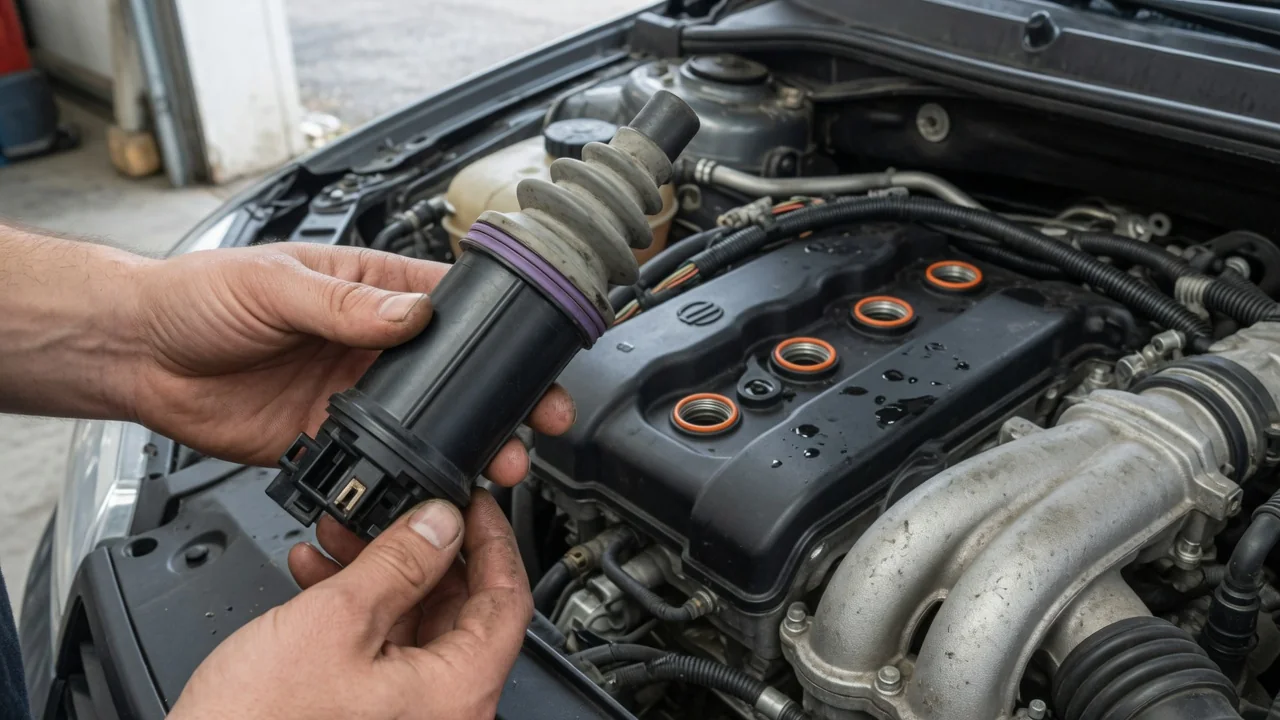
If you have ever wondered what is an ignition coil, the short answer is that it is a compact transformer that turns the modest voltage of a car's battery into the far higher voltage a spark plug needs. Every gasoline engine relies on that step-up to ignite its air-fuel mixture, and understanding how it works makes rough running, warning lights, and repair conversations easier to interpret.
Electrical conversion
A vehicle's electrical system runs at roughly twelve volts, which is nowhere near enough to push current across the gap of a spark plug inside a compressed cylinder. The ignition coil solves that problem with two windings of wire wrapped around an iron core. The primary winding has relatively few turns of thicker wire, while the secondary winding has many more turns of very fine wire. That difference in turn count is what allows a low input voltage to become an output measured in many thousands of volts.
The conversion depends on a magnetic field rather than a direct connection. Current flowing through the primary winding builds a field in the core, and when the engine computer or ignition module abruptly switches that current off, the field collapses and induces a high voltage in the secondary winding. Layout differs by vehicle: older engines often use a single coil feeding a distributor, some use coil packs serving pairs of cylinders, and many modern engines place an individual coil directly on each spark plug.
Spark event
The spark event begins when the high voltage leaves the coil and reaches the center electrode of the spark plug, either through a plug wire or a short boot on a coil-on-plug design. Once the voltage is high enough to ionize the mixture in the gap, current jumps to the ground electrode as a brief arc. That arc ignites the compressed air-fuel charge, and the resulting pressure pushes the piston down to produce power.
Timing matters as much as voltage. The engine computer uses crankshaft and, on many engines, camshaft position signals to decide exactly when to cut primary current so the spark arrives slightly before the piston reaches the top of its compression stroke. The time the coil spends charging, often called dwell, is also managed so the coil stores enough energy without overheating. Drivers cannot see any of this, but a smooth idle and crisp throttle response are signs that the sequence is happening consistently on every cylinder.
Misfire clues
When a coil cannot deliver enough energy, the mixture in that cylinder may fail to ignite, which is a misfire. Typical clues include a shaky idle, hesitation or stumbling under acceleration, a loss of power on hills, harder starting, and worse fuel economy. A check engine light may illuminate, and a flashing light generally signals a misfire severe enough to risk damaging the catalytic converter with unburned fuel, so easing off and having the vehicle checked promptly is the sensible response.
Stored fault codes can point toward a particular cylinder or an ignition circuit, but a code is evidence to interpret, not proof that a coil has failed. Worn spark plugs, cracked boots, oil in the plug wells, fuel injector faults, vacuum leaks, and low compression can all produce similar symptoms. Generic misfire codes are widely shared across makes, while other codes are manufacturer-dependent and need vehicle-specific confirmation. That is why technicians test before replacing parts, often by comparing readings or seeing whether the misfire follows a coil moved to another cylinder.
Everyday Use and Observations
In daily driving, an ignition coil works without any attention from the driver, firing countless times on every trip. It lives in a harsh place, however, exposed to engine heat, vibration, and sometimes moisture or leaking oil, and those conditions gradually stress its insulation and windings. Spark plugs also affect it: as electrodes wear and the gap widens, the coil has to generate higher voltage to bridge it, which adds strain. Keeping plugs maintained according to the owner's manual schedule therefore helps the coils too.
Owners can notice useful patterns without tools. A misfire that appears mainly in damp weather, after washing the engine bay, or under heavy load such as towing or merging can hint at voltage leaking through weak insulation instead of reaching the plug. With the engine off and cool, a visual check may reveal cracked housings, corroded connectors, or oil pooled around the coil boots. Where the coils sit varies widely; some are plainly visible on top of the engine, while others hide beneath covers or intake components.
Limits and Next Steps
Understanding the coil has limits as a diagnostic tool. Symptoms overlap heavily with fuel, air, and mechanical faults, and an intermittent coil can behave normally when cold and fail only when hot, which makes casual checks unreliable. The secondary side of the ignition system also carries voltage high enough to deliver a painful and potentially dangerous shock, so probing or unplugging components on a running engine is not a job for guesswork. Hybrid vehicles add further high-voltage systems that demand trained handling.
A practical next step is to note when the problem occurs, whether the warning light is steady or flashing, and any codes retrieved with a scan tool, then share those details with a qualified technician. Specifications, coil design, access, and recommended service practices differ by make, model, and engine, so the service information for the specific vehicle should guide any testing or replacement. Diesel engines are a notable exception to all of this, since they ignite fuel through compression and do not use ignition coils or spark plugs at all.