What Is an HVAC Expansion Valve? How It Works in Car AC Systems
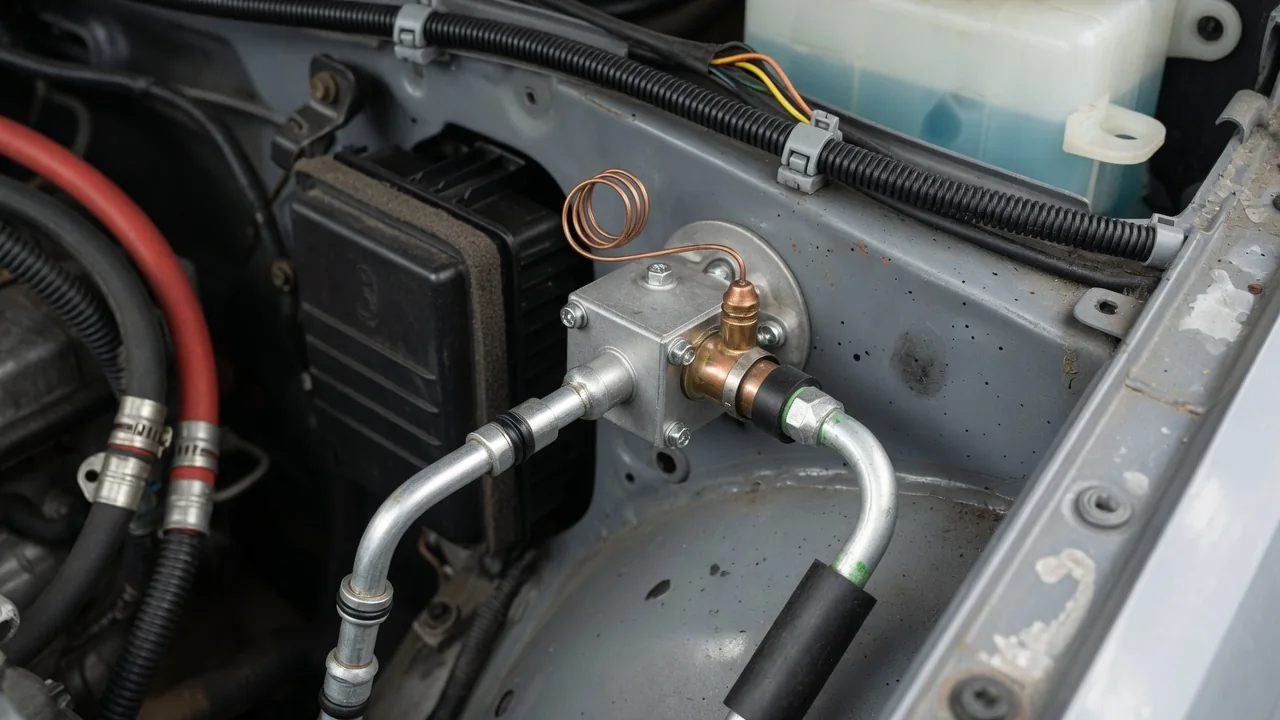
An HVAC expansion valve is the metering device that controls how much refrigerant enters the evaporator in an air conditioning system. In a car AC system, it sits between the high-pressure side and the evaporator behind the dashboard. It turns warm, pressurized liquid refrigerant into a cold, low-pressure mixture that can absorb heat from cabin air. Knowing what a car AC expansion valve does explains why it matters for cooling performance and how its failures show up.
Refrigerant Pressure Drop at the Expansion Valve
The compressor raises the pressure and temperature of refrigerant vapor. The condenser, usually mounted at the front of the vehicle, sheds that heat to outside air, and the refrigerant condenses into a high-pressure liquid. That liquid then reaches the expansion valve, which works as a small, adjustable restriction. As the liquid is forced through the narrow opening, its pressure falls sharply. Part of it flashes into vapor right away, and this sudden boiling pulls heat from the remaining liquid, lowering its temperature. What leaves the valve is a low-pressure, low-temperature mix of liquid and vapor. This restriction is also the dividing point between the system's high side and low side.
The common automotive design is the thermostatic expansion valve, or TXV. Its sensing element contains a charge whose pressure rises and falls with temperature. In some designs this is a bulb clamped to the evaporator outlet line; in the block-style valves used in many cars, the sensing element sits in the outlet passage inside the valve body. The charge pushes on a diaphragm, balanced against a spring and evaporator pressure, and that balance moves a pin that sets the opening. A warmer evaporator outlet opens the valve further; a cooler outlet closes it down. Not every vehicle uses a TXV. Many use a fixed orifice tube with an accumulator instead, and some newer systems, including some in electrified vehicles, use electronically controlled expansion valves driven by a control module.
How the Expansion Valve Supports Cooling
Lowering the pressure lowers the temperature at which refrigerant boils. Inside the evaporator, the low-pressure refrigerant boils as the blower pushes cabin or outside air across the fins. Changing from liquid to vapor absorbs a large amount of heat, so the air leaving the evaporator comes out cooler. It also comes out drier, because moisture condenses on the cold fins and drains out of the vehicle. That is why the AC also helps clear a fogged windshield.
The valve's main job is to feed the right amount of refrigerant, not simply as much as possible. Ideally, refrigerant boils across most of the evaporator coil and is fully vaporized just before the outlet, leaving slightly warmer than its boiling point. That margin is called superheat. If too little refrigerant enters, the evaporator is starved: part of the coil does little useful cooling. If too much enters, the evaporator floods, and liquid can travel toward the compressor, which is built to compress vapor, not liquid. Heat load keeps changing with outside temperature, sun, recirculation setting, blower speed and compressor output, and the valve keeps adjusting its opening to match.
The expansion valve does not set the cabin temperature you choose on the controls. Blend doors and the climate control logic mix cooled air with heated air to reach that setting. Other components keep the evaporator from icing, such as an evaporator temperature sensor, a cycling switch or a variable-displacement compressor, depending on the design. The valve's role is narrower: it meters refrigerant into the evaporator so the coil can work efficiently under whatever conditions the rest of the system creates.
Common Expansion Valve Faults and Symptoms
A valve that is stuck closed or restricted starves the evaporator. Common causes include debris circulating in the system, such as material from a failed receiver-drier or metal particles from a worn compressor. Moisture in the system can also freeze at the metering opening. Typical signs are weak or no cooling, a low-side pressure lower than expected, and frost on the valve or the lines next to it. Moisture freezing and thawing can cause cooling that works, fades and then returns. If the sensing element loses its charge, the valve generally moves toward closed, which produces similar starving symptoms.
A valve that is stuck open, or that overfeeds, has the opposite effect. Low-side pressure tends to read higher than expected and cooling is poor, because the evaporator is flooded rather than boiling refrigerant efficiently. The suction line may be very cold or frosted all the way back toward the compressor, and liquid reaching the compressor can cause noise and wear. On designs with an external sensing bulb, a bulb that has come loose from its line or lost its insulation can misread outlet temperature and make the refrigerant feed erratic.
These symptoms overlap heavily with other problems. Low refrigerant charge, overcharge, poor airflow across the condenser, compressor or clutch faults, and blend door problems can all cause weak cooling or unusual pressures. Diagnosing the valve means reading both high- and low-side pressures, comparing them with ambient conditions and the manufacturer's service information, and checking line and vent temperatures. No single reading proves the valve has failed.
Practical Implications and Limits
For most owners, the expansion valve should not be the first suspect when the AC blows warm. Simpler checks come first: whether the compressor engages, whether the cabin air filter is clogged, whether the blower and cooling fans run, and whether the condenser is blocked by debris. Valve location varies by vehicle. It is often at or near the firewall, but on some designs it sits inside the HVAC housing, where reaching it can mean significant disassembly. The vehicle's service information is the reliable guide to location, labor and specifications.
Replacing a valve requires opening the sealed refrigerant circuit. The refrigerant must first be recovered with proper equipment. In the United States, venting it is prohibited and technicians who service vehicle AC systems must be certified under EPA rules. The refrigerant type on the under-hood label, typically R-134a or R-1234yf in modern vehicles, must be respected, because the two are not interchangeable. Technicians commonly replace the receiver-drier or accumulator whenever the system is opened or contaminated, and they install new compatible seals. They then evacuate the system and recharge it by weight to the specified amount. If debris clogged the valve, the source must be found and addressed, or the new valve can fail the same way.
Many service professionals also warn against sealant-type additives, because they can contribute to restrictions in small passages such as the valve's metering opening. Keep in mind that this article describes general principles. Valve design, normal pressure ranges and control strategies differ between vehicles, so model-specific diagnosis and repair should always follow the manufacturer's procedures. Understanding the valve's role still helps owners describe symptoms clearly and make sense of a technician's findings.