What Is an Evaporator Core in a Car? Cooling, Condensation and Odor
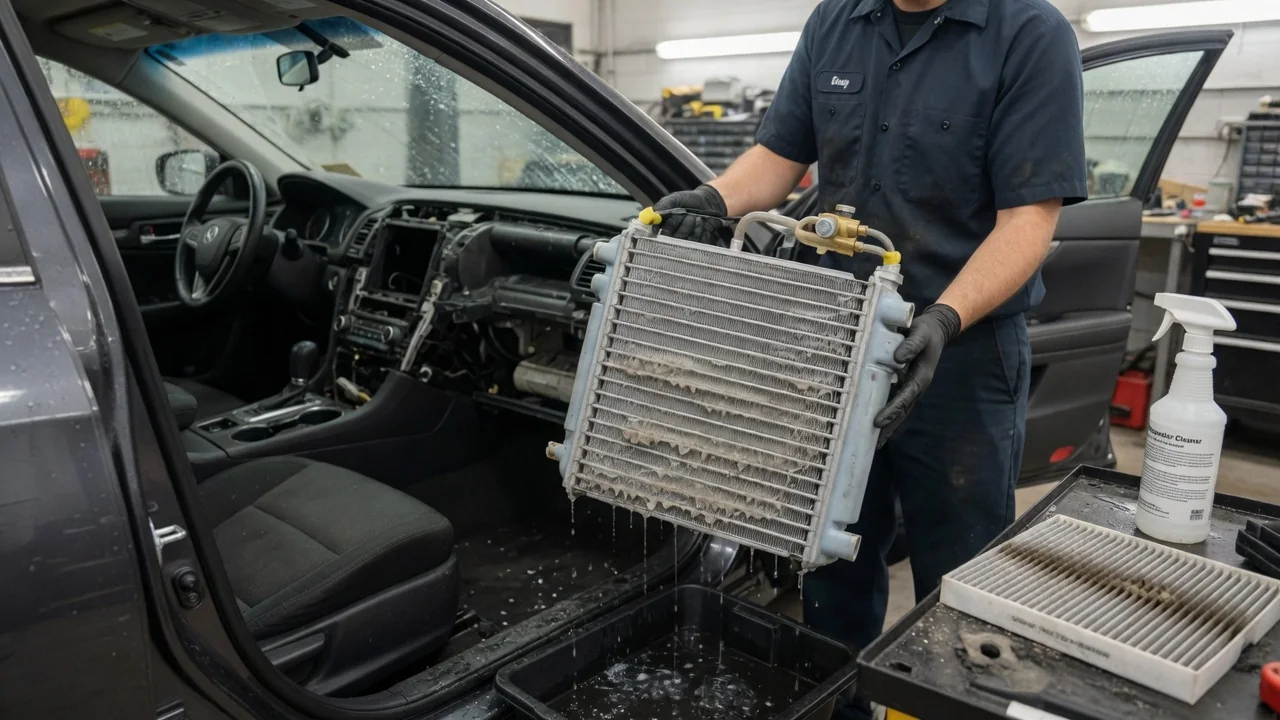
An evaporator core is the heat exchanger inside a car's air conditioning system that chills the air you feel from the vents. It sits within the HVAC housing, usually behind the dashboard, where the blower pushes cabin or outside air across it. Knowing what the car AC evaporator core does explains three everyday experiences: cold airflow, water dripping under the vehicle, and the musty smell some systems develop over time.
Cooling air
The evaporator core is a compact heat exchanger built from rows of small tubes or stacked plates joined to thin fins, most commonly made of aluminum. Refrigerant reaches it after passing through an expansion valve or orifice tube, which sharply drops its pressure and temperature. Inside the core, that cold, low-pressure refrigerant absorbs heat from the air flowing across the fins and boils into vapor, which is where the component gets its name. The vapor then travels back to the compressor, is pressurized, and moves to the condenser at the front of the vehicle, where the collected heat is released to outside air. The evaporator is therefore the point where heat is removed from the cabin side of the system.
Airflow follows a path set by the HVAC housing. The blower fan draws in either outside air or recirculated cabin air, often through a cabin air filter, and pushes it across the evaporator. Downstream, a blend door determines how much of that chilled air also passes through the heater core, which lets the system deliver a mixed temperature rather than only maximum cold. Mode doors then route the air to the dash, floor, or defrost outlets. To keep the fins from icing over, systems limit how cold the core gets, using approaches such as a temperature sensor, a pressure or thermostatic switch, or compressor displacement control. The exact strategy depends on the vehicle's design.
Condensation
Whenever the core surface is colder than the dew point of the air moving across it, water vapor condenses on the fins, much like moisture forming on a cold drink glass. This is not a side effect to be avoided; it is part of how air conditioning works. Removing moisture makes the air feel more comfortable and is the reason many systems engage the AC compressor in defrost modes, since drier air clears a fogged windshield more effectively even when the temperature setting is warm.
The collected water drips into the bottom of the housing and leaves through a drain tube, which typically exits through the firewall or floor so the water falls beneath the vehicle. A puddle of clear, odorless water under the car after running the AC in humid weather is normal. Problems start when the drain is blocked by debris or insects, or when the hose is pinched or dislodged. Water can then back up and spill into the cabin, showing up as damp front floor carpet, a sloshing sound during turns or braking, or unusual window fogging. Condensate should be plain water; fluid that feels slippery, smells sweet, or is colored points toward a different source, such as a heater core coolant leak.
Odor
The same moisture that makes the evaporator effective also explains why it is a common source of cabin odor. The core sits in a dark, enclosed housing, its tightly spaced fins stay wet during operation, and they gradually collect dust, pollen, and fine organic debris that gets past or around the filter. Those conditions can support mold, mildew, and bacteria. The typical result is a musty or damp-cloth smell that is often strongest in the first moments after the fan or AC is switched on, when air begins moving across a surface that has been sitting wet.
Several factors can make this worse: a clogged or overdue cabin air filter, leaves and debris collected in the cowl intake below the windshield, a partially blocked drain that leaves standing water, and long periods of AC operation followed by immediate shutdown, which leaves the core wet. Not every smell from the vents comes from the evaporator, though. A sweet smell, a burning odor, or exhaust fumes are not characteristic of microbial growth on the core and should be investigated as separate issues in the cooling, electrical, or exhaust systems.
Practical implications and limits
Because the evaporator lives deep inside the HVAC housing, it is rarely visible or easy to reach. On many vehicles, replacing it involves removing much of the dashboard, and the job requires recovering the refrigerant and recharging the system afterward with suitable equipment. Refrigerant handling is regulated, so evaporator replacement is generally professional work rather than a simple driveway repair. The labor involved varies widely between vehicles, which is why the service manual for the specific model is the right reference for the procedure.
Evaporators can develop refrigerant leaks from corrosion or physical damage, but weak cooling alone does not identify the core as the cause. Low charge can come from hoses, fittings, the condenser, or other components, and electrical or blend-door faults can also produce warm air. Since the core is hidden, confirming a leak there usually depends on methods such as UV dye or an electronic leak detector, sometimes checked at the drain outlet or through a vent. Diagnosing before replacing avoids expensive work on the wrong part.
Day-to-day habits can address the mechanisms behind cooling, moisture, and smell. Replacing the cabin air filter at the interval in the owner's manual, keeping the cowl area clear, and checking the drain when water appears inside all reduce moisture and debris around the core. Some owners switch off the AC while leaving the fan running for a short time before parking to help dry the fins, and some vehicles include an automatic after-blow function. Evaporator cleaning products are sold, but results vary and application methods differ, so follow the product and vehicle guidance. Persistent odor, recurring water leaks, or loss of cooling are signs to have the system inspected.