What Is an EV's State of Charge?
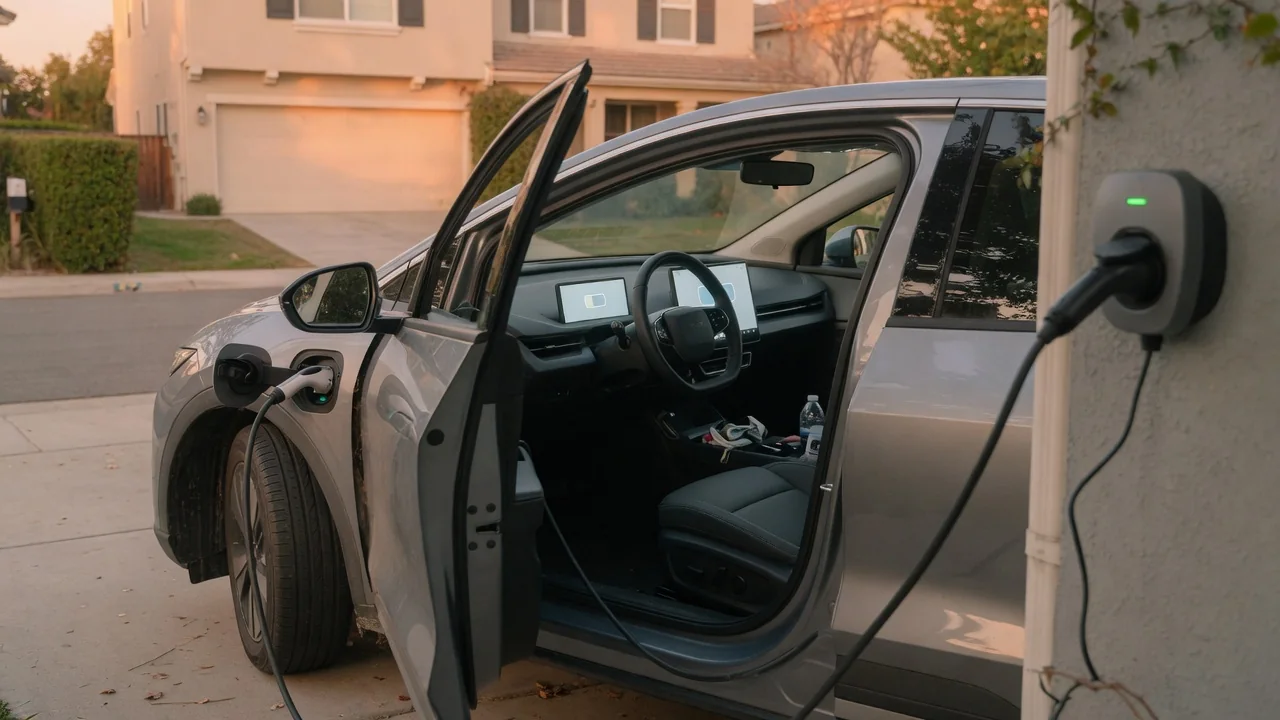
An EV's state of charge is the battery's remaining energy expressed as a percentage of its capacity, much like a fuel gauge for electricity. Asking what an EV's state of charge is really means asking how much driving the pack can still support. The number looks simple, but it is an estimate shaped by temperature, battery age, and how each manufacturer chooses to present it.
Percentage display
The percentage on the instrument cluster or center screen comes from the battery management system, which cannot measure stored energy directly. Instead it tracks current flowing in and out of the pack, watches cell voltages and temperatures, and calculates a best estimate. That is why the reading can occasionally shift by a point or two after the car sits overnight, especially when the weather changes. The system is simply recalibrating its estimate against a rested battery, not losing or gaining meaningful energy.
Most electric vehicles show the percentage alongside an estimated range figure, and some let the driver choose which one takes priority on the display. The percentage is generally the steadier of the two, because range depends on recent driving style, speed, and climate control use. Layouts differ between brands: some show a simple battery icon with a number, others add a bar graph or a projected arrival percentage in the navigation screen. The owner's manual explains exactly what each indicator represents for a given model.
Usable energy
The displayed percentage normally refers to usable energy rather than the pack's total capacity. Automakers commonly hold back a portion at the top and bottom as buffers, so a reading of 100 percent does not mean the cells are filled to their absolute chemical limit, and zero does not mean they are completely empty. These reserves protect the cells from the stress of extreme charge levels and help the pack age more gracefully. The size of the buffers is a manufacturer decision and varies by vehicle.
Usable energy also changes with conditions. A cold battery cannot deliver or accept energy as freely, so a winter morning may bring reduced range for the same percentage, limited regenerative braking, or a section of the gauge marked as temporarily unavailable on some models. As a pack ages, its capacity gradually declines, yet the display still reads 100 percent when full. The percentage therefore describes a share of whatever the battery can currently hold, not a fixed quantity of kilowatt-hours over the vehicle's life.
Planning stops
On a road trip, state of charge is the figure that decides when and where to plug in. Built-in route planners typically predict the percentage remaining at each charger and at the destination, adjusting as speed, elevation, wind, and temperature change consumption. Watching that arrival prediction is more useful than watching the range number alone, because it accounts for the road ahead. If the predicted figure keeps dropping, slowing down modestly or choosing a closer charging station restores the margin.
Charging speed depends heavily on state of charge. DC fast charging is usually quickest when the battery is low and tapers as the pack fills, so the last portion toward full can take a disproportionate amount of time. Many drivers find that arriving with a low but comfortable percentage and leaving once the rate slows noticeably keeps total travel time down. The exact charging curve differs from one vehicle to another, and battery preconditioning, where equipped, can influence how quickly a session begins.
Everyday Use and Observations
For daily driving, most owners rarely see either end of the gauge. Home charging lets the car start each morning at a chosen level, and many vehicles offer a charge limit setting in the menu or companion app. Manufacturers often suggest a daily limit below full for certain battery chemistries, while recommending regular full charges for others so the system can keep its estimate accurate. Because that guidance depends on the pack type, the recommendation for a specific vehicle is the one worth following.
A few patterns are easy to notice over a week of commuting. The percentage falls faster at highway speeds than in city traffic, where regenerative braking returns some energy. Heating the cabin on a cold day draws noticeably more than mild-weather driving, and short trips with a cold battery are less efficient than one longer drive. A parked car may also lose a small amount over several days as onboard systems stay awake, particularly if security monitoring or cabin protection features are active.
Limits and Next Steps
State of charge is an estimate, and it has blind spots. It says nothing about battery health on its own, and it can drift if a car spends months cycling within a narrow band without ever reaching a high or low point. Near the bottom of the gauge, power may be restricted and the remaining distance becomes harder to predict, so treating the last few percent as an emergency reserve rather than planned range is the prudent approach. Some vehicles hide a small margin below zero, but relying on it is risky.
When the reading behaves strangely, such as sudden drops of many points, a full charge that delivers far less range than it used to under similar conditions, or a battery warning message, the display alone cannot identify the cause. A warning light or stored fault code is evidence for a technician to interpret, not proof that the pack or any single component has failed. High-voltage systems are not suited to home diagnosis, so a dealer or qualified EV specialist should assess the vehicle using its specific service information.