What Is an EV's Maximum AC Charging Rate?
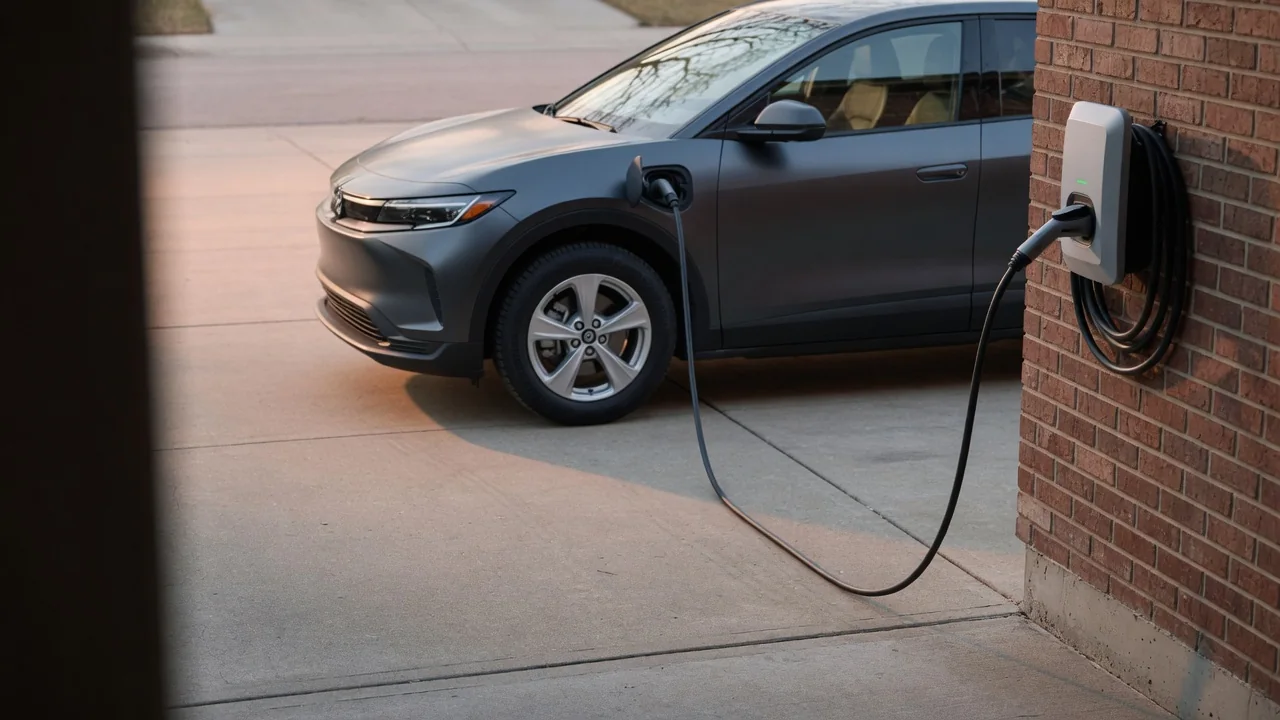
An EV's maximum AC charging rate is the highest power it can accept from an alternating-current source, such as a home wall unit or a public Level 2 station. The station alone does not set that number. It depends on the onboard charger built into the vehicle, the electrical supply feeding the equipment, and the conditions during the session itself. These three factors explain why the power on a charger display often differs from the figure on a spec sheet.
Onboard Charger: The Vehicle's Built-In Ceiling
A traction battery stores direct current, while homes and Level 2 stations deliver alternating current. When you plug into an AC source, the conversion happens inside the car, in a component usually called the onboard charger. It rectifies the incoming AC and regulates voltage and current to suit the battery. Its power rating, expressed in kilowatts, is the hard upper limit for AC charging. However capable the wall unit is, the car will not draw more than its onboard charger is designed to handle. In most cases, this rating is the most direct answer to what an EV's AC charging power limit is.
Onboard charger ratings vary between vehicles, and sometimes between versions of the same vehicle. Some manufacturers offer a higher-capacity unit as an option, and ratings can change across model years. Phase capability also matters. Where three-phase supply is common, an onboard charger built to use all three phases can draw considerably more power than a single-phase unit at the same current per phase. Most North American homes have single-phase 240-volt service, so three-phase capability is rarely relevant there. The reliable source for a specific car's rating is the owner's manual or the manufacturer's official specifications, not assumptions based on similar models.
Do not confuse the AC rating with the DC fast-charging rating. A DC fast charger performs the conversion inside the station and feeds direct current to the battery, bypassing the onboard charger. This is why DC charging rates can be much higher. The two figures are separate specifications. A high DC number says nothing about how quickly the same car charges from an AC wall unit.
Supply: What the Circuit and Equipment Can Deliver
Charging power is roughly voltage multiplied by current. The wall unit or station, formally called electric vehicle supply equipment (EVSE), is not the charger itself. It is a controlled supply point. It handles safety switching and tells the vehicle how much current is available. With the J1772 standard used for AC charging in North America, the EVSE advertises this through a pilot signal on the connector, and the vehicle limits its draw to the advertised value. The supply side therefore sets a second ceiling, independent of the onboard charger.
The arithmetic is simple. Level 1 charging from a standard 120-volt outlet usually runs at about 12 amps, which works out to roughly 1.4 kW. Level 2 charging at 240 volts and 32 amps delivers about 7.7 kW, and 48 amps delivers about 11.5 kW. US electrical practice treats EV charging as a continuous load. The charging current is generally limited to 80 percent of the circuit breaker rating, so a 40-amp circuit supports 32 amps of charging. Voltage matters too. Many commercial buildings provide 208 volts rather than 240, so the same current produces noticeably less power at those sites.
The effective maximum for any session is the lowest of three limits: the onboard charger rating, the current the EVSE advertises, and the capacity of the circuit behind it. A powerful station cannot push a car past its onboard charger. A large onboard charger cannot exceed what a modest circuit allows. Many wall units can also be configured to advertise less than their maximum to match the installed wiring. Many vehicles let the owner lower the charging current in their settings, which adds a further cap.
Real Session: Why Observed Power Differs
Even with every component well matched, the power delivered during a real session rarely equals the nominal figure. Conversion is not perfectly efficient. Some energy drawn from the wall is lost as heat in the onboard charger and related electronics, so less reaches the battery than leaves the outlet. While the car is awake to charge, other systems may also draw power: battery thermal management, cabin preconditioning, and the low-voltage electrical system. This reduces the share going into the pack. Displays differ as well. Some report power at the plug, others estimate power entering the battery, and the two numbers can differ.
Battery and grid conditions add variation. AC charging is slow compared with what most packs can accept, so the slowdown as the battery fills is usually less pronounced than during DC fast charging. A vehicle may still reduce power near full charge, at very low or high battery temperatures, or while balancing cells. Grid voltage fluctuates during the day, so power at a fixed current moves up and down slightly. At public sites, stations may share capacity among several ports and lower the advertised current when more cars connect. Scheduled charging or utility load-management programs can also change the rate during a session.
Practical Implications and Limits
For planning, estimate charging time by dividing the energy you need by the power the battery actually receives, not by the headline rating of the station or the car. The bottleneck principle also guides equipment choices. Installing a wall unit rated well above the vehicle's onboard charger adds no charging speed for that car, though it may suit a future vehicle. A car with a high-capacity onboard charger may never reach its rating on a 208-volt or shared public station. Sizing a home installation to the onboard charger, within what the electrical panel can support, avoids paying for capacity the car cannot use. A qualified electrician can perform the load calculation for the panel and circuit.
General principles only go so far. Several behaviors vary from car to car: whether a car uses three-phase supply, how it limits power in cold weather, which current settings it offers, and how it reports charging power. These are documented by each manufacturer and can change with software updates. Connector adapters do not raise the rate beyond the weakest component in the chain, including the adapter's own rating. For owners who charge overnight, the car is often parked long enough that a moderate AC rate is sufficient. Higher AC capacity tends to matter more when the car is parked only briefly, such as at a workplace or a destination stop.