What Is an EV Onboard Charger? AC Conversion, Power Limits and Heat
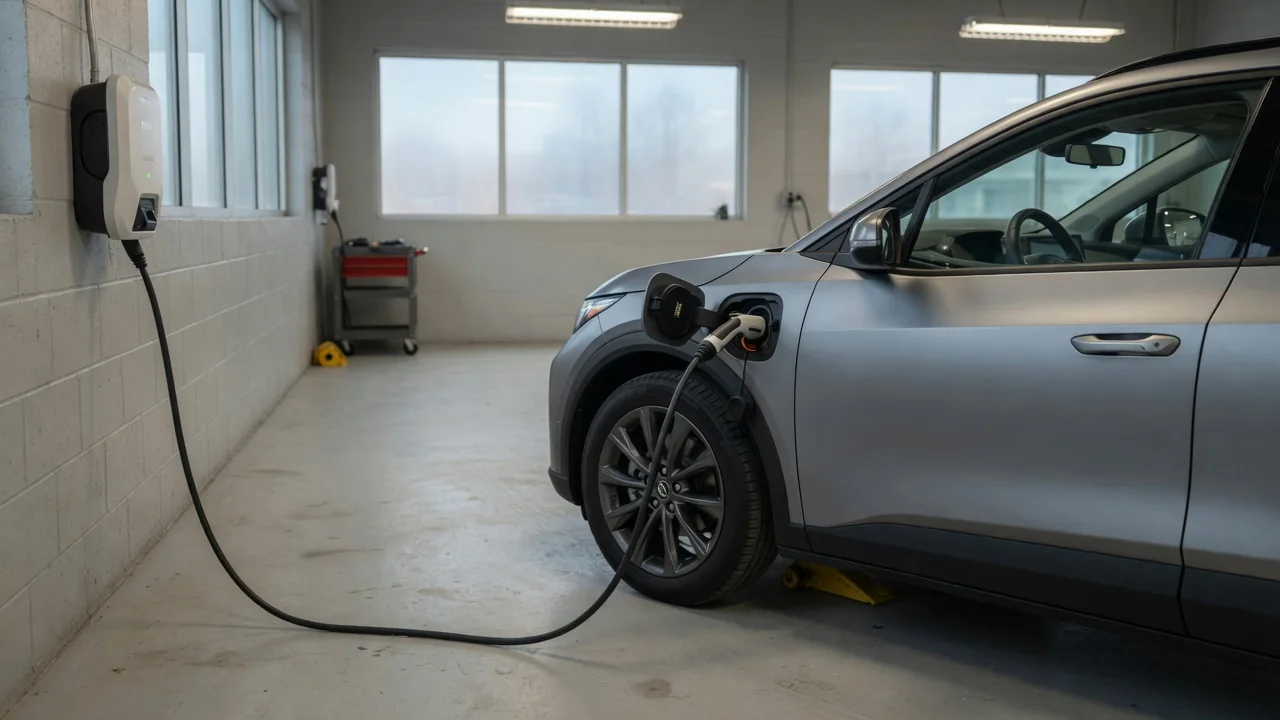
An EV onboard charger is the power-conversion module built into an electric car. It turns alternating current from a household outlet or a Level 2 charging station into the direct current the traction battery can store. It is the reason the car can charge from ordinary AC wiring at all, and it largely sets how fast that charging can go. Its role in AC conversion, its power limit, and the heat it produces explain many everyday charging behaviors.
AC conversion: turning grid power into battery power
The electrical grid supplies alternating current, which reverses direction many times per second. A lithium-ion traction battery stores and delivers direct current. The wall box or portable charging cord that owners often call a charger does not perform this conversion. Technically it is electric vehicle supply equipment, or EVSE: a supervised switch and safety device that tells the car how much current is available and connects power only when the vehicle signals it is ready. The actual conversion happens inside the vehicle, in the onboard charger. That is why the onboard charger is central to home and workplace charging.
Inside the onboard charger, conversion typically happens in stages. A rectifier stage changes incoming AC into DC. A power factor correction stage shapes the current drawn from the grid so it follows the voltage waveform, which reduces wasted current and electrical noise on the supply. A DC-DC converter then adjusts the output voltage to match the battery's present voltage. In many designs this stage passes energy through a high-frequency transformer, which electrically isolates the grid side from the high-voltage battery. The exact circuit topology, component choices, and packaging vary between manufacturers and designs.
The onboard charger does not decide the charging profile on its own. The battery management system monitors cell voltages, temperatures, and state of charge, and requests a suitable current and voltage. The charger delivers that request within its own capability. DC fast charging works differently: the external station performs the conversion, and DC power reaches the battery through a separate path that bypasses the onboard charger. The onboard charger therefore matters for AC charging sessions, not for DC fast charging.
Power limit: what sets AC charging speed
Every onboard charger has a maximum continuous power rating, set by its components and its ability to shed heat. AC charging speed is governed by the lowest of several limits. These include the current the EVSE advertises through its control pilot signal, the capacity of the circuit and electrical supply, the onboard charger's own rating, and how much power the battery will accept at that moment. Whichever limit is smallest sets the pace, and raising any of the others has no effect on charging speed.
Electrical power is roughly voltage multiplied by current, so the type of supply matters. On a single-phase connection, the charger can draw only what that phase and circuit allow. Some onboard chargers are designed to use three-phase supply, which is common in some regions and can deliver considerably more AC power. Others are single-phase only and draw from just one phase even when plugged into a three-phase connection. Whether a particular vehicle supports three-phase charging, and at what current, is vehicle-specific. That information belongs in the owner's manual or official specifications.
Even when the supply and charger allow full power, the battery can impose a lower limit. As the battery approaches full charge, the battery management system tapers the current, so charging power falls below the charger's rating near the end of a session. A cold battery may also be restricted until it warms. In addition, the vehicle may power its own systems during charging, such as battery thermal management. As a result, the power reaching the battery can be lower than the power drawn from the outlet.
Heat: losses, cooling and derating
No power conversion is perfectly efficient. Some energy is lost in the switching transistors, diodes, magnetic components, capacitors, and internal wiring, and that lost energy appears as heat. Even a small percentage of loss produces meaningful heat when the charger handles kilowatts of power continuously over a session lasting several hours. That heat has to be removed steadily, or component temperatures will keep rising. Overall wall-to-battery efficiency also includes losses in the cabling, the battery itself, and any cooling or heating the vehicle runs while charging.
Onboard chargers are cooled either by air or by a liquid coolant loop, which may be shared with other power electronics in the vehicle. This is why pumps, fans, or a radiator fan may run during AC charging even while the car is parked and switched off. The charger's location in the vehicle and its cooling method differ between designs, so the sounds and behavior an owner notices during charging are not the same from one vehicle to another.
The charger monitors its internal temperatures and reduces its output if components approach their limits, a process known as derating. Common triggers include hot ambient conditions, restricted airflow, or a fault in the cooling system. Derating protects the semiconductors and capacitors, whose service life is shortened by sustained high temperatures. Usually the only sign is slower charging than expected rather than a warning message. Persistent overheating, however, can cause the charger to log a fault and stop the session.
Practical implications and limits
For owners, the most useful step is to find the onboard charger's maximum AC power for their specific vehicle, usually listed in the owner's manual or specification sheet, and match the home charging equipment to it. A wall unit that can supply more current than the charger accepts will not make charging faster. Equipment or a circuit that supplies less leaves charger capacity unused. Any new or upgraded circuit should be sized and installed by a qualified electrician according to local code. That decision depends on the building's wiring, not on the onboard charger itself.
Charge times on the same equipment can vary from one session to the next. Battery temperature, starting state of charge, summer heat, and normal fluctuations in supply voltage all play a part, and the variation is not necessarily a fault. At public AC stations, a common source of confusion is a station advertising more power than the car accepts. In that case the vehicle's onboard charger, not the station, is often the limiting factor, and moving to a higher-rated AC station will not change the result.
If AC charging fails while DC fast charging still works, the onboard charger or its supporting parts are possible suspects. These include the charging inlet, wiring, cooling, and control signaling. A symptom alone is not a diagnosis, however, and the EVSE or the electrical supply may be the actual cause. The onboard charger operates at high voltage and contains capacitors that can store energy, so inspection and repair belong with trained technicians following the manufacturer's procedures. Some vehicles also use onboard charger hardware for bidirectional functions, such as powering external devices. Whether a given vehicle offers this is a model-specific feature to confirm in its documentation.