What Is an EV Motor Controller? Torque, Sensors and Protection Explained
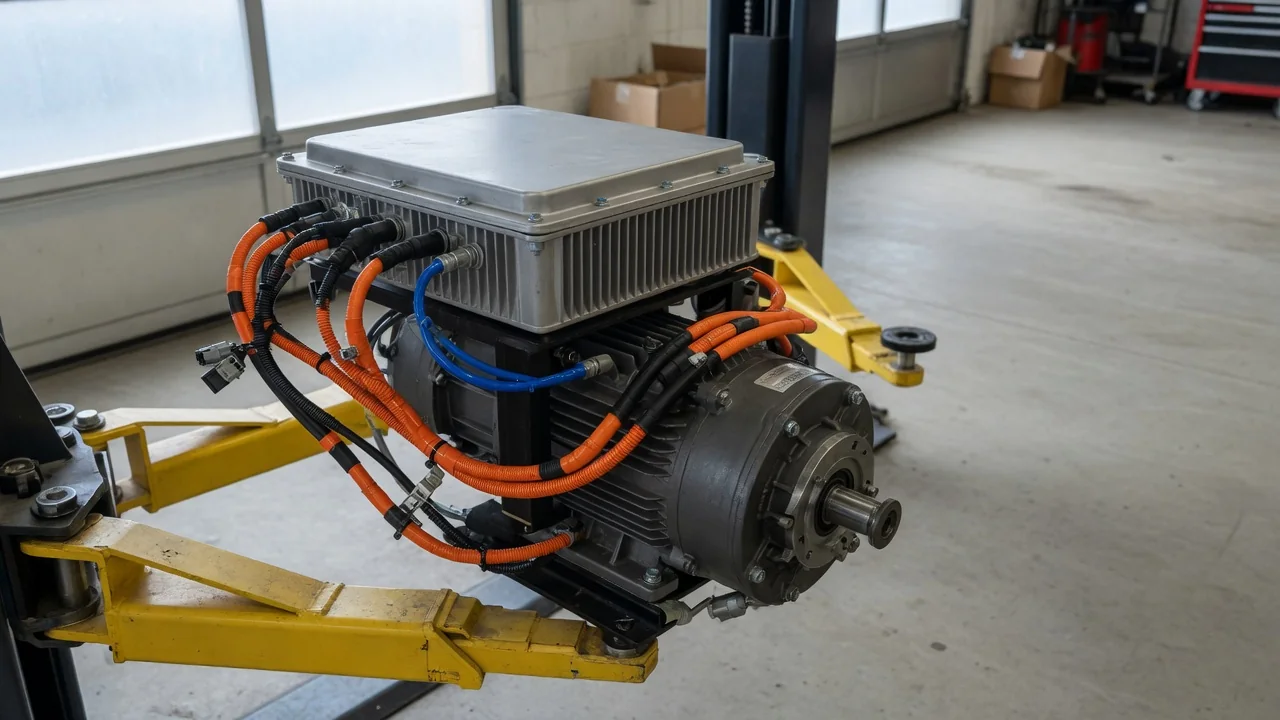
An EV motor controller is the electronic system that decides how much current flows into an electric vehicle's traction motor, and when. It sits between the high-voltage battery and the motor and is usually combined with the inverter that converts the battery's direct current into the alternating current the motor needs. In short, it turns a driver's request into precisely managed motor torque while watching its sensors and protecting the hardware.
Torque request: how driver input becomes motor output
Electric motor control in a car starts with the driver, but the accelerator pedal does not connect directly to the motor. Pedal position sensors report how far the pedal is pressed, and a vehicle control unit interprets that signal as a torque demand. That demand is then adjusted for conditions such as available battery power, the selected drive mode, traction or stability control intervention, and limits imposed by temperature or state of charge. The result is the torque request the motor controller receives. Depending on the vehicle's architecture, the vehicle control unit and the motor controller may be separate modules that communicate over a vehicle network, or some of their functions may be combined in one unit.
The controller's job is to deliver the requested torque as accurately and smoothly as possible. In a typical AC traction motor, torque depends on the size and timing of the current in the stator windings relative to the rotor's magnetic field. The controller calculates the current required and commands the inverter's power transistors to switch on and off thousands of times per second, a technique called pulse-width modulation. By varying the width and pattern of those pulses, it shapes three-phase currents of the right amplitude and frequency. A widely used method, field-oriented control, treats the current as two components: one that produces torque and one that affects the magnetic field. Managing them separately allows fine control across a wide speed range.
The same process works in reverse during regenerative braking. When the torque request is negative, such as when the driver lifts off the accelerator or applies the brakes, the controller times its switching so the motor acts as a generator. Kinetic energy is converted into electrical energy and returned to the battery, within whatever limits the battery can accept at that moment.
Sensor feedback: how the controller knows what the motor is doing
Precise torque control depends on constant measurement. The controller runs feedback loops that compare what it commanded with what is actually happening, then corrects the difference many times per second. The most important inputs are rotor position and speed, the current in each motor phase, and the DC voltage supplied by the battery. Without accurate rotor position, the controller cannot align the current with the motor's magnetic field, and torque production becomes inefficient or uneven.
Rotor position is commonly measured with a resolver, a rugged rotary transformer that tolerates heat and vibration well, although encoders and other sensor types are also used. Some designs supplement or replace the position sensor with sensorless estimation at certain speeds, calculating rotor position from electrical signals. Current sensors on the motor leads measure phase currents, and voltage sensing tracks the battery supply so the controller can adjust its switching as battery voltage changes with load and charge level.
Temperature sensing completes the picture. Sensors typically monitor the power semiconductors, the motor windings and the coolant circuit. Temperature data does not shape each individual switching cycle, but it determines how much current the controller is willing to allow and can help it account for motor characteristics that change as components heat up.
Protection: guarding the motor, inverter and battery
Because the controller handles high voltage and large currents, protection is a core function rather than an add-on. Many protective actions happen in hardware within microseconds, faster than software could respond. Overcurrent detection can shut off the power transistors if a short circuit or fault drives current beyond safe levels. Gate driver circuits commonly include desaturation detection, which recognizes when a transistor is not switching properly and turns it off before it is damaged. Overvoltage and undervoltage monitoring guards against supply conditions that could harm components or cause unstable operation.
Software handles slower but equally important risks. As temperatures rise, the controller usually derates, gradually reducing available torque or power instead of stopping abruptly. It can also restrict regenerative braking when the battery is nearly full or cold, because forcing charge current into a battery that cannot accept it may cause damage. Plausibility checks compare sensor readings with each other and with expected behavior, which helps identify a failed position or current sensor.
When a fault is serious, the controller can put the inverter into a safe state. Depending on the design and the situation, that may mean switching all transistors off so no current flows, or deliberately shorting the motor phases to control the voltage a spinning permanent magnet motor can generate. The controller typically stores diagnostic trouble codes and reports the fault to other modules, which may turn on a warning light or place the vehicle in a reduced-power mode.
Practical implications and limits
For drivers, the motor controller explains much of how an electric car feels. Smooth launches, consistent response and the strength of one-pedal driving all reflect how the controller is calibrated, and similar hardware can behave quite differently depending on the manufacturer's software choices. Reduced power after repeated hard acceleration, in high heat, or with a very low or very cold battery is usually intended behavior rather than a defect. Weak regeneration right after a full charge or on a cold morning is often a deliberate limit as well.
There are also limits to what an owner can diagnose or change. Motor controllers are generally sealed high-voltage assemblies, and symptoms that seem to come from the motor can originate in sensors, wiring, coolant flow or the controller itself. Finding the cause usually requires a scan tool that can read the relevant modules and, for any work inside the high-voltage system, trained technicians following proper safety procedures. Exact behavior, warnings and service steps vary between vehicles, so the owner's manual and the manufacturer's service information remain the authoritative guide for a specific car. Knowing the general mechanism helps you describe symptoms clearly and recognize when a limit is normal and when a warning deserves prompt attention.