What Is an EV Drive Unit? Motor, Inverter and Reduction Gear Explained
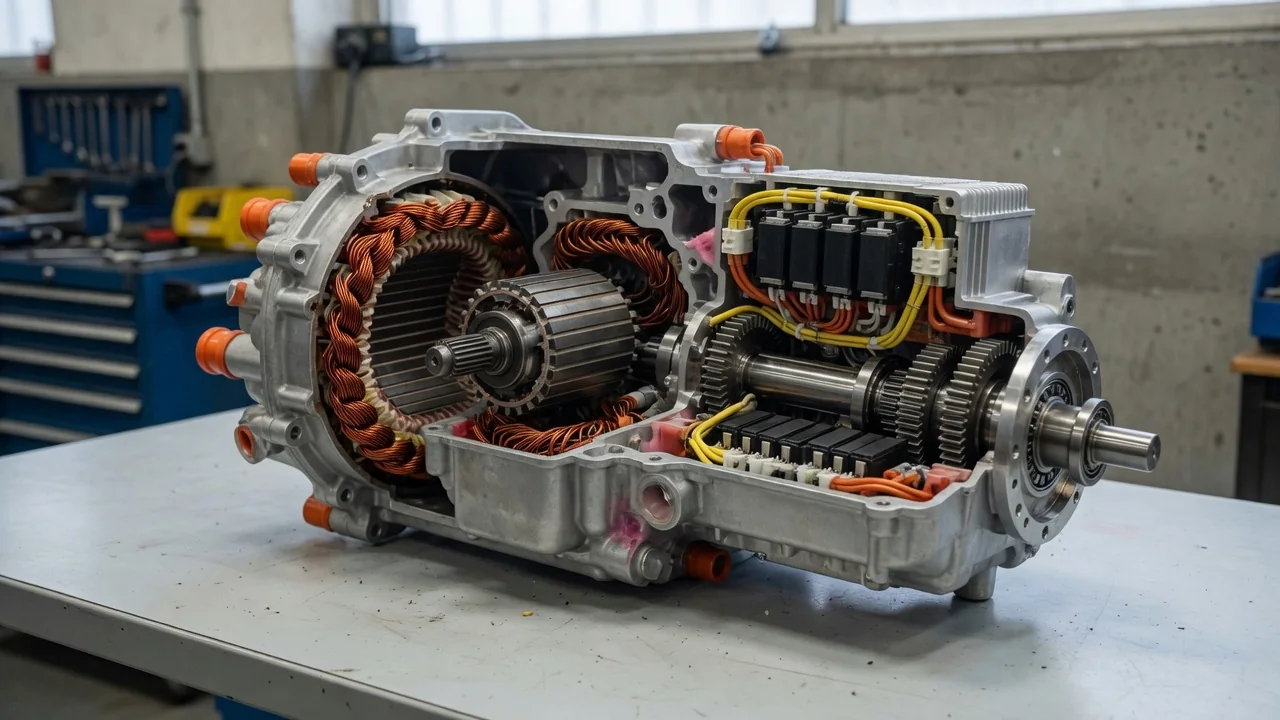
An EV drive unit is the assembly that turns energy stored in the battery into motion at the wheels. In most electric cars it combines three core parts: an electric motor, an inverter that controls the motor, and a reduction gear with a differential that sends torque to the axle. Some manufacturers package all three in one housing, while others mount them separately. Knowing what each part does makes service documents, warning messages and repair conversations much easier to follow.
Motor: Where Electricity Becomes Torque
The motor is the part of the drive unit that actually produces rotation. It has two main sections: a stator, which is fixed to the housing and carries copper windings, and a rotor, which spins inside it on bearings. When alternating current flows through the stator windings in a controlled sequence, it creates a rotating magnetic field that pulls the rotor around. Because this happens electrically, the motor can deliver strong torque from a standstill. It needs no idle speed, no clutch and no starter, which is why electric cars move off smoothly and quietly.
Several motor types are used in electric cars. Permanent magnet synchronous motors have magnets built into the rotor and are valued for compact size and high efficiency. Induction motors create the rotor's magnetic field by inducing current in it, so they do not need permanent magnets. Wound-rotor or externally excited synchronous motors use an electrically powered rotor winding instead of magnets. Which type a given vehicle uses is a manufacturer design choice, and some vehicles with more than one motor combine different types. The owner's manual or official technical documentation is the reliable place to confirm what a specific car has.
The same motor also works in reverse as a generator. When the driver lifts off the accelerator or brakes lightly, the wheels turn the rotor, and the motor converts that motion back into electrical energy. This is the basis of regenerative braking. Motors also generate heat under load, so drive units typically include a cooling system, often liquid coolant passages or oil circulated around the windings, along with a position sensor that reports exactly where the rotor is at any moment.
Inverter: The Motor's Power Controller
The battery stores direct current, but most traction motors need three-phase alternating current whose frequency and strength change constantly. The inverter performs that conversion. Inside it, power semiconductors, commonly IGBTs or silicon carbide transistors, switch on and off at very high speed. By varying how long each switch stays on, a technique called pulse-width modulation, the inverter builds smooth AC waveforms out of DC. The frequency of those waveforms sets motor speed, and the current level sets how much torque the motor produces.
The inverter is not just a converter; it is also the motor's control brain. Its control board receives a torque request from the vehicle's main controller, which interprets accelerator pedal position, traction control and other inputs. Using signals from the rotor position sensor and current sensors, it calculates precisely how to energize each motor phase. During regenerative braking the process runs in the other direction: the inverter turns the motor's AC output back into DC that can recharge the battery. A large capacitor on the DC side helps keep voltage stable during this rapid switching.
Switching high currents produces heat, so inverters are usually connected to a coolant loop. They also constantly monitor their own temperature, voltage and current. If a reading moves outside safe limits, the inverter can reduce available power or shut down to protect itself and the motor, and the vehicle typically records a fault. In some designs the inverter housing also contains other power electronics, such as a DC-DC converter for the 12-volt system, but that arrangement varies by manufacturer.
Reduction Gear: Matching Motor Speed to Wheel Speed
An electric motor runs efficiently at rotational speeds far higher than the wheels ever turn. The reduction gear bridges that gap by lowering speed and multiplying torque before it reaches the axle. Most electric cars use a single fixed ratio rather than a multi-speed transmission, because the motor's wide usable speed range can cover everything from pulling away to highway cruising. A small number of designs use a two-speed gearbox to balance acceleration and high-speed efficiency, but a single-speed reduction gear is the common approach.
Inside the housing, the reduction is usually achieved with one or two stages of helical gears, followed by a differential. The differential allows the left and right wheels to turn at different speeds in corners, and it delivers torque to the half-shafts. Reverse is generally produced by running the motor backward rather than by a separate reverse gear. Many drive units also include a parking lock mechanism in this section, which holds the vehicle when it is placed in Park.
The gears run in lubricating oil, and in some designs that oil also helps cool the motor. Maintenance requirements for this fluid differ between manufacturers: some schedules describe it as long-life, while others specify inspection or replacement intervals. Because there is no engine noise to mask it, a faint gear whine can be more noticeable in an electric car than in a conventional one, which is normal within limits described by the manufacturer.
Practical Implications and Limits
For owners, the main benefit of an integrated drive unit is a shorter list of routine maintenance items. There are no engine oil changes, spark plugs, timing belts or clutches. That does not make the system maintenance-free. Coolant condition, gear oil, seals, mounts and drive shafts may all appear in the service schedule, and the intervals depend on the specific vehicle. Following the owner's manual matters more than general rules of thumb, because designs and fluids vary widely between electric car drive unit parts from different manufacturers.
Diagnosis and repair are a different matter from conventional drivetrains. The drive unit operates at high voltage, marked by orange cabling, and working on it requires training, protective equipment and the manufacturer's isolation procedure. Owners should not open inverter or motor housings. Symptoms worth reporting include warning lights, a reduced-power mode, new clunking or rising whine, and coolant or oil leaks. Reading the relevant fault codes usually needs a scan tool that supports the manufacturer's systems. Whether a fault is fixed by replacing an individual component or the entire assembly depends on the manufacturer's repair policy and parts availability.
Finally, published power and torque figures describe what the drive unit can deliver under favorable conditions. Real output also depends on battery temperature, state of charge and how long the system has been working hard. Very cold weather, sustained towing or repeated full-power acceleration can lower the power available at a given moment, and this is often a limit set by the battery as much as by the drive unit. For figures that apply to a particular car, rely on the manufacturer's own documentation.